
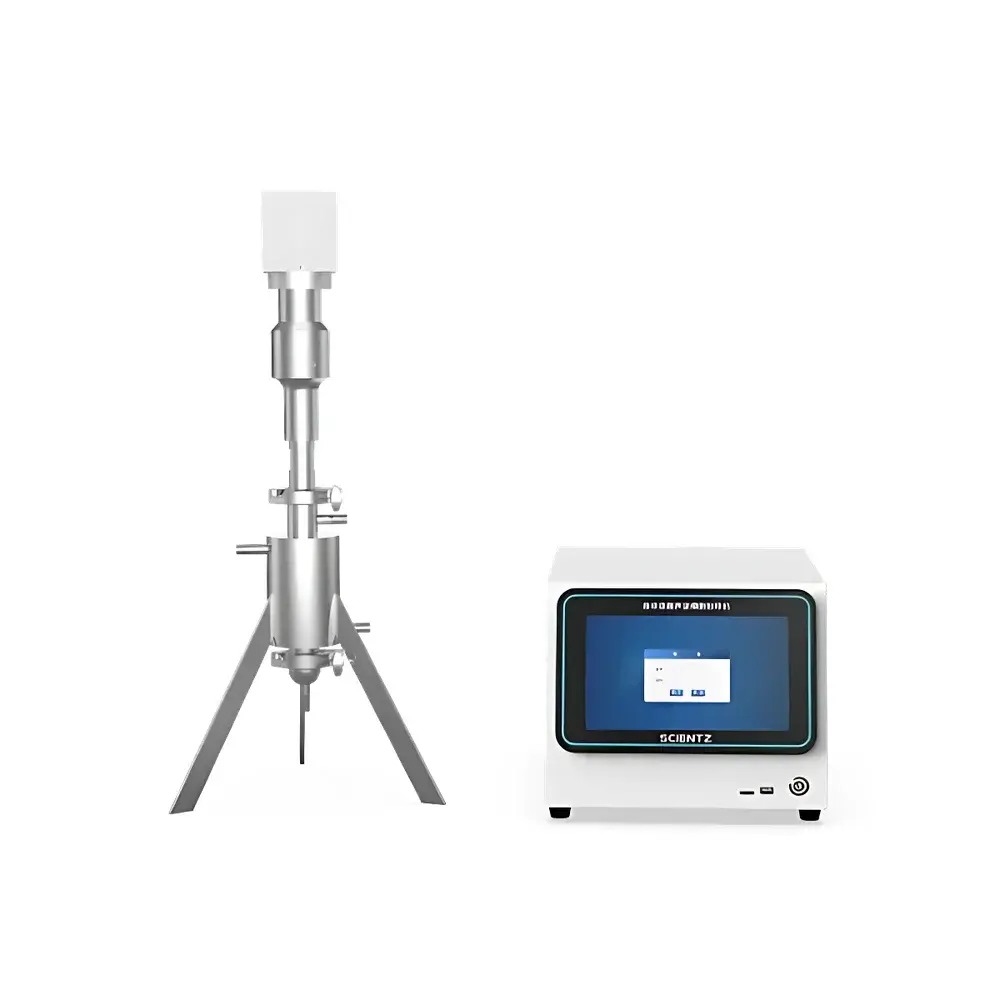
Scientz CFU-750W-M2 Continuous-Flow Ultrasonic Cell Disruptor
| Brand | Scientz |
|---|---|
| Origin | Zhejiang, China |
| Manufacturer Type | Direct Manufacturer |
| Product Category | Domestic (China-made) |
| Model | CFU-750W-M2 |
| Instrument Type | Ultrasonic Cell Disruptor |
| Operating Frequency | 20 kHz ± 1 kHz |
| Ultrasonic Power Output | 750 W |
| Sample Throughput | 5–50 L/h |
Overview
The Scientz CFU-750W-M2 is a purpose-engineered continuous-flow ultrasonic cell disruptor designed for scalable, reproducible, and temperature-controlled processing of biological and chemical suspensions in GMP-aligned biomanufacturing and R&D environments. It operates on the principle of acoustic cavitation—where high-intensity ultrasonic waves (20 kHz ± 1 kHz) generate transient microbubbles in liquid media that collapse violently, producing localized shear forces, microstreaming, and transient hotspots (~5,000 K, ~1,000 atm). This physical mechanism enables efficient disruption of microbial, mammalian, or plant cells; uniform dispersion of nanoparticles; stabilization of oil-in-water or water-in-oil emulsions; and enhancement of mass transfer in heterogeneous reactions—without introducing chemical additives or thermal degradation when properly cooled. Unlike batch-mode sonicators, the CFU-750W-M2 integrates a recirculating flow path through a jacketed reaction chamber, enabling consistent energy delivery across large-volume streams (5–50 L/h), minimizing thermal runaway and ensuring process repeatability across scales from lab development to pilot production.
Key Features
- Continuous-flow architecture with integrated peristaltic or diaphragm circulation pump (user-selectable interface), supporting uninterrupted operation over extended durations.
- High-power 750 W piezoelectric transducer stack fabricated from medical-grade titanium alloy (Grade 5 Ti-6Al-4V), offering exceptional corrosion resistance, mechanical durability, and stable acoustic coupling under prolonged duty cycles.
- Dual-wall thermostatically controlled reactor vessel with independent coolant inlet/outlet ports; compatible with external chillers (e.g., −10 °C to +25 °C range) to maintain sample temperature within ±2 °C during sustained operation.
- ARM-based embedded control system with 7-inch capacitive touchscreen HMI, supporting intuitive parameter setting (amplitude, cycle time, total processing volume), real-time power monitoring, and fault diagnostics.
- Comprehensive data integrity framework: automatic timestamped logging of all operational parameters (power, frequency, flow rate, temperature, runtime), exportable via USB or Ethernet as CSV/Excel files; compliant with ALCOA+ principles for traceability.
- Modbus-TCP communication protocol support for seamless integration into supervisory control and data acquisition (SCADA) systems and MES platforms—enabling centralized monitoring and automated batch record generation.
Sample Compatibility & Compliance
The CFU-750W-M2 accommodates aqueous, organic, and viscous suspensions—including bacterial cultures (E. coli, P. pastoris), CHO or HEK293 lysates, metal oxide nanoparticle dispersions (e.g., TiO₂, Fe₃O₄), vaccine antigen-adjuvant mixtures (e.g., alum, saponin-based ISCOMs), and food-grade emulsions. Its wetted-path components meet USP Class VI and ISO 10993-5 biocompatibility requirements. The reactor chamber features seamless, electropolished interior surfaces (Ra ≤ 0.4 µm) with zero dead-leg geometry, validated for clean-in-place (CIP) and steam-in-place (SIP) protocols per ASME BPE-2023 standards. Sterilization validation includes F₀ ≥ 15 at 121 °C for 30 min using saturated steam. The system supports full 21 CFR Part 11 compliance when deployed with validated electronic signatures and audit-trail-enforced user authentication.
Software & Data Management
The onboard firmware implements role-based access control (RBAC) with three hierarchical permission levels: Operator (run-only), Supervisor (parameter adjustment + log review), and Administrator (system configuration, user management, audit trail purge). All user actions—including login/logout events, parameter changes, and emergency stops—are immutably recorded with digital signatures and hardware timestamps. Data logs include checksum verification and are stored redundantly in internal flash memory and removable SD card. Optional Scientz ProcessLink™ software (Windows-based) provides remote monitoring, trend analysis, PDF report generation with electronic signature fields, and direct export to LIMS or ELN systems via ODBC or REST API.
Applications
- Vaccine Manufacturing: Homogenization of recombinant subunit antigens with adjuvants (e.g., MF59-like squalene emulsions), improving colloidal stability and dose consistency across fill-finish batches.
- Nanomaterial Synthesis: Deagglomeration and surface functionalization of transition metal oxides for catalytic slurries, battery electrode inks, and antimicrobial coatings—achieving D₉₀ < 150 nm in single-pass mode.
- Bioprocess Intensification: In-line lysis of high-density microbial fermentations prior to chromatographic purification; reduces downstream clogging and increases soluble protein recovery by >22% vs. high-pressure homogenization (per internal benchmark studies).
- Pharmaceutical Formulation: Preparation of nanoemulsions for oral or topical delivery of poorly water-soluble APIs (BCS Class II/IV), meeting ICH Q5A and Q5C stability criteria over 24-month accelerated testing.
- Food & Beverage R&D: Cold emulsification of dairy-free alternatives (e.g., oat milk–coconut oil blends) without thermal denaturation, preserving native enzyme activity and sensory profile.
FAQ
What is the maximum allowable viscosity for continuous processing?
Viscosity up to 500 mPa·s (measured at 20 °C, 10 s⁻¹) is supported with optional high-torque pump configuration; above this, pre-dilution or staged processing is recommended.
Can the system be validated for GMP manufacturing?
Yes—DQ/IQ/OQ/PQ documentation packages are available upon request, aligned with ASTM E2500, ISO 13485, and EU Annex 15 guidelines.
Is the ultrasonic horn replaceable without recalibration?
Yes—the titanium alloy probe and booster assembly are field-replaceable as calibrated subassemblies; factory calibration certificates include traceability to NIST standards.
Does the system support PAT integration?
Yes—real-time analog outputs (4–20 mA) for temperature, power, and flow rate are provided; digital signals via Modbus-TCP enable closed-loop feedback control with third-party analyzers (e.g., inline UV-Vis, particle sizers).
What maintenance intervals are recommended?
Transducer performance verification every 500 operating hours; coolant filter replacement every 3 months; full system leak and pressure decay testing annually per preventive maintenance SOP.





