
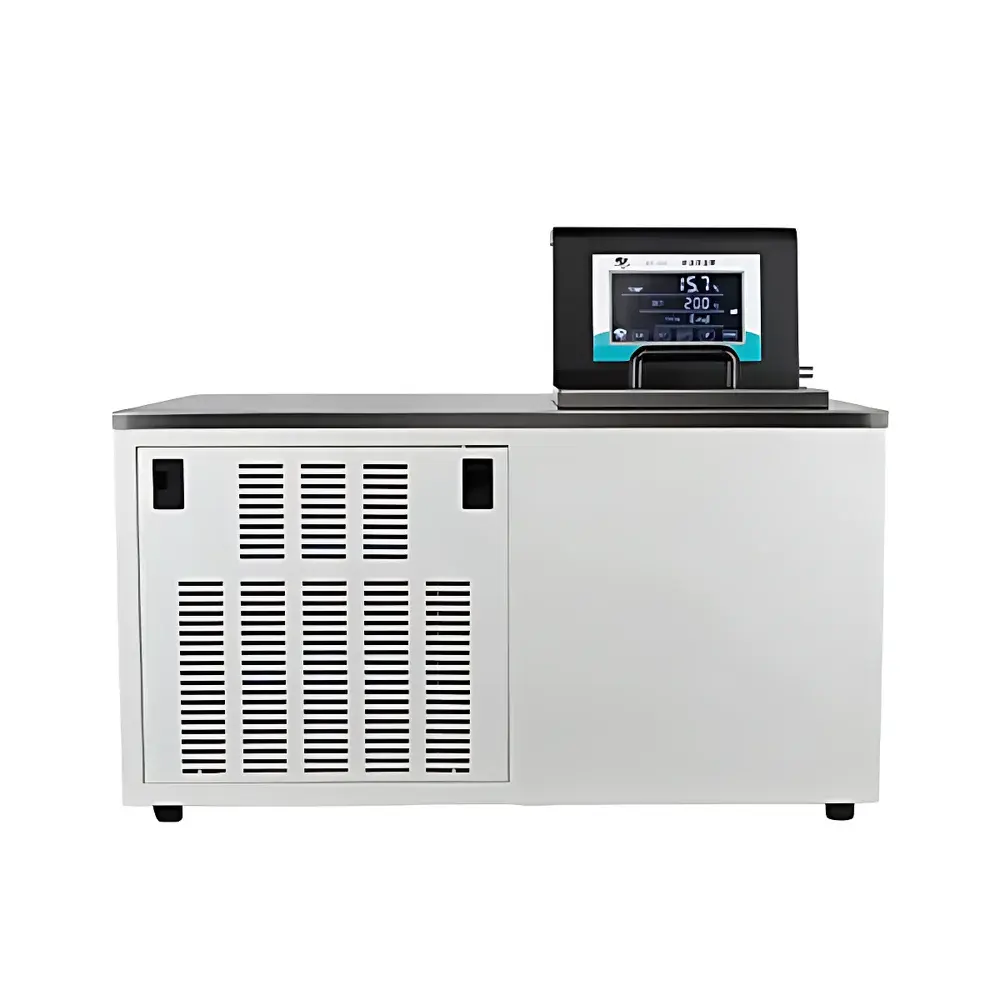
Ningbo Scientz DCW-3510 Low-Temperature Circulating Chiller/Heater
| Brand | Ningbo Scientz |
|---|---|
| Origin | Zhejiang, China |
| Manufacturer Type | Direct Manufacturer |
| Product Category | Domestic |
| Model | DCW-3510 |
| Instrument Type | Constant-Temperature Bath Circulator |
| Circulation Mode | Internal & External |
| Temperature Control | Dual-mode (Heating & Refrigeration) |
| Bath Chamber Dimensions | 250 × 200 × 200 mm (L × W × H) |
| Temperature Range | −35 °C to +100 °C |
| Temperature Stability | ±0.1 °C |
Overview
The Ningbo Scientz DCW-3510 Low-Temperature Circulating Chiller/Heater is a precision-engineered thermal management system designed for laboratory environments requiring stable, programmable temperature control across a broad operational range. Utilizing a closed-loop circulation architecture based on the principles of forced convection heat transfer, the unit delivers highly uniform thermal conditions within its stainless-steel bath chamber and supports external temperature regulation via integrated dual-mode (heating and refrigeration) capability. Its core thermodynamic performance relies on a high-efficiency, hermetically sealed Danfoss (Secop) compressor paired with an environmentally compliant R-134a refrigerant—ensuring low global warming potential (GWP) and compliance with EU F-Gas Regulation (EU No. 517/2014) and related international environmental directives. The system operates under microprocessor-based PID feedback control, enabling dynamic compensation for thermal load variations and maintaining setpoint stability within ±0.1 °C under steady-state conditions—a specification validated per ISO 17025-accredited calibration protocols.
Key Features
- Integrated dual-function thermal control: simultaneous heating (up to +100 °C) and refrigeration (down to −35 °C) in a single compact chassis
- 7-inch angled capacitive touchscreen interface with intuitive HMI navigation, real-time parameter display (setpoint, actual bath temperature, elapsed time, pump status), and multi-language support
- Programmable timer function: automatic shutdown upon completion of user-defined duration; configurable auto-restart or standby mode following power interruption
- Adjustable circulation pump (0–20 L/min flow rate) supporting both internal bath homogenization and external load conditioning via dual-port fluid coupling
- Comprehensive safety architecture: compressor overheat and overload protection, dry-run detection, high/low temperature alarms, and bath-level monitoring with audible and visual alerts
- Low-noise operation (<58 dB(A) at 1 m distance) achieved through vibration-dampened mounting, acoustic insulation, and optimized refrigerant flow dynamics
Sample Compatibility & Compliance
The DCW-3510 accommodates aqueous, ethylene glycol–water mixtures, silicone oils, and other non-corrosive heat-transfer fluids compatible with 316 stainless steel and fluoropolymer wetted components. Its design conforms to IEC 61010-1:2010 (Safety Requirements for Electrical Equipment for Measurement, Control, and Laboratory Use) and meets CE marking requirements for electromagnetic compatibility (EN 61326-1) and low-voltage directive (2014/35/EU). For regulated laboratories, the instrument supports GLP-compliant workflows through traceable temperature logging (via optional RS485/Modbus RTU or USB data export) and enables audit-ready documentation when integrated into validated systems adhering to FDA 21 CFR Part 11 (electronic records/signatures) and ISO/IEC 17025 quality management frameworks.
Software & Data Management
While the DCW-3510 operates autonomously via its embedded controller, it provides standardized communication interfaces—including RS485 (Modbus RTU protocol) and USB virtual COM port—for integration with third-party laboratory information management systems (LIMS), SCADA platforms, or custom Python/Matlab-based automation scripts. Temperature profiles, runtime logs, alarm events, and pump status are timestamped and exportable in CSV format. Optional Scientz LabControl software (Windows-compatible) enables remote parameter setting, real-time graphing of temperature vs. time, and scheduled ramp-soak-hold sequences—supporting reproducible thermal protocols required in ASTM E2251 (Standard Practice for Calibration of Thermometers) and USP (Thermal Analysis).
Applications
- Condenser cooling for rotary evaporators (e.g., maintaining 0–5 °C coolant supply during solvent recovery)
- Temperature stabilization of non-contact ultrasonic disruptors and probe sonicators during cell lysis or nanoparticle dispersion
- Exothermic/endothermic reaction control in jacketed glass reactors and calorimetric setups
- Cryopreservation sample equilibration, enzyme kinetics assays, and thermal denaturation studies in molecular biology
- Thermal testing of semiconductor devices, PCB assemblies, and optoelectronic components under controlled ambient stress
- Calibration of platinum resistance thermometers (PRTs), thermocouples, and infrared sensors across extended temperature spans
FAQ
What is the maximum external load capacity supported by the DCW-3510’s circulation system?
The unit maintains ±0.1 °C stability with external heat exchangers up to 5 kW thermal load when using recommended glycol-water mixtures (30% v/v) and optimal tubing diameter (≥10 mm ID).
Can the DCW-3510 be used with silicone oil as a bath medium?
Yes—provided viscosity remains below 100 cSt at operating temperature and fluid level is maintained above minimum mark; note that maximum temperature must not exceed oil manufacturer’s flash point rating.
Is firmware update capability available?
Firmware updates are performed via USB drive using Scientz-provided binaries; version history and release notes are documented in the technical manual and accessible through authorized service channels.
Does the device meet requirements for GMP-compliant environments?
When deployed with calibrated NIST-traceable reference thermometers and configured with electronic audit trail enabled (via optional software), the DCW-3510 supports key elements of GMP Annex 15 (Qualification and Validation) and EU GMP Chapter 3 (Premises and Equipment).



