
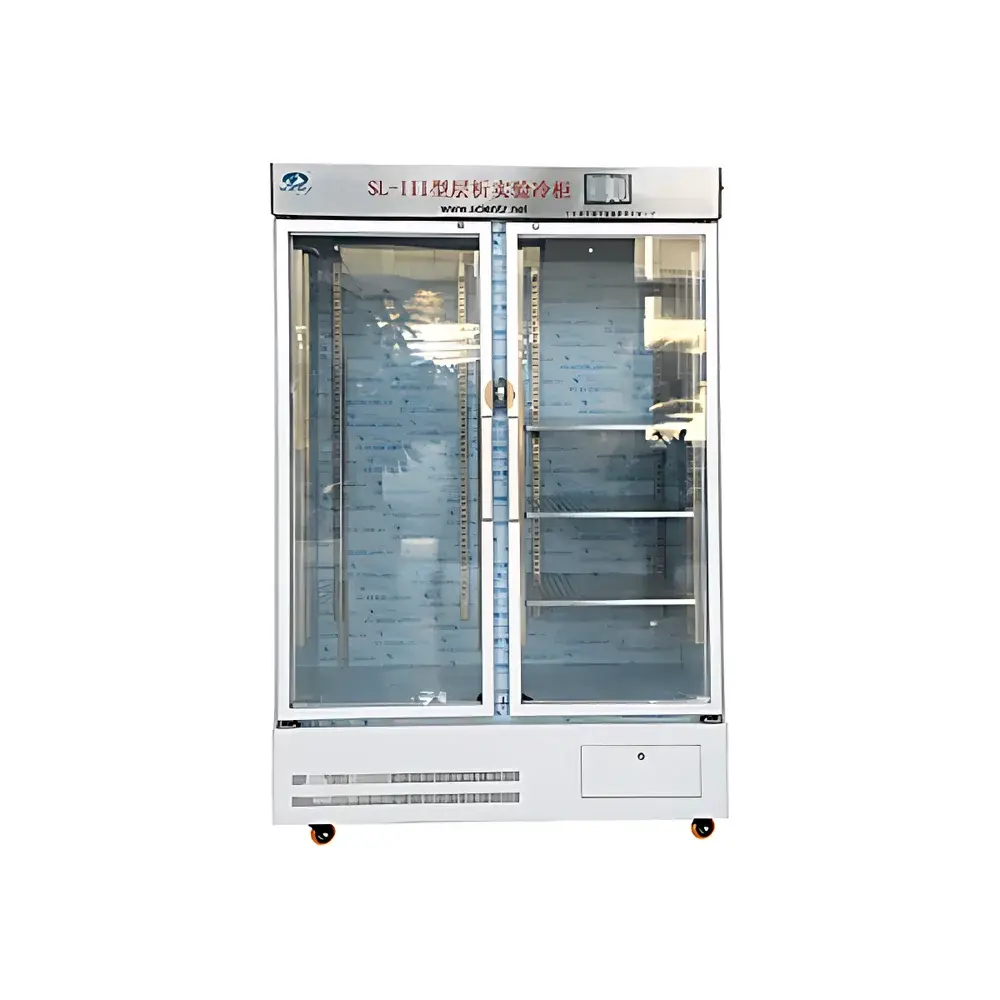
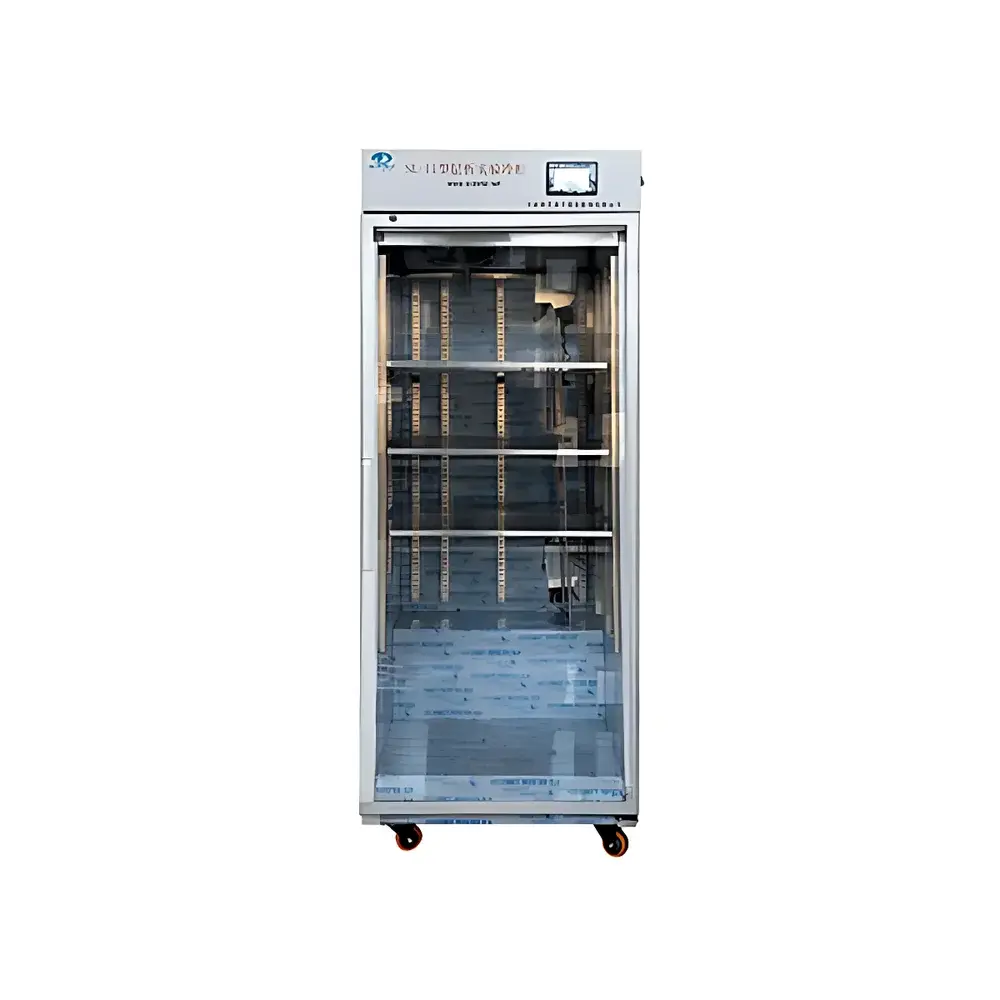
Scientz SL-II/III Chromatography Refrigerator
| Brand | Scientz |
|---|---|
| Origin | Zhejiang, China |
| Manufacturer Type | Direct Manufacturer |
| Model | SL-II/III |
| Price | Upon Request |
Overview
The Scientz SL-II/III Chromatography Refrigerator is an engineered low-temperature environmental chamber specifically designed for biomolecular chromatography workflows—including gel filtration, ion exchange, affinity, and size-exclusion chromatography—where precise thermal stability (2–8 °C) is critical to column integrity, buffer viscosity, and analyte recovery. Unlike general-purpose laboratory refrigerators, this unit integrates industrial-grade thermal management architecture with application-specific ergonomics: its ≤2000 mm total height enables seamless transit through standard doorways and freight elevators, while its vertical internal volume (optimized via high-clearance shelving and unobstructed rear airflow channels) accommodates stacked FPLC systems, fraction collectors, peristaltic pumps, and associated tubing manifolds without compromising temperature uniformity or accessibility. The cabinet operates on a forced-air convection principle with microprocessor-regulated dual-stage cooling, ensuring thermodynamic consistency across all load conditions—from empty validation runs to fully equipped operational configurations.
Key Features
- Microprocessor-based temperature control system with 0.1 °C display and setpoint resolution; adjustable range: 0 °C to ambient temperature, standard operating band: 2–8 °C
- High-efficiency imported hermetic compressor with intelligent defrost cycle—defrost initiation and termination triggered by real-time frost-sensor feedback, not fixed timers
- Anti-condensation architecture: electrically heated transparent glass door + heated vertical door mullions, eliminating fogging and water droplet formation during high-humidity operation
- Dual independent power circuits: main cabinet supply + isolated interior GFCI-protected AC outlet (115/230 V, 50/60 Hz), enabling simultaneous operation of external analytical instruments
- Forced horizontal air circulation with optimized duct geometry ensures ≤±2 °C temperature deviation across all shelf planes (per ISO 14644-1 Class 8 background verification protocol)
- Triple-layer insulation: 80 mm polyurethane foam core (λ ≈ 0.022 W/m·K) enclosed within reinforced steel frame; door gasket: closed-cell EPDM with magnetic seal integrity
- Touchscreen HMI with real-time data logging: displays current temperature, setpoint, runtime clock, cumulative operational hours, and dynamic temperature curve (72-hr buffer)
- Comprehensive safety suite: dual independent high/low temperature alarms, differential temperature lockout, auto-cutout at ±5 °C deviation, battery-backed power-fail memory retention
- Two 60 mm-diameter pass-through ports (front-mounted, sealed with silicone grommets) for tubing, sensor cables, and pneumatic lines
- Integrated LED task lighting + UV-C germicidal lamp (254 nm, 15 W), programmable via timer or manual override
Sample Compatibility & Compliance
The SL-II/III supports storage and operational hosting of chromatographic media (e.g., Sephadex®, Toyopearl®, Ni-NTA resins), pre-chilled buffers (Tris-HCl, PBS, imidazole gradients), and temperature-sensitive biological samples (purified proteins, monoclonal antibodies, viral vectors). Its thermal performance meets the baseline requirements of USP for refrigerated storage of biologics and aligns with ISO 20387:2018 (Biobanking) clause 7.3.2 for controlled-temperature specimen holding. While not certified as a medical device under FDA 21 CFR Part 820, the unit’s audit-ready event log (timestamped alarms, defrost cycles, door-open durations) supports GLP/GMP-aligned laboratory documentation practices. All electrical components comply with IEC 61010-1:2010 for laboratory equipment safety.
Software & Data Management
Data acquisition occurs locally via embedded ARM Cortex-M7 controller running a deterministic real-time OS. Temperature readings (PT1000 sensors, calibrated traceable to NIST SRM 1750) are sampled every 3 seconds and buffered in non-volatile FRAM. The touchscreen interface provides immediate access to: (i) live trend visualization (scrollable 72-hour plot), (ii) exportable CSV logs via USB-A port (no cloud dependency), and (iii) configurable alarm thresholds with email/SMS alert relay via optional RS-485-to-Ethernet gateway (Modbus TCP compatible). Audit trail functionality records user login/logout events, parameter changes, and maintenance interventions—fully compliant with ALCOA+ principles for raw data integrity.
Applications
- On-column temperature stabilization during AKTA™-based purification runs
- Long-term storage of affinity columns (e.g., Protein A, GST-tag) between use cycles
- Buffer reservoir conditioning for HPLC/UHPLC mobile phase delivery systems
- Pre-chilling of electrophoresis reagents (SDS-PAGE gels, running buffers)
- Short-term holding of primary cell isolates prior to cryopreservation
- Environmental simulation for stability testing of chromatographic consumables
FAQ
What is the recommended ambient temperature range for optimal SL-II/III performance?
The unit is rated for continuous operation in rooms maintained between 15–30 °C with ≤70% non-condensing relative humidity.
Can the interior power outlet support motor-driven devices like peristaltic pumps?
Yes—the dedicated 10 A, 230 VAC outlet delivers stable sinusoidal output with surge protection; maximum continuous load: 2000 W.
Is remote monitoring supported out-of-the-box?
Local USB data export is standard; Ethernet or Wi-Fi connectivity requires optional communication module (order code: SL-COM-ETH).
How often does the defrost cycle activate under typical lab conditions?
Defrost frequency depends on door-open events and ambient humidity; average interval is 48–72 hours during normal 8-hr/day usage with ≤3 door openings per hour.
Does the unit meet noise emission standards for open-plan laboratories?
Operational sound pressure level is ≤48 dB(A) at 1 m distance—compliant with ISO 7779 and suitable for shared research spaces.



