
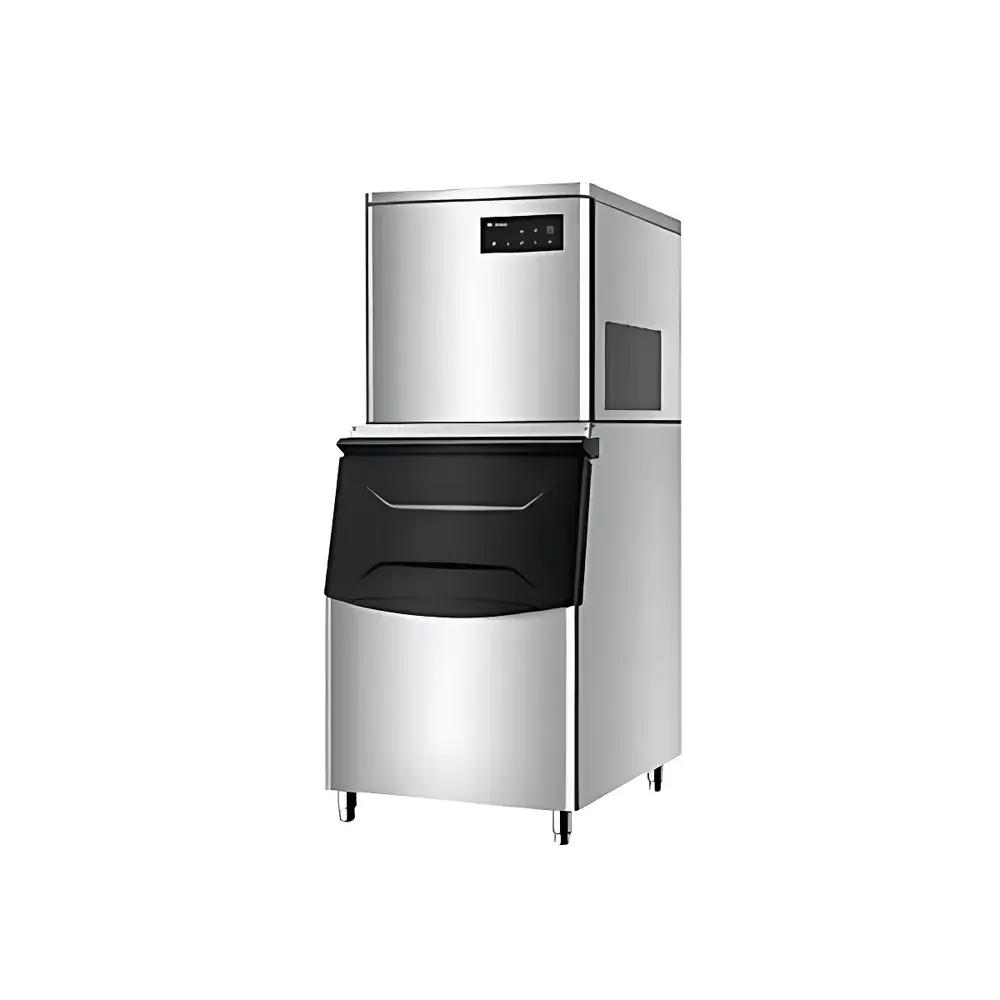
Scientz XB-200 Flake Ice Machine
| Brand | Scientz |
|---|---|
| Model | XB-200 |
| Ice Production Capacity | 200 kg/24h |
| Storage Capacity | 32 kg |
| Ice Type | Irregular flake ice (fine granular, low moisture content) |
| Ice Making Method | Dual-screw extrusion freezing |
| Cooling System | Air-cooled, dual-screw evaporator |
| Compressor | High-efficiency imported compressor |
| Control System | Microprocessor-based automatic control with self-diagnosis |
| Drainage | Active elevated drainage system |
| Water Filtration | Integrated OEM water purifier |
| Power Supply | 220 V / 50 Hz |
| Dimensions (W×D×H) | 560 × 610 × 870 mm |
| Net Weight | 78 kg |
Overview
The Scientz XB-200 Flake Ice Machine is an air-cooled, microprocessor-controlled laboratory and light-industrial ice generator engineered for consistent, high-purity flake ice production. It operates on the principle of direct-contact freezing via a dual-screw extrusion evaporator: filtered feed water flows over a stainless-steel evaporator surface maintained at approximately –18 °C; rapid heat extraction induces instantaneous solidification into thin, irregular ice lamellae. These flakes are then mechanically scraped and compacted by counter-rotating augers before being extruded through a die and gravity-fed into the insulated storage bin. Unlike cubed or tube ice systems, flake ice offers maximal surface-area-to-volume ratio, rapid thermal transfer, and minimal mechanical damage to temperature-sensitive samples—making it the preferred medium for biological specimen chilling, cold-chain sample transport, histology tissue embedding, and controlled-temperature reaction quenching in analytical workflows.
Key Features
- High-output flake ice generation: Rated capacity of 200 kg per 24 hours under standard ambient conditions (25 °C, 60% RH), with first ice delivery within 5 minutes of startup.
- Dual-screw extrusion architecture: Ensures uniform ice density, low residual moisture (<2.5%), and consistent particle morphology (typical flake thickness: 1–2 mm, lateral dimension: 3–8 mm).
- Integrated OEM water purification module: Reduces scale-forming minerals (Ca²⁺, Mg²⁺) and particulates to <5 µm, extending evaporator service life and maintaining ice clarity and purity—critical for GLP-compliant sample preparation.
- Self-diagnostic control system: Monitors evaporator temperature, compressor discharge pressure, water flow rate, and storage bin fullness; displays error codes (e.g., E01 = low water, E03 = high head pressure) on LED interface for rapid troubleshooting.
- Active elevated drainage: Built-in condensate pump enables drainage up to 1.2 m vertical height, eliminating dependency on floor-level floor drains—ideal for retrofit installations in labs, cleanrooms, or mobile units.
- Energy-optimized refrigeration circuit: Utilizes R290 (propane) refrigerant and a high-efficiency imported hermetic compressor, achieving COP ≥ 2.8 at rated load while complying with EU F-Gas Regulation (EU) No 517/2014 Annex III.
Sample Compatibility & Compliance
The XB-200 produces non-contaminated, microbiologically inert ice suitable for direct contact with clinical specimens, pharmaceutical intermediates, and food-grade materials. Its stainless-steel evaporator drum, food-grade auger housing, and NSF/ANSI 12 certified internal components meet requirements for ISO 22000 and HACCP-aligned environments. The unit conforms to IEC 61000-6-3 (EMC emission limits) and IEC 61000-6-2 (immunity), and its electrical safety design complies with IEC 61010-1 for laboratory equipment. While not classified as a medical device under FDA 21 CFR Part 820, its operational consistency supports adherence to CLIA and CAP pre-analytical standards for specimen stabilization.
Software & Data Management
The XB-200 features a standalone embedded controller with no external software dependency. All operational parameters—including runtime hours, total ice output (cumulative kg), fault history (timestamped last 10 events), and maintenance reminders—are stored in non-volatile memory. Audit trails are accessible via front-panel navigation and support manual export via USB log download (optional firmware upgrade). For integration into centralized facility monitoring systems, optional 4–20 mA analog outputs (ice level, compressor status) and Modbus RTU RS-485 interface are available upon request—enabling alignment with FDA 21 CFR Part 11 data integrity expectations when paired with validated SCADA platforms.
Applications
- Life sciences: Rapid cooling of centrifuged cell pellets, enzyme assays, PCR setup, and cryosectioning blocks.
- Clinical diagnostics: Stabilization of whole blood, CSF, and urine specimens during transport to central labs (per CLSI GP44-A4 guidelines).
- Pharmaceutical QA/QC: Temperature control during dissolution testing, lyophilization cycle monitoring, and stability chamber validation.
- Food safety laboratories: Chilling of composite food samples prior to microbial plating or toxin extraction.
- Field-deployable research: Used aboard marine research vessels (fishery sampling), mobile pathology units, and disaster-response labs where portability and reliability are paramount.
FAQ
What is the typical flake ice density and melting rate at room temperature?
Flake ice from the XB-200 exhibits a bulk density of 380–420 kg/m³ and melts at ~0.8–1.2 kg/h per 10 L volume under ambient conditions (25 °C, 50% RH), depending on airflow and container insulation.
Can the machine operate continuously without manual intervention?
Yes—the unit cycles automatically between ice-making and standby modes based on bin-level sensor feedback; full 32 kg storage supports unattended operation for up to 8 hours at peak demand.
Is the evaporator surface compatible with cleaning agents used in ISO Class 5 cleanrooms?
The electropolished 304 stainless-steel evaporator accepts neutral pH enzymatic cleaners and 70% IPA wipes; alkaline or chloride-based detergents are not recommended to avoid pitting corrosion.
Does the XB-200 require a dedicated circuit?
A dedicated 16 A, 220 V AC circuit with residual-current device (RCD) protection is required to ensure stable compressor startup and prevent nuisance tripping during peak current draw (max. 8.2 A).
Related Products



