
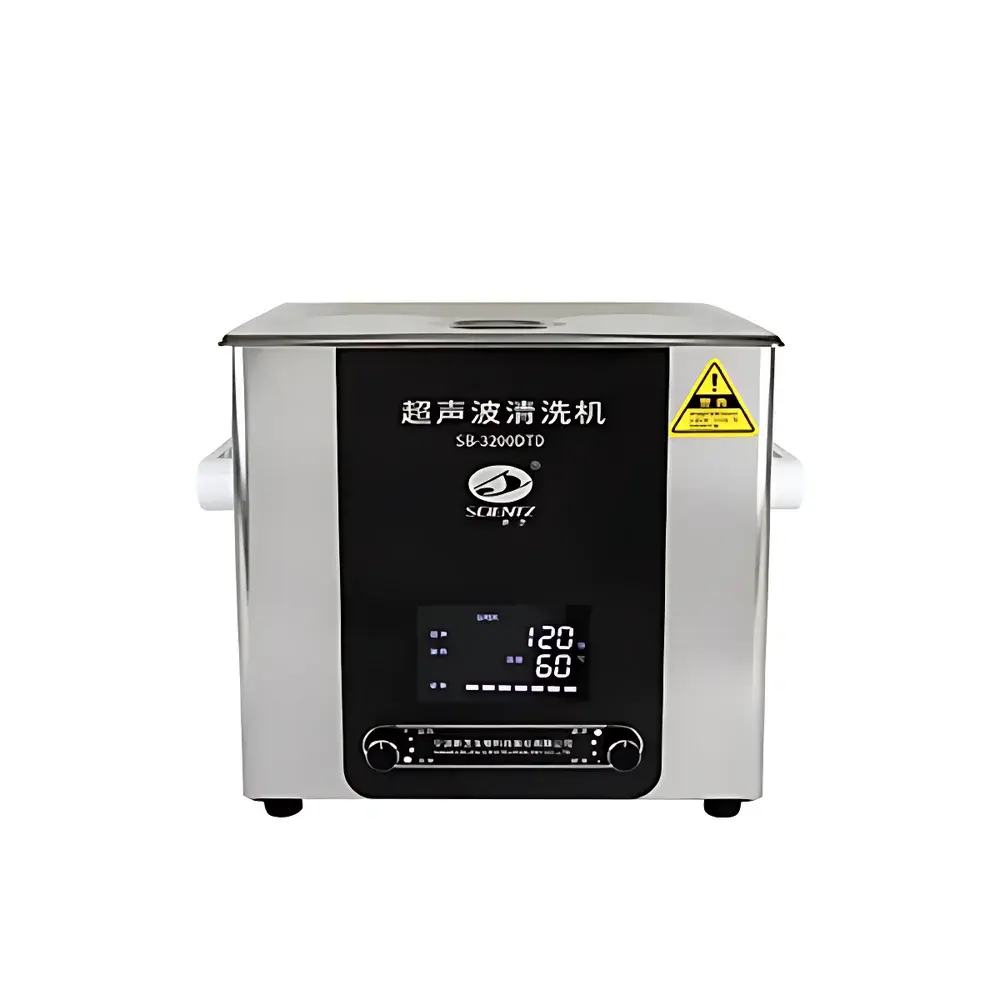
Ningbo Scientz SB-3200DTD Digital Ultrasonic Cleaner
| Brand | Ningbo Scientz |
|---|---|
| Origin | Zhejiang, China |
| Manufacturer Type | Direct Manufacturer |
| Instrument Type | General-Purpose Ultrasonic Cleaner |
| Capacity | 6 L |
| Ultrasonic Frequency | 40 kHz |
| Ultrasonic Power Output | 180 W |
| Adjustable Power | Yes (40–100% stepless) |
| Adjustable Temperature | Yes (Room Temp to 80 °C) |
| Adjustable Timer | Yes (1–999 min) |
| Sound-Dampening Lid | Included |
| Drain/Inlet Fitting | Not Provided |
Overview
The Ningbo Scientz SB-3200DTD Digital Ultrasonic Cleaner is an engineered solution for precision cleaning in academic, pharmaceutical, clinical, and industrial laboratories. It operates on the principle of acoustic cavitation—where high-frequency ultrasonic energy (40 kHz) is transmitted into a liquid medium via piezoelectric transducers bonded to the stainless-steel tank base. This generates controlled microbubble formation and implosive collapse, producing localized transient pressures exceeding 1000 atm and liquid jet velocities up to 400 m/s. These physical phenomena enable non-contact mechanical disruption of contaminants—including particulates, biofilms, oils, and organic residues—from complex geometries such as capillary interiors, threaded surfaces, blind holes, and porous substrates. Unlike abrasive or solvent-intensive methods, ultrasonic cleaning preserves substrate integrity while delivering reproducible, process-controlled decontamination. The SB-3200DTD is designed for routine use in ISO 17025-accredited labs, GLP-compliant environments, and facilities adhering to USP guidelines for equipment qualification.
Key Features
- Digital microprocessor control with real-time display of elapsed/remaining time and actual bath temperature (±1 °C accuracy)
- Stepless ultrasonic power regulation from 40% to 100%, enabling optimization for delicate optics, soft polymers, or heavily soiled metal components
- Heating system with PID temperature control (range: ambient to 80 °C), supporting enhanced solubilization of waxy or viscous residues
- Integrated sound-dampening lid with safety interlock—reduces operational noise to ≤55 dB(A) at 1 m and prevents solvent evaporation
- Non-volatile memory retains user-defined settings (time, temperature, power) after power interruption, ensuring protocol continuity
- 304 stainless-steel tank (240 × 150 × 170 mm internal dimensions) with rounded corners for uniform energy distribution and ease of cleaning
Sample Compatibility & Compliance
The SB-3200DTD accommodates standard laboratory ware including borosilicate glassware (vials, beakers, pipettes), centrifuge tubes (up to 50 mL), stainless-steel surgical instruments, quartz cuvettes, optical lenses, and MEMS components. Its 6 L capacity supports batch processing of multiple items without compromising cavitation density. The unit complies with IEC 61000-6-3 (EMC emissions) and IEC 61000-6-2 (immunity). While not certified for sterile reprocessing per ISO 15883 or AAMI ST-79, it serves as a validated pre-cleaning stage in multi-step disinfection workflows. Users performing regulated cleaning must conduct in-house performance qualification (PQ) per ASTM E2810–21 (Standard Guide for Validation of Ultrasonic Cleaning Processes) and document parameters traceably.
Software & Data Management
This model features embedded firmware—not PC-linked software—ensuring deterministic timing and thermal response without external dependencies. All operational data (start time, setpoints, duration, final temperature) are logged internally with timestamping. Though no USB/RS-232 interface is provided, manual audit trails can be generated via operator logbooks aligned with FDA 21 CFR Part 11 principles (e.g., handwritten entries with signature/date/timestamp). For laboratories requiring electronic records, integration with LabVantage or STARLIMS via analog signal logging (0–5 V output optional upon request) is feasible through third-party DAQ modules.
Applications
- Routine decontamination of volumetric glassware prior to calibration or trace analysis
- Removal of residual PCR inhibitors or nucleic acid carryover from microcentrifuge tubes and qPCR plates
- Pre-cleaning of HPLC injection valves, autosampler needles, and column frits
- De-gassing of mobile phases and cell culture media to prevent bubble formation in pumps and bioreactors
- Surface preparation of SEM/TEM specimens and AFM cantilevers to eliminate hydrocarbon contamination
- Supporting ASTM D2624 (jet fuel conductivity testing) and ISO 4406 (fluid cleanliness) sample prep protocols
FAQ
Is the SB-3200DTD suitable for cleaning delicate optical components such as microscope objectives?
Yes—when operated at 40–60% power with low-surface-tension aqueous detergents (e.g., Alconox® Liquinox®) and temperatures ≤45 °C, it reliably removes fingerprint oils and dust without micro-scratching.
Can this unit be used with flammable solvents like acetone or ethanol?
No—this model lacks explosion-proof certification and intrinsically safe design. Only water-based or flashpoint >60 °C solutions are permitted per UL 61010-1 requirements.
Does the device support validation documentation for GMP environments?
It provides stable, repeatable operation suitable for IQ/OQ/PQ execution; however, users must generate their own qualification protocols, including thermocouple mapping, cavitation intensity profiling (using aluminum foil test per ASTM E2810), and timer/power calibration checks.
What maintenance is required to ensure long-term performance?
Transducer adhesion integrity should be verified annually via impedance spectroscopy; tank interior must be descaled every 3–6 months using 5% citric acid solution when using hard water.



