
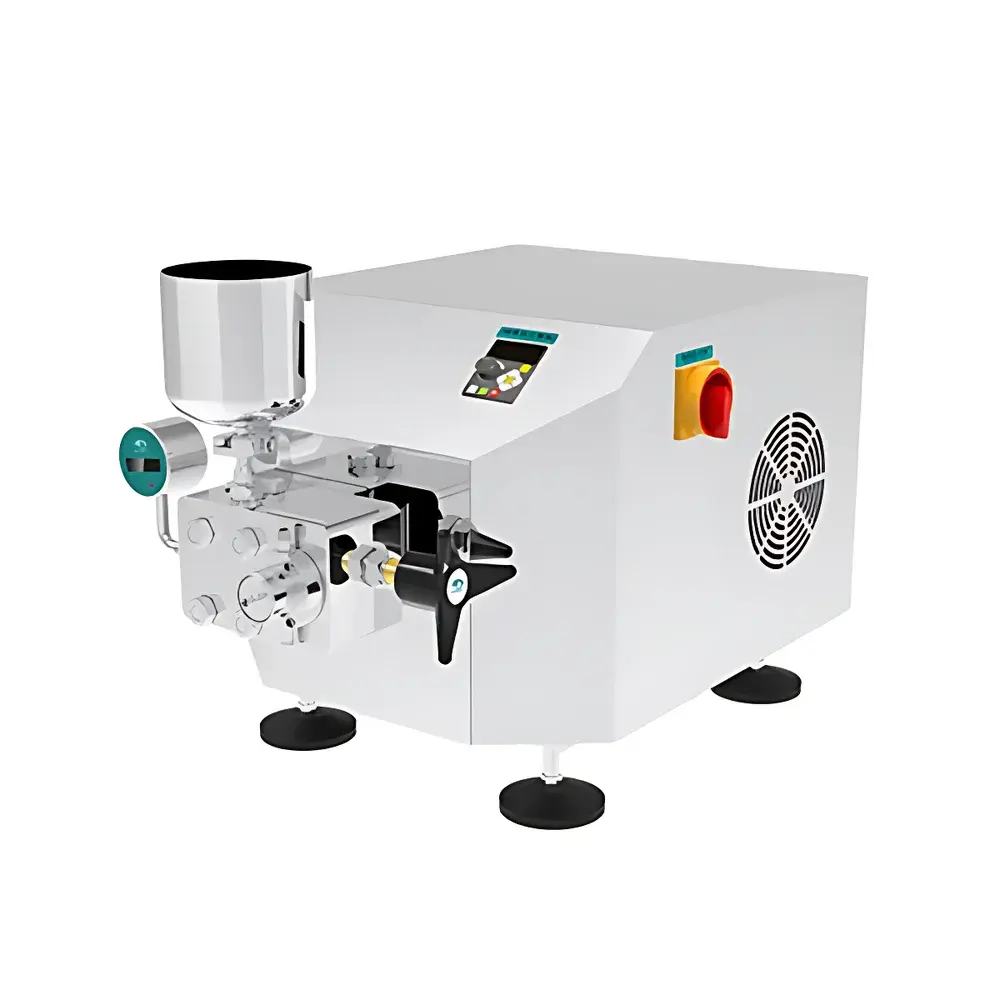
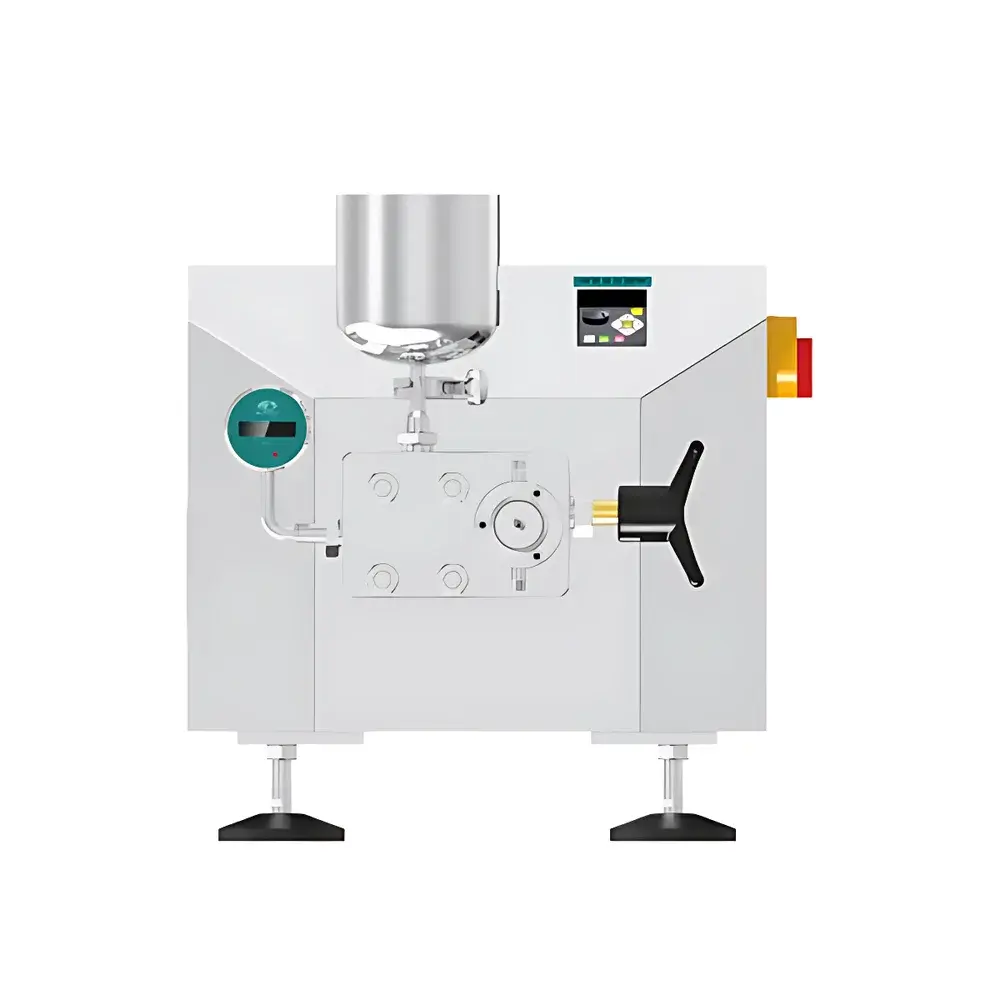
Scientz SCIENTZ-Nano Benchtop High-Pressure Homogenizer
| Brand | Scientz |
|---|---|
| Origin | Zhejiang, China |
| Manufacturer Type | Direct Manufacturer |
| Instrument Type | High-Pressure Homogenizer |
| Model | SCIENTZ-Nano |
| Dimensions (W×D×H) | 800 × 460 × 450 mm |
| Processing Capacity | 6–10 L/h |
| Maximum Operating Pressure | 150 MPa |
| Minimum Particle Size Achievable | <100 nm |
| Material of Wetted Parts | ASTM A276 Type 316L Stainless Steel |
| Cooling Interface | Dual-port temperature-controlled coolant connection |
| Flow Control | Variable-frequency drive (VFD)-regulated flow system |
| Homogenization Valve Options | Impact valve (R-type), Spherical valve (PS-type), Diamond-coated ceramic valve |
Overview
The Scientz SCIENTZ-Nano Benchtop High-Pressure Homogenizer is an engineered solution for scalable, reproducible nano-scale homogenization in research and pilot-scale biopharmaceutical, food science, and advanced materials laboratories. Based on the principle of high-pressure microfluidization, it subjects liquid suspensions to controlled pressures up to 150 MPa, forcing them through a precisely engineered narrow orifice—generating intense hydrodynamic shear, cavitation, and impact forces. This multi-mechanism disruption enables consistent sub-100 nm particle size reduction, cell lysis, emulsification, and nano-dispersion without thermal degradation. Designed as a compact, air-cooled or external chiller-integrated benchtop system, the SCIENTZ-Nano delivers industrial-grade performance within a footprint suitable for ISO Class 5–7 cleanroom environments and GLP-compliant labs.
Key Features
- Adjustable pressure control from 0 to 150 MPa with real-time digital monitoring and pressure-hold stability ±0.5 MPa
- Integrated dual-port cooling interface compatible with external recirculating chillers (e.g., −5 °C to 25 °C range) to maintain sample temperature below 30 °C during extended operation
- Patented internal heat-dissipating homogenizing head architecture minimizing localized thermal accumulation at the valve seat
- Dual-valve configuration support: R-type impact valve for high-efficiency microbial and algal cell disruption; PS-type spherical valve optimized for stable oil-in-water and water-in-oil nanoemulsions
- Zero-residue fluid path design featuring automated purge valves and full-system drain capability—critical for cross-sample integrity in GMP-aligned workflows
- VFD-driven peristaltic feed pump enabling precise volumetric flow rate adjustment (0.5–10 L/h) independent of pressure setting
- Wetted components constructed entirely from ASTM A276 Type 316L stainless steel, certified to FDA 21 CFR Part 117 and EU 1935/2004 food-contact compliance standards
- Diamond-reinforced ceramic homogenizing valves offering >500 hours operational life under continuous 120 MPa load
Sample Compatibility & Compliance
The SCIENTZ-Nano accommodates viscous and particulate-laden suspensions up to 15% w/v solids concentration—including Gram-negative bacteria (e.g., E. coli), yeast (Saccharomyces cerevisiae), cyanobacteria (Spirulina platensis), plant tissues (e.g., loquat leaf, ginger rhizome), lipid-based formulations (IV fat emulsions, liposomal doxorubicin precursors), pigment dispersions (phthalocyanine blue/green, carbon black slurries), and protein isolates (soy, peanut, sweet potato). All contact surfaces meet USP Class VI biocompatibility requirements. System validation documentation supports IQ/OQ protocols aligned with ASTM F2370-21 (standard practice for qualification of homogenizers in pharmaceutical applications) and ISO 22000:2018 food safety management criteria.
Software & Data Management
The SCIENTZ-Nano operates via an embedded industrial PLC controller with touchscreen HMI interface. All critical process parameters—including pressure setpoint, actual pressure trace, inlet/outlet temperature, flow rate, total processed volume, and runtime—are logged at 1-second intervals and exportable in CSV format. Audit trail functionality complies with FDA 21 CFR Part 11 requirements when paired with Scientz’s optional LabLink™ data management software, which provides electronic signature support, user role-based access control, and automatic report generation per ICH E6(R3) clinical trial material processing guidelines.
Applications
- Biopharmaceutical development: Production of nanosuspensions for poorly water-soluble APIs (e.g., flavonoids, paclitaxel analogs), liposomal mRNA encapsulation pre-formulation, and bacterial inclusion body solubilization
- Functional food R&D: Stabilization of plant-protein beverages, cold pasteurization of juice matrices via nano-scale microbial membrane disruption, and viscosity-modified dairy alternatives
- Nanomaterial synthesis: Continuous top-down fabrication of pigment nanoparticles, quantum dot colloids, and metal-organic framework (MOF) dispersions
- Cosmetic formulation: Generation of sub-200 nm lipid nanoparticles (LNPs) and ethosomes for transdermal delivery, and long-term stable cosmetic emulsions without chemical co-emulsifiers
- Botanical extraction: Enhanced release of intracellular phytochemicals from tough plant matrices (e.g., polysaccharide-rich Tremella fuciformis sporocarps) while preserving thermolabile actives
FAQ
What is the minimum recommended sample volume for reliable pressure stabilization?
A minimum batch volume of 300 mL is required to ensure consistent hydraulic response and avoid cavitation-induced pressure fluctuations.
Can the SCIENTZ-Nano be integrated into a closed-loop sterile processing line?
Yes—when configured with SIP-capable 316L sanitary fittings and validated steam-traceable cooling lines, it meets ASME BPE-2022 Category D requirements for single-use bioprocessing integration.
Is third-party calibration certification available?
Scientz provides NIST-traceable pressure transducer calibration certificates (ISO/IEC 17025 accredited) upon request, with annual recalibration services supported globally.
How does the built-in exhaust function maintain pressure integrity during degassing?
The auto-recover degas cycle vents entrapped air through a dedicated vent port while simultaneously compensating flow rate to restore target pressure within ±1.2 MPa tolerance in <8 seconds.
What maintenance intervals are recommended for the diamond-coated valve assembly?
Under standard operating conditions (≤100 MPa, aqueous buffers), inspection is recommended every 200 operating hours; replacement interval averages 500–700 hours depending on abrasive load and pH.



