
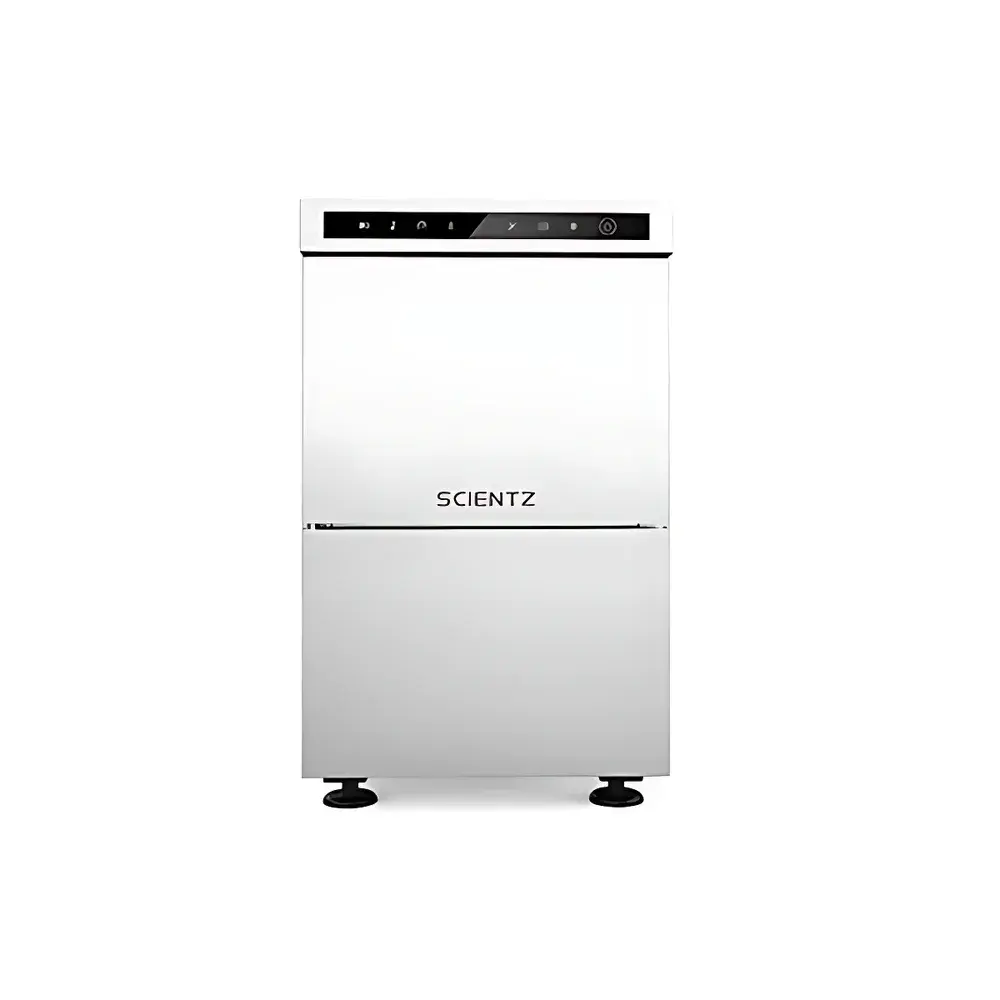
Scientz XB-50II Fully Automatic Flake Ice Maker
| Brand | Scientz |
|---|---|
| Model | XB-50II |
| Ice Production Capacity | 50 kg/24h |
| Storage Capacity | 15 kg |
| Cooling Method | Air-Cooled |
| Ice Type | Irregular Flake Ice |
| Compressor | High-Efficiency International Brand |
| Control System | Microprocessor-Based Automatic Control |
| Drainage | Active Gravity-Assisted Elevated Drainage |
| Water Filtration | Integrated OEM Water Purifier |
| Operating Ambient Temperature Range | 10–32°C |
| Power Supply | 220 V / 50 Hz |
| Dimensions (W×D×H) | 470 × 540 × 820 mm |
| Net Weight | 62 kg |
Overview
The Scientz XB-50II Fully Automatic Flake Ice Maker is an engineered solution for laboratories, clinical facilities, and industrial environments requiring consistent, high-purity flake ice with low moisture content and rapid on-demand availability. It operates on the principle of direct-contact freezing via a rotating auger-type evaporator—where filtered water flows over a stainless-steel spiral evaporator maintained at approximately −18 °C. Heat exchange induces instantaneous phase transition, forming thin, irregular ice flakes. A gear-reduced rotary cutter continuously scrapes and compresses the nascent ice layer, conveying it downward by mechanical extrusion and gravity into the insulated storage bin. This design eliminates reliance on batch freezing or thermal cycling, ensuring continuous output and minimal ice bridging or compaction—critical for applications demanding free-flowing, dry ice morphology.
Key Features
- Rapid Ice Generation: Achieves first ice output within 5 minutes of startup; sustained production rate of 50 kg per 24 hours under standard ambient conditions (21 °C, 60% RH).
- Dry Flake Morphology: Produces irregular, sub-3 mm flake ice with <15% surface moisture content—ideal for temperature-sensitive sample preservation, enzymatic reaction quenching, and cold-chain transport preparation.
- Integrated Water Purification: Factory-installed OEM water filter removes particulates, chlorine, and scale-forming ions, reducing evaporator fouling and extending service intervals between descaling cycles.
- Intelligent Diagnostics: Microprocessor-based controller monitors compressor discharge pressure, evaporator temperature, water flow status, and bin fullness; displays fault codes and initiates safe shutdown on anomaly detection.
- Elevated Drainage System: Built-in pump-assisted gravity drainage enables installation in locations without floor-level drains—supports flexible placement in ISO-certified labs, cleanrooms, or mobile units.
- Air-Cooled Condensing Architecture: Optimized finned-tube condenser with axial fan ensures stable operation across ambient temperatures from 10 °C to 32 °C without external water cooling infrastructure.
Sample Compatibility & Compliance
The XB-50II is compatible with deionized, distilled, or municipally treated potable water meeting ASTM D1193 Type IV specifications. Its stainless-steel evaporator, food-grade ice delivery path, and NSF/ANSI 12 certified components comply with FDA 21 CFR Part 110 (Current Good Manufacturing Practice) for ice used in analytical sample handling and biological specimen stabilization. The unit meets IEC 61000-6-3 (EMC Emission) and IEC 61000-6-2 (Immunity) standards. While not classified as medical device per ISO 13485, its design supports GLP-compliant documentation workflows when integrated with laboratory information management systems (LIMS) via optional RS-485 serial interface.
Software & Data Management
The XB-50II employs embedded firmware with non-volatile memory for cycle logging—including total operational hours, cumulative ice output, and fault event timestamps. All logs are exportable via USB port in CSV format for audit trail generation. Optional integration with Scientz’s LabLink™ software suite (v3.2+) enables remote monitoring of real-time evaporator temperature, compressor duty cycle, and storage bin fill level—supporting preventive maintenance scheduling and adherence to ISO/IEC 17025 clause 6.4.2 (Equipment Monitoring). Audit trails retain ≥18 months of data with immutable timestamps compliant with ALCOA+ principles.
Applications
- Life Sciences: Cryopreservation buffer preparation, tissue dissection cooling, PCR master mix chilling, and electrophoresis gel tray conditioning.
- Clinical Diagnostics: Hematology sample temperature stabilization pre-analysis, urinalysis refrigeration, and point-of-care assay cold chain integrity assurance.
- Food & Beverage QA/QC: Rapid cooling of microbiological enrichment broths (ISO 6579), sensory evaluation sample presentation, and HACCP-critical process step control.
- Industrial Field Use: On-site fishery catch preservation, chemical reagent temperature moderation during exothermic synthesis, and portable calibration standard maintenance.
FAQ
What is the recommended water quality for optimal performance?
Deionized or reverse-osmosis treated water with conductivity <5 µS/cm and hardness <1°dH is strongly recommended to minimize scale accumulation and maintain evaporator efficiency over time.
Can the unit operate continuously without manual intervention?
Yes—the XB-50II features fully automatic start/stop logic tied to bin fullness sensors and programmable daily production windows, supporting unattended 24/7 operation in controlled environments.
Is the ice suitable for direct contact with biological samples?
Flake ice produced using purified water meets ISO 8573-1 Class 2 purity requirements for non-sterile cold contact applications; sterile ice requires additional validation per ISO 11137.
How often does the system require descaling?
With integrated filtration and soft water input, descaling is typically required every 6–12 months depending on usage frequency and feedwater mineral content—verified via built-in scale-detection algorithm.
Does the unit support regulatory compliance reporting?
Yes—CSV-exportable logs include traceable timestamps, operator ID fields (via optional RFID badge reader), and change history for all parameter modifications, fulfilling core elements of 21 CFR Part 11 Subpart B electronic record requirements.



