
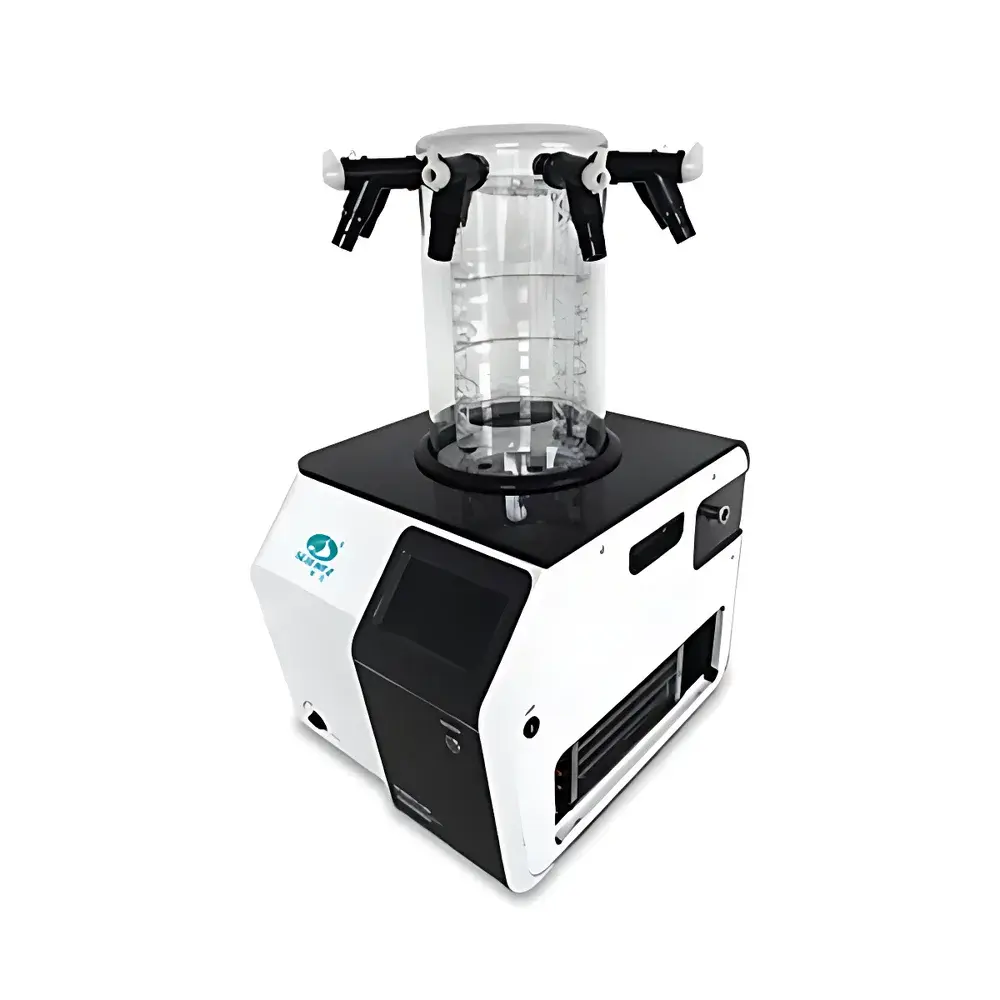
Ningbo Scientz SCIENTZ-10N/C Benchtop Manifold Freeze Dryer with Bell Jar Configuration
| Brand | Ningbo Scientz |
|---|---|
| Origin | Zhejiang, China |
| Manufacturer Type | Direct Manufacturer |
| Instrument Type | Manifold Freeze Dryer |
| Application | Laboratory-Scale Lyophilization |
| Shelf Area | 0.12 m² |
| Ultimate Vacuum | ≤5 Pa |
| Condenser Capacity (24 h) | 3 kg/batch |
| Condenser Temperature | ≤−56 °C (optional −80 °C configuration available) |
| Dimensions (L×W×H) | 590 × 460 × 450 mm (main unit) + 440 mm (bell jar height) |
Overview
The Ningbo Scientz SCIENTZ-10N/C is a benchtop manifold freeze dryer engineered for precise, reproducible lyophilization of small-to-medium batch samples in academic, governmental, and industrial R&D laboratories. It operates on the principle of sublimation under deep vacuum: frozen aqueous or solvent-based samples are dried directly from solid to vapor phase without passing through the liquid state—preserving thermolabile structures such as proteins, nucleic acids, enzymes, vaccines, and microbial cultures. The system integrates a high-efficiency dual-stage refrigeration circuit, a transparent polycarbonate bell jar chamber, and an eight-port stainless-steel manifold for simultaneous processing of multiple vials or flasks. Its compact footprint (under 0.13 m³ total volume) enables seamless integration into fume hoods, biosafety cabinets, or shared lab benches while maintaining full compliance with core lyophilization performance benchmarks for laboratory-scale applications.
Key Features
- Compact, space-optimized design with modular bell jar configuration—ideal for limited lab footprints without compromising condensation capacity or vacuum integrity.
- Imported high-reliability hermetic compressors delivering stable condenser temperatures ≤−56 °C (standard); optional −80 °C dual-compressor cascade system available for low-eutectic-point formulations.
- 7-inch true-color capacitive touchscreen interface with industrial-grade embedded OS—supporting real-time monitoring of condenser temperature, chamber pressure, and process time; no external PC required for operation.
- Automated data logging: all critical parameters recorded at user-defined intervals; freeze-drying profiles stored internally (≥1000 cycles) and exportable via USB to standard CSV or proprietary .fdp format for offline analysis.
- Polycarbonate bell jar: optically clear, autoclavable-grade, chemically resistant, and structurally reinforced to withstand repeated vacuum cycling (rated to 0.1 mbar absolute).
- Manifold system with eight standardized 24/29 ground-glass ports—compatible with international lyophilization vials (e.g., Kimble, Wheaton), stopper-sealed flasks, and valve-capped tubes.
- Intelligent vacuum sequencing: vacuum pump activation delayed until condenser reaches setpoint temperature, minimizing oil backstreaming and extending pump service life.
Sample Compatibility & Compliance
The SCIENTZ-10N/C supports diverse sample formats including aqueous biological suspensions (bacteria, viruses, cell lysates), pharmaceutical intermediates (peptides, monoclonal antibodies, adjuvants), botanical extracts, food matrices (fruit purees, meat homogenates), environmental specimens (soil slurries, wastewater solids), and nanomaterial dispersions. All wetted surfaces are electropolished stainless steel (304 grade) or medical-grade polymers compliant with ISO 10993-5 cytotoxicity requirements. The system meets general laboratory safety standards per IEC 61010-1 and supports GLP/GMP-aligned workflows via audit-trail-enabled data logging (timestamped, user-ID tagged, tamper-resistant). While not certified to FDA 21 CFR Part 11 out-of-the-box, its firmware architecture permits third-party validation packages for regulated environments requiring electronic record integrity.
Software & Data Management
The embedded control software provides full-cycle automation—from pre-freezing ramping and primary drying hold points to secondary drying slope detection and endpoint determination based on pressure rise test (PRT) logic. Up to 20 customizable freeze-drying protocols can be saved onboard. USB export enables post-process analysis in MATLAB, Python (Pandas), or commercial tools such as EndoLab or LyoTools. Optional PC-based upper-level software (Scientz-LyoView) offers remote monitoring, multi-unit fleet management, and report generation compliant with ISO/IEC 17025 documentation templates. All data files include metadata headers (operator ID, ambient conditions, batch ID) and support digital signature embedding for QA/QC traceability.
Applications
This instrument serves as a primary lyophilization platform across disciplines:
- Life sciences: long-term preservation of bacterial/archaeal strains, viral vectors, CRISPR ribonucleoprotein complexes, and extracellular vesicles.
- Pharmaceutical development: formulation screening of lyophilized injectables (e.g., mAbs, fusion proteins), stability testing per ICH Q5C, and excipient compatibility studies.
- Agricultural research: dehydration of plant tissue sections, pollen grains, and mycorrhizal spores for morphological and genomic analysis.
- Food science: preparation of reference standards for pesticide residue analysis (AOAC 2007.01), nutrient retention assessment, and sensory panel sample conditioning.
- Environmental analytics: concentration and stabilization of PFAS-spiked water filters, sediment porewater extracts, and bioaerosol collection media prior to LC-MS/MS quantification.
FAQ
What is the maximum sample volume per batch?
Each port accommodates up to 250 mL in standard 24/29 vials; total batch capacity is limited by condenser load (3 kg ice/24 h) and surface area (0.12 m² shelf-equivalent). Optimal loading is 60–70% of condenser capacity for consistent primary drying rates.
Is the system compatible with inert gas backfilling?
Yes—the integrated solenoid-controlled purge valve supports nitrogen or argon backfill to ≤200 mbar absolute, configurable via touchscreen with programmable flow rate and dwell time.
Can the condenser temperature be monitored independently during operation?
Yes—dual Pt100 sensors provide redundant measurement of condenser coil surface temperature and vapor-phase temperature near the trap inlet, both displayed in real time.
Does the system support automated defrosting?
Yes—electric resistive heating elements embedded in the condenser jacket enable rapid, controlled defrost cycles (≤15 min), with automatic condensate drainage via gravity-fed PTFE-lined tubing.
What vacuum pump options are validated for use with this model?
Scientz recommends two-stage oil-lubricated rotary vane pumps (e.g., Edwards RV8, Welch DuoSeal 10) rated ≥4 m³/h at 5 Pa; optional oil mist filter and auto-differential vacuum valve kits are available to prevent oil contamination and extend pump longevity.



