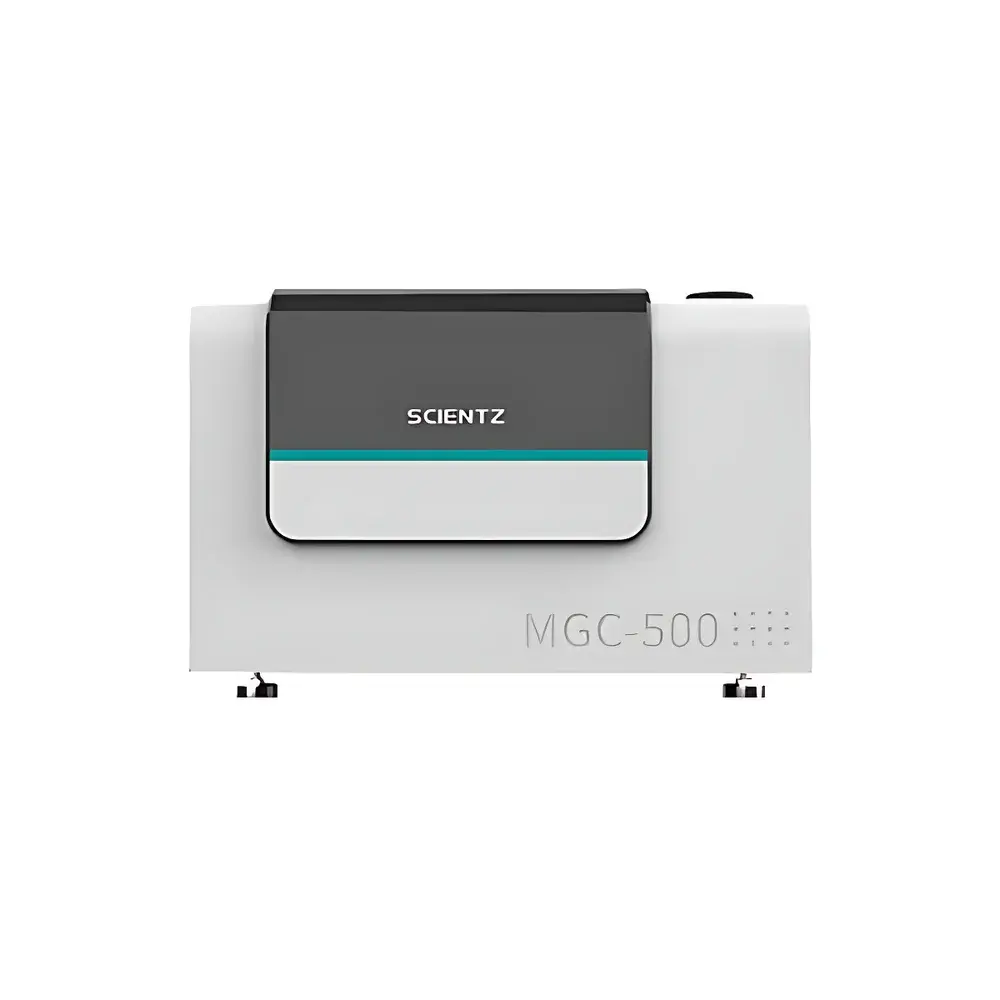
Scientz MGC-500 Microbial Growth Curve Analyzer
| Brand | Scientz |
|---|---|
| Origin | Zhejiang, China |
| Manufacturer Type | Direct Manufacturer |
| Country of Origin | China |
| Model | MGC-500 |
| Pricing | Available Upon Request |
Overview
The Scientz MGC-500 Microbial Growth Curve Analyzer is an integrated, fully automated platform engineered for real-time, non-invasive monitoring of microbial growth kinetics under precisely controlled environmental conditions. It operates on the principle of optical density (OD) measurement via dual-beam spectrophotometry across a broad wavelength range (300–850 nm), enabling label-free, continuous quantification of cell population dynamics in microplate-based cultures. Unlike conventional manual sampling methods—which introduce contamination risk, sample depletion, and temporal resolution gaps—the MGC-500 performs in situ measurements without disturbing culture integrity. Its modular architecture supports simultaneous regulation of temperature (15–60 °C), gas composition (O₂: 0.5–20 %, CO₂: 1–20 %), agitation (200–1250 rpm), and optional RGBW visible-light illumination (380–780 nm), making it uniquely suited for characterizing obligate aerobes, microaerophiles, facultative anaerobes, and strict anaerobes—including oxygen-sensitive strains such as Bifidobacterium spp.—within a single instrument platform.
Key Features
- Precise dual-gas control system with catalytic palladium-mediated O₂ scavenging for true anaerobic operation (O₂ ≤ 0.1 %); optimized gas consumption reduces operational cost by >60 % versus standard incubators.
- Programmable orbital shaking (200–1250 rpm) with independent static or dynamic mode selection—critical for sedimentation-prone cultures (e.g., Schizosaccharomyces pombe) and gas-exchange-dependent growth (e.g., Bacillus subtilis).
- Full-spectrum scanning capability (300–850 nm) to empirically determine optimal detection wavelengths per strain; supports up to six user-defined wavelengths for concurrent, time-resolved absorbance acquisition.
- High-throughput dual-plate configuration accommodating 12-, 24-, 48-, and 96-well microplates—enabling up to 192 parallel samples per run with configurable measurement intervals (as short as 20 min).
- High-intensity, long-life xenon flash lamp providing stable, pulse-driven illumination without warm-up delay—ensuring consistent photometric sensitivity across extended kinetic runs (>72 hr).
- Optional RGBW LED illumination module enabling spectral tuning (380–780 nm) and programmable light/dark cycles for photobiological studies involving cyanobacteria, algae, or light-regulated gene expression systems.
- Thermally regulated chamber with active lid heating to prevent condensation—maintaining optical clarity and measurement fidelity during prolonged incubation at high humidity.
Sample Compatibility & Compliance
The MGC-500 supports quantitative growth profiling of diverse biological systems including bacteria (Gram-positive and Gram-negative), yeasts, filamentous fungi, bacteriophages, protozoa, mammalian cells (in suspension), and photoautotrophic microorganisms. Its closed-loop, non-invasive design eliminates cross-contamination and sample volume loss—aligning with GLP-compliant workflows and reducing biosafety risks associated with open handling. While not certified to ISO/IEC 17025 or FDA 21 CFR Part 11 out-of-the-box, the system’s audit-trail-capable software architecture permits integration into validated laboratory environments when paired with documented SOPs and electronic signature protocols. Data export formats (CSV, Excel, PDF) facilitate traceability and regulatory submission preparation per USP <61>, CLSI M07, and ISO 20723 standards.
Software & Data Management
The embedded Chinese-language interface features intuitive workflow navigation, parameter scheduling (temperature ramps, gas setpoints, shaking profiles, illumination sequences), and real-time OD visualization. All raw absorbance data are timestamped and stored locally with automatic backup options. Built-in curve-fitting algorithms compute key kinetic parameters—including lag phase duration, exponential growth rate (µmax), doubling time, and stationary-phase onset—using nonlinear regression models compliant with Monod and logistic growth formalisms. Exported datasets retain full metadata (plate layout, well annotations, environmental logs), supporting downstream analysis in MATLAB, GraphPad Prism, or Python-based bioinformatics pipelines. Remote monitoring via Ethernet connection enables centralized lab management without compromising data sovereignty.
Applications
- Antibiotic susceptibility testing (AST) and MIC determination under physiologically relevant O₂/CO₂ conditions.
- Strain comparison and bioprocess optimization for industrial fermentation (e.g., lactic acid bacteria, probiotics, recombinant protein expression hosts).
- Metabolic adaptation studies—e.g., diauxic shifts, stress response kinetics, or pH- and temperature-dependent growth inhibition.
- Photobioreactor development for microalgal biomass production and carbon capture research.
- Host–microbe interaction modeling using co-culture systems in multi-well plates with differential environmental zoning.
- Quality control of starter cultures in food, dairy, and pharmaceutical manufacturing environments.
FAQ
Does the MGC-500 support anaerobic cultivation without external nitrogen or argon supply?
Yes—the integrated palladium catalyst chamber enables O₂ removal from ambient air, achieving <0.1 % residual O₂ using only compressed air as input. Optional CO₂ enrichment requires external gas cylinders.
Can I export raw absorbance data for custom kinetic modeling?
Yes—all time-series OD values are saved in CSV format with full environmental metadata (temperature, gas %, rpm, wavelength). No proprietary file locking or vendor-specific dependencies apply.
Is the xenon lamp user-replaceable, and what is its rated lifetime?
The xenon flash lamp is field-replaceable and rated for ≥1 × 10⁹ flashes under standard operating conditions—equivalent to >5 years of typical academic lab usage.
What microplate formats are mechanically compatible with the dual-plate carriage?
12-, 24-, 48-, and 96-well flat-bottom or round-bottom plates meeting ANSI/SBS dimensional standards. Skirted and non-skirted variants are supported.
How does the system ensure thermal uniformity across all wells during gradient experiments?
Independent PID-controlled heating elements and forced-air convection maintain ±0.3 °C uniformity across the full plate surface, verified per ASTM E2251-22 thermal mapping guidelines.