
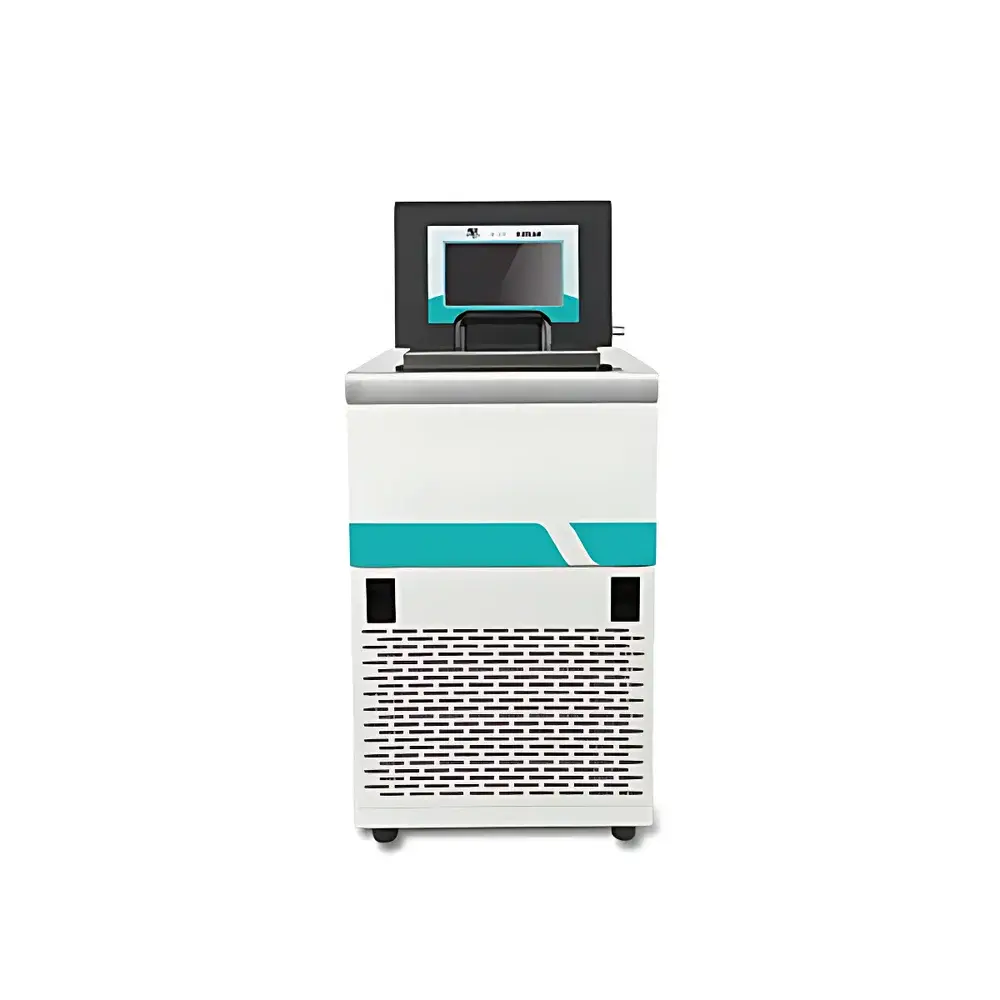
Ningbo Scientz DC-3030 Low-Temperature Circulating Bath (Heating & Cooling)
| Brand | Ningbo Scientz |
|---|---|
| Origin | Zhejiang, China |
| Manufacturer Type | Direct Manufacturer |
| Product Category | Domestic |
| Model | DC-3030 |
| Instrument Type | Constant-Temperature Bath |
| Circulation Mode | Internal & External Circulation |
| Temperature Control | Dual-mode (Heating & Refrigeration) |
| Bath Chamber Dimensions | 440 × 325 × 200 mm (L×W×H) |
| Temperature Range | −30 °C to +100 °C |
| Temperature Stability | ±0.1 °C |
Overview
The Ningbo Scientz DC-3030 Low-Temperature Circulating Bath is a precision-engineered thermal management system designed for laboratory-scale temperature control of external equipment and internal sample environments. Operating on the principle of forced liquid circulation with integrated refrigeration and electric heating, the unit maintains a thermally stable, uniform fluid medium—water or silicone oil—within a wide operational range of −30 °C to +100 °C. Its dual-mode thermal regulation leverages a high-efficiency sealed compressor (Secop, Germany) coupled with PID-controlled resistive heating elements, enabling dynamic response to thermal load variations while minimizing overshoot and drift. The bath’s structural design supports both internal immersion applications (e.g., calibration baths, reaction vessels) and external closed-loop cooling/heating of auxiliary instruments—including rotary evaporator condensers, ultrasonic disruptors, jacketed reactors, and semiconductor test fixtures—via its adjustable flow pump and dual-port circulation interface.
Key Features
- High-stability temperature control with ±0.1 °C stability across the full operating range, verified under steady-state conditions per ISO/IEC 17025-compliant thermal validation protocols
- 7-inch capacitive touchscreen interface with ergonomic tilt mounting; displays real-time bath temperature, setpoint, elapsed time, pump status, and alarm history
- Programmable timer function: automatic shutdown upon reaching user-defined duration, supporting unattended overnight operation in GLP-compliant workflows
- Power-loss recovery mode: retains all configuration parameters and allows configurable auto-restart or standby state upon AC restoration
- Variable-speed circulation pump (0–20 L/min, adjustable in 1 L/min increments) compatible with both internal bath homogenization and external loop pressure requirements up to 0.3 MPa
- Integrated safety architecture including compressor overheat protection, current overload cutoff, low-level fluid sensor, and dry-run prevention for pump longevity
- Environmentally compliant refrigerant R-134a (GWP = 1430), selected to meet EU F-Gas Regulation (EU No 517/2014) and China’s HCFC Phase-out Management Plan
Sample Compatibility & Compliance
The DC-3030 accommodates aqueous solutions, glycol-water mixtures, and heat-transfer oils (e.g., silicone oil, mineral oil) within its stainless-steel 440 × 325 × 200 mm chamber (≈28.6 L usable volume). Its corrosion-resistant 304 stainless-steel tank and fluoropolymer-coated internal components ensure compatibility with mildly acidic/basic reagents and organic solvents commonly used in chemical synthesis and analytical sample preparation. The unit conforms to IEC 61010-1:2010 for electrical safety in laboratory equipment and meets CE marking requirements for electromagnetic compatibility (EN 61326-1) and low-voltage directive compliance. It supports traceable temperature calibration using NIST-traceable RTD probes and is routinely deployed in laboratories adhering to ASTM E2877 (Standard Guide for Calibration of Liquid-in-Glass Thermometers) and USP (Temperature Calibration).
Software & Data Management
While the DC-3030 operates as a standalone instrument with embedded microcontroller-based PID logic, it features RS485 communication (Modbus RTU protocol) for integration into centralized lab automation systems. Optional Scientz LabLink software enables remote monitoring of temperature profiles, event logging (including alarms and power cycles), and export of CSV-formatted time-series data for audit trails. All parameter changes, runtime events, and fault codes are timestamped and stored locally for ≥30 days—supporting 21 CFR Part 11-aligned electronic record integrity when paired with validated system configurations and user access controls.
Applications
- Condenser cooling for rotary evaporation systems requiring sub-ambient temperatures (e.g., solvent recovery of volatile organics at −20 °C)
- Thermal stabilization of non-contact ultrasonic homogenizers during cell lysis or nanoparticle dispersion
- Exothermic/endothermic reaction control in jacketed glass reactors (50–500 mL scale)
- Calibration of thermocouples, RTDs, and infrared pyrometers against reference standards
- Temperature-dependent material testing (e.g., viscosity, phase transition, thermal expansion) per ASTM D3418 and ISO 11357
- Stabilization of optical benches, spectrophotometer detectors, and CCD sensors in analytical instrumentation
FAQ
What is the maximum external loop pressure the DC-3030 can sustain?
The built-in circulation pump delivers up to 0.3 MPa (3 bar) static pressure at zero flow; continuous operation under external backpressure >0.15 MPa requires verification of system hydraulic resistance and thermal load balance.
Can the bath operate continuously at −30 °C with a full load of water?
No—water freezes at 0 °C; operation below 0 °C requires use of antifreeze-compatible fluids such as 30% ethylene glycol/water or silicone oil (e.g., Dow Corning PMX-200 series).
Is the temperature display calibrated to NIST-traceable standards?
The factory-calibrated PT100 sensor provides ±0.05 °C accuracy at 25 °C; users may perform field verification using an accredited secondary standard probe per ISO/IEC 17025 procedures.
Does the unit support external temperature feedback control (e.g., from a reactor jacket sensor)?
Not natively—the DC-3030 regulates based on internal bath temperature only; external feedback requires integration via PLC or third-party controller using its analog 0–10 V output signal.
What maintenance intervals are recommended for long-term reliability?
Compressor oil and refrigerant levels require inspection every 24 months; pump impeller and seals should be inspected annually if operated >4,000 hours/year; filter cleaning is recommended quarterly under heavy particulate load conditions.



