
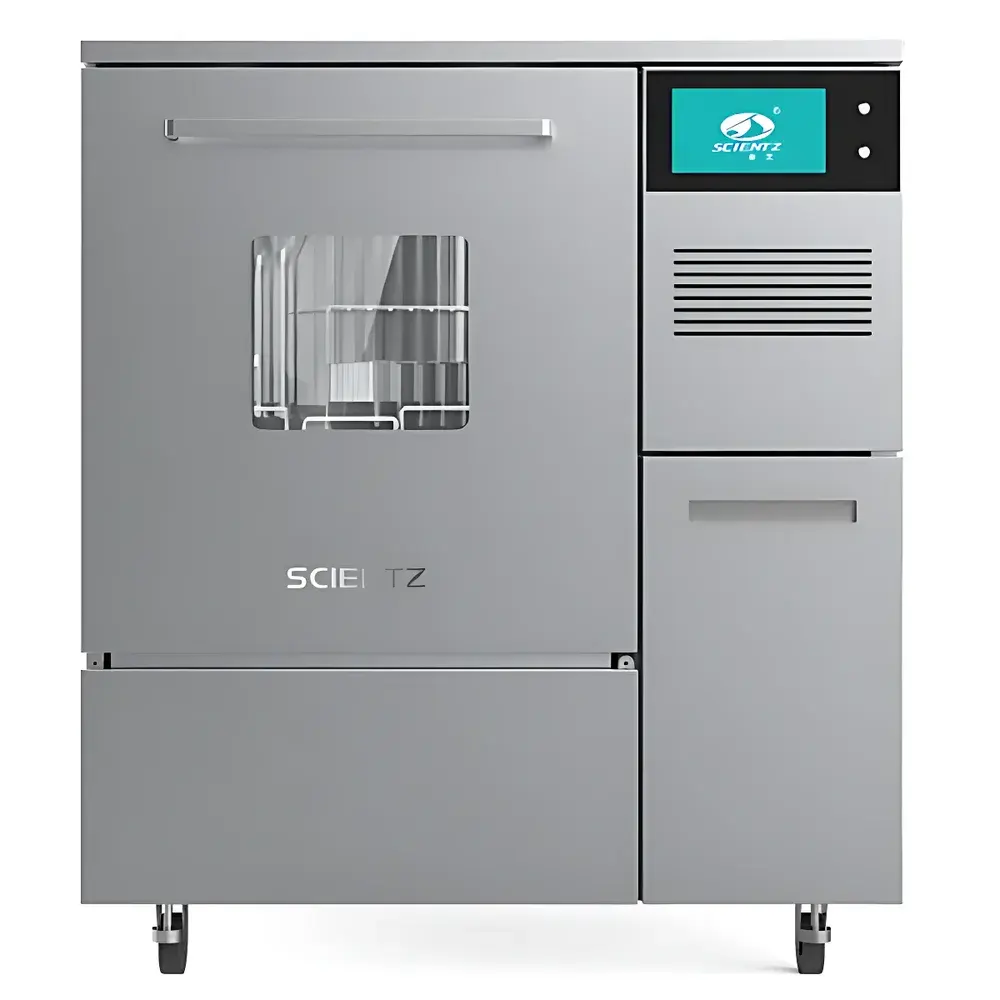
Scientz LGW-200 Laboratory Glassware Washer
| Brand | Scientz |
|---|---|
| Origin | Zhejiang, China |
| Manufacturer Type | Direct Manufacturer |
| Country of Origin | China |
| Model | LGW-200 |
| Chamber Volume | 200 L |
| Heating Power | 4000 W |
| Wash Temperature Range | Ambient to 93 °C |
| Wash Medium | Deionized Water (DI Water) |
| External Dimensions (L×W×D) | 907 × 785 × 958 mm |
Overview
The Scientz LGW-200 Laboratory Glassware Washer is an integrated, fully automated cleaning, disinfection, and drying system engineered for high-reproducibility processing of reusable laboratory glassware—including volumetric flasks, pipettes, culture bottles, reaction vessels, and sample vials. It operates on a closed-loop, recirculating wash principle grounded in mechanical impingement and thermal-chemical synergy: pressurized deionized water—delivered via rotating spray arms and multi-directional nozzles—impinges uniformly across all interior and exterior surfaces at controlled flow rates and temperatures. This ensures removal of organic residues, protein films, particulates, and microbial contaminants through combined hydrodynamic shear, thermal denaturation, and surfactant-assisted emulsification. The system meets the fundamental performance criteria outlined in EN ISO 15883-1 and EN ISO 15883-2 for washer-disinfectors used in laboratory and healthcare settings, supporting validation protocols under GLP and GMP environments.
Key Features
- Stainless steel construction: 304 stainless steel chassis with anti-fingerprint sandblasted finish; seamless, one-piece molded 316L mirror-finish inner chamber with radius-rounded corners to eliminate crevices and prevent biofilm accumulation.
- Self-cleaning chamber design: Automatic internal rinse cycle between runs minimizes carryover risk and simplifies cleaning validation documentation.
- 7.1-inch capacitive LCD touchscreen interface: Real-time display of wash phase, temperature, pressure, fault codes, and user-accessible diagnostics.
- Modular chemical dosing: Drawer-type reagent reservoir with dual peristaltic pumps (standard), expandable to four for precise, programmable delivery of neutralizers, alkaline detergents, or acid rinses.
- Triple-stage filtration: Three-tier stainless steel mesh filter assembly—easily removable and cleanable—retains particulates >50 µm and protects pump and nozzle integrity over extended service life.
- Thermal disinfection capability: Integrated heating system maintains stable 93 °C hold for ≥1 minute, satisfying thermal disinfection requirements per EN ISO 15883-1 Annex A.
- Safety-engineered access: Dual-layer insulated door with HEPA-filtered air intake (99.99% efficiency at 0.3 µm), automatic power cutoff upon forced opening (ESL circuit), and condensate recovery system to prevent ambient humidity rise.
Sample Compatibility & Compliance
The LGW-200 accommodates up to two stacked basket levels with configurable rack geometry: upper level supports vessels up to 170 mm height; lower level accepts vessels up to 470 mm when used independently, or 265 mm when both levels are loaded. Compatible load types include borosilicate glass, polypropylene, and PTFE-lined containers rated for repeated thermal cycling. All materials in contact with wash media comply with USP Class VI and FDA 21 CFR Part 177 standards. The system supports audit-ready operation through three-tier password-protected user roles (Operator, Supervisor, Administrator), with timestamped logs for program execution, parameter changes, alarms, and maintenance events—fully traceable for regulatory review under ISO/IEC 17025, GLP, and FDA 21 CFR Part 11-compliant configurations (when paired with optional USB/WiFi data export modules).
Software & Data Management
Preloaded with 12 customizable wash programs—each editable for soak time, wash/intermediate rinse/drain cycles, temperature ramp profiles, and final hot-air drying duration—the LGW-200 enables method-specific optimization for applications ranging from HPLC vial preparation to bioreactor component decontamination. Firmware includes built-in self-diagnostic routines that identify low-level faults (e.g., fluid level sensor drift, heater resistance deviation, airflow restriction) and display actionable error codes. Optional USB logging provides CSV-formatted records of every cycle—including start/end timestamps, actual vs. setpoint temperatures, pump actuation status, and alarm history—for integration into LIMS or electronic lab notebooks. WiFi-enabled remote configuration allows off-site parameter adjustment without physical access—critical for containment-lab workflows handling hazardous or bioactive substances.
Applications
This washer serves laboratories requiring consistent, validated cleaning outcomes across regulated and non-regulated workflows: environmental testing labs processing soil/water extraction vials; pharmaceutical QC units preparing dissolution test apparatus components; clinical research facilities decontaminating PCR tubes and microcentrifuge rotors; and food safety labs cleaning homogenizer jars and filtration housings. Its ability to deliver repeatable thermal disinfection makes it suitable for pre-sterilization conditioning prior to autoclaving or ethylene oxide treatment. The modular architecture also supports integration into automated lab infrastructure via dry-contact I/O signals for PLC synchronization.
FAQ
Does the LGW-200 meet international washer-disinfector standards?
Yes—it complies with EN ISO 15883-1 and EN ISO 15883-2 for performance, safety, and thermal disinfection efficacy.
Can the system be validated for GMP use?
Yes—its audit trail functionality, password-controlled access, and deterministic thermal profiles support IQ/OQ/PQ validation per Annex 15 of the EU GMP Guidelines.
What water quality is required for optimal performance?
Deionized water (resistivity ≥5 MΩ·cm) is recommended; dual-inlet capability allows separate connection to DI water and municipal supply for preliminary rinse stages.
Is HEPA filtration mandatory for the drying phase?
Standard configuration includes HEPA filtration with real-time clogging alert; bypass is not supported to maintain ISO Class 5 air quality during drying.
How often must the stainless-steel filters be cleaned?
Filters should be inspected after each cycle and cleaned manually when visible particulate accumulation occurs—typically every 5–10 cycles depending on soil load.



