
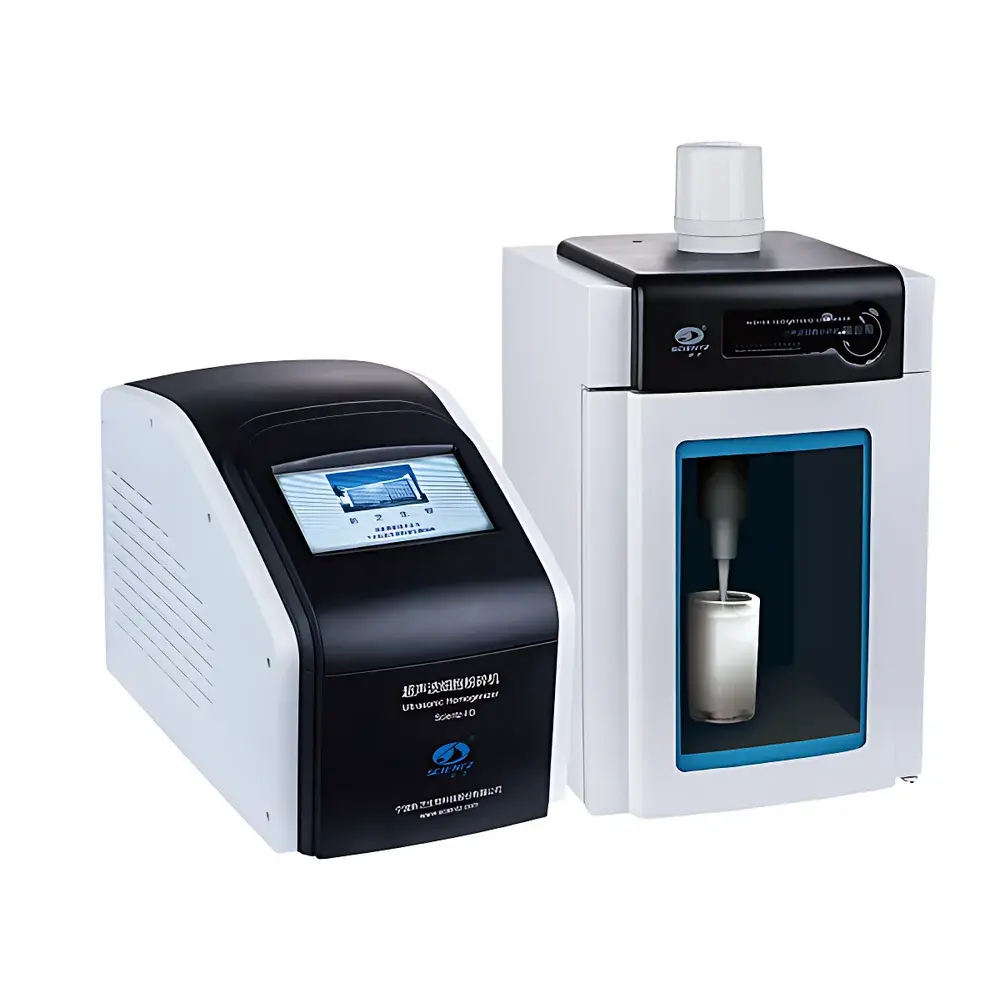
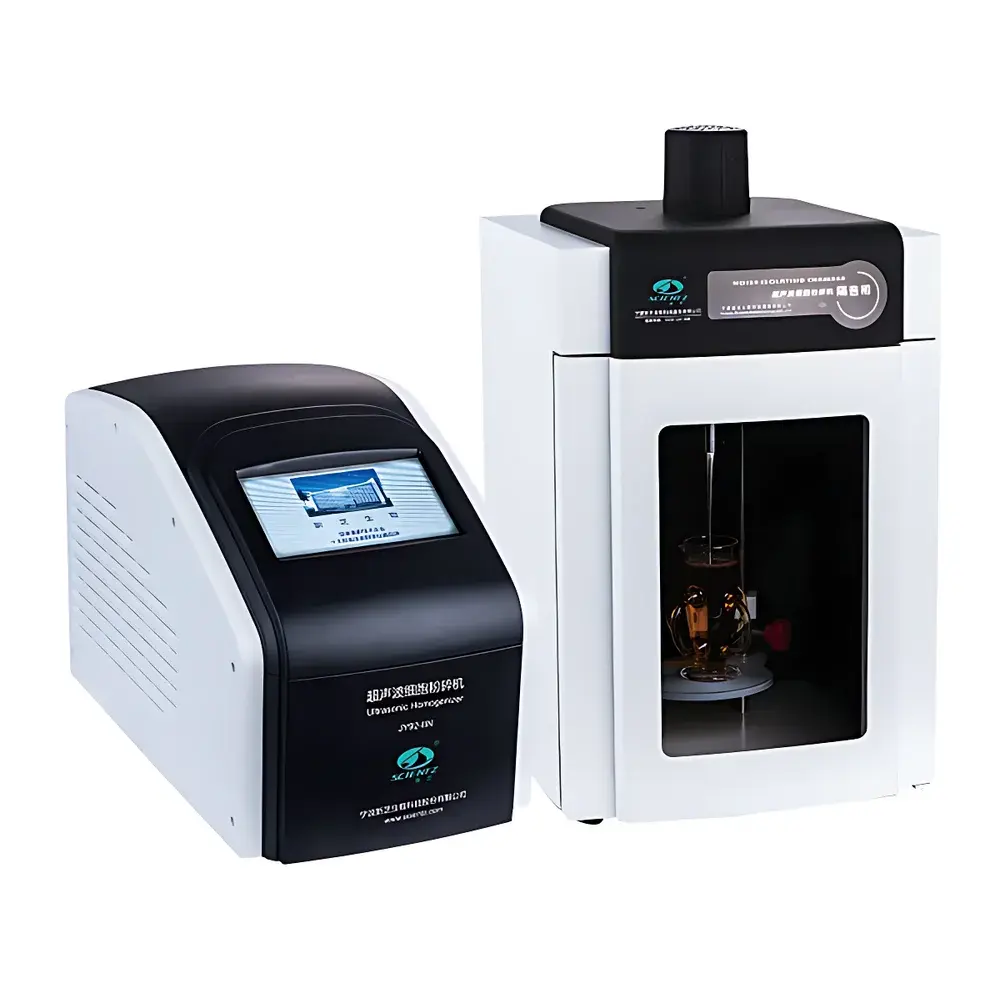
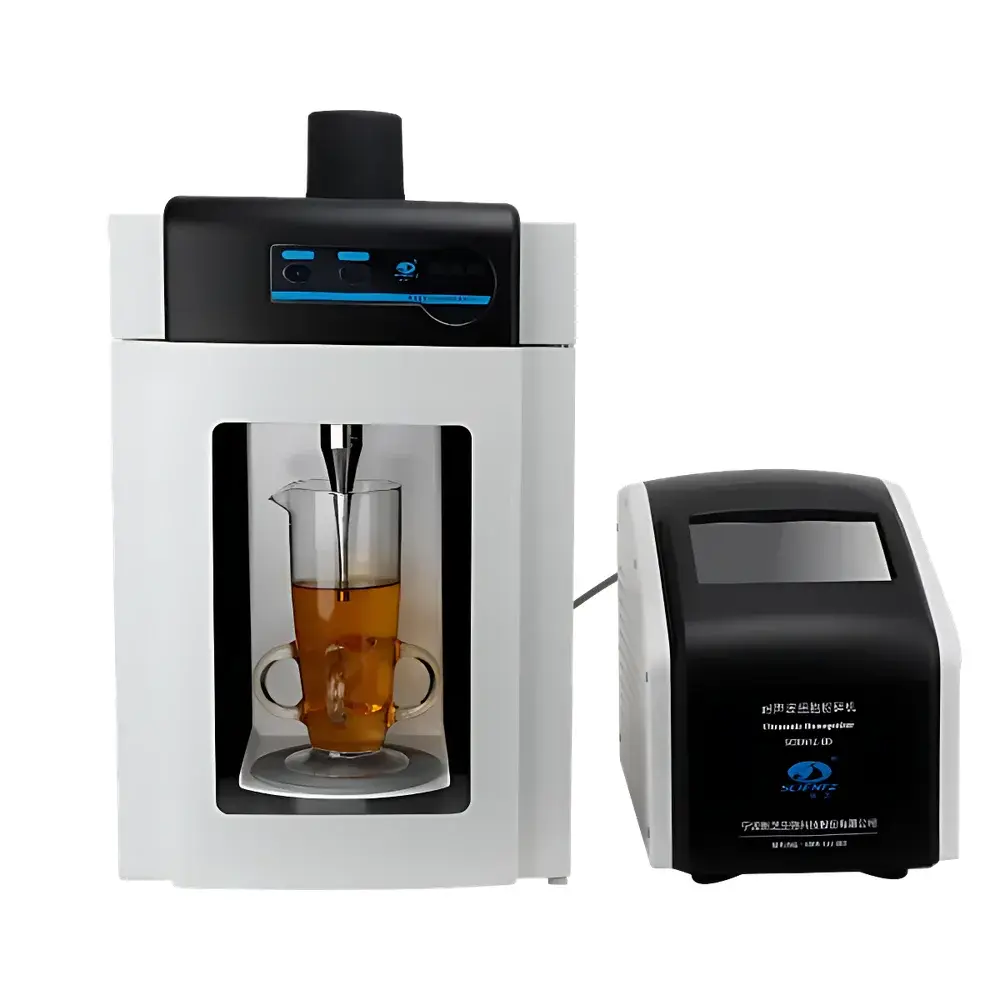
Scientz JY92-IIDN Ultrasonic Cell Disruptor
| Brand | Scientz |
|---|---|
| Origin | Zhejiang, China |
| Manufacturer Type | Direct Manufacturer |
| Instrument Type | Ultrasonic Cell Disruptor |
| Ultrasonic Power | 900 W (adjustable from 1% to 99%) |
| Operating Frequency | 20–25 kHz |
| Temperature Control Range | 0–99 °C |
| Sample Volume Capacity | 0.5–600 mL |
| Sample Throughput | Single-sample processing |
| Transducer Material | Titanium Alloy |
Overview
The Scientz JY92-IIDN Ultrasonic Cell Disruptor is a laboratory-grade ultrasonic processor engineered for controlled mechanical lysis of biological samples through acoustic cavitation. It operates on the principle of high-intensity ultrasonic energy transmission—generated by a piezoelectric titanium alloy transducer—converted into longitudinal mechanical vibrations via a tapered horn (sonotrode). These vibrations propagate into the liquid medium, inducing transient microcavities that collapse violently (inertial cavitation), generating localized shockwaves, microstreaming, and shear forces exceeding 10⁴ Pa. This physical disruption mechanism enables efficient, non-thermal lysis of eukaryotic cells, prokaryotes (including Gram-positive bacteria), yeast, spores, and subcellular organelles—without enzymatic or chemical additives. Designed for reproducible sample preparation in regulated research environments, the JY92-IIDN supports both continuous and pulsed ultrasonication modes, with real-time temperature monitoring to mitigate thermal degradation of heat-labile biomolecules such as nucleic acids and native proteins.
Key Features
- Titanium alloy transducer and sonotrode assembly—optimized for >92% electroacoustic conversion efficiency, extended operational lifespan, and resistance to corrosion under aqueous and mildly aggressive solvents.
- Precise digital control of ultrasonic power (1–99% of 900 W nominal output) and pulse duty cycle (on/off ratio), enabling fine-tuned energy delivery for sensitive applications including chromatin shearing and RNA extraction.
- Integrated Peltier-assisted cooling system with PID-controlled temperature regulation (0–99 °C), allowing active thermal management during prolonged sonication runs—critical for preserving epitope integrity in ChIP-seq workflows.
- Programmable memory for up to 20 user-defined protocols, each storing power level, duration, pulse mode, and temperature setpoint—supporting GLP-compliant documentation and method traceability.
- Dual safety interlocks: automatic shutdown triggered by overtemperature (>99 °C), overcurrent, or transducer overload; visual and audible alerts for fault conditions.
- Modular horn design accommodating interchangeable probes (2–25 mm tip diameter), compatible with microtubes, centrifuge tubes, and custom reaction vessels within the 0.5–600 mL volume range.
Sample Compatibility & Compliance
The JY92-IIDN accommodates diverse biological and material science specimens—including mammalian cell suspensions, bacterial cultures (E. coli, Bacillus spp.), plant tissue homogenates, viral lysates, and nanomaterial dispersions (e.g., carbon nanotubes, rare-earth oxide colloids). Its non-contact sonication capability meets requirements for low-input epigenomic assays (e.g., CUT&Tag, ATAC-seq) where cross-contamination must be avoided. The instrument conforms to IEC 61000-6-3 (EMC emissions) and IEC 61010-1 (safety for laboratory equipment). While not certified for GMP manufacturing, its programmable parameters, audit-ready protocol storage, and temperature logging support alignment with FDA 21 CFR Part 11 expectations for electronic records in preclinical research settings.
Software & Data Management
The embedded firmware provides a tactile membrane keypad interface with LCD status display—no external PC dependency required for routine operation. All parameter inputs, run logs (timestamp, power %, duration, final temperature), and alarm events are stored internally and exportable via USB port in CSV format. Optional RS-232 or Ethernet connectivity enables integration into centralized lab information management systems (LIMS) for automated data archiving. Protocol recall functionality ensures consistent operator-independent execution across shifts—reducing inter-user variability in sample prep reproducibility.
Applications
- Cell lysis for protein extraction, Western blotting, and enzyme activity assays.
- Chromatin fragmentation in ChIP-seq and CUT&RUN workflows—validated for sub-500 bp DNA fragment size distribution.
- Preparation of nanoemulsions and liposomal formulations in pharmaceutical development.
- Dispersion and deagglomeration of inorganic nanoparticles (TiO₂, SiO₂, graphene oxide) for materials characterization.
- Accelerated solvent extraction of phytochemicals from botanical matrices (e.g., flavonoids, alkaloids).
- Mechanical activation of mineral samples (soil, sediment, rock powders) for geochemical analysis.
- Ultrasonic homogenization of dairy and beverage emulsions—applied in food science R&D for stability testing.
FAQ
What is the maximum recommended continuous operating time per cycle?
For optimal transducer longevity and thermal stability, continuous operation should not exceed 5 minutes without a 2-minute cooling interval. Pulsed mode (e.g., 5 s on / 3 s off) permits extended total processing durations.
Is the JY92-IIDN suitable for RNA isolation protocols?
Yes—when operated at ≤30% power with ice-water bath immersion and pulse mode, it minimizes RNase activation and RNA degradation while achieving efficient lysis of fibroblasts and immune cells.
Can this instrument perform indirect (bath-style) sonication?
No—the JY92-IIDN is a probe-type sonicator designed exclusively for direct immersion sonication. For indirect treatment, a separate ultrasonic cleaning bath is required.
Does the system support validation documentation for ISO/IEC 17025 laboratories?
While the unit itself does not include factory-issued calibration certificates, its digital parameter logging, repeatable output, and stable frequency response enable users to establish in-house performance qualification (PQ) protocols aligned with ISO/IEC 17025 clause 5.5.2.
What maintenance is required for long-term reliability?
Monthly inspection of horn tip erosion, annual torque verification of transducer-horn coupling, and biannual replacement of the O-ring seal kit—per Scientz’s preventive maintenance schedule—are recommended to sustain acoustic coupling efficiency and prevent coolant leakage.
Related Products





