
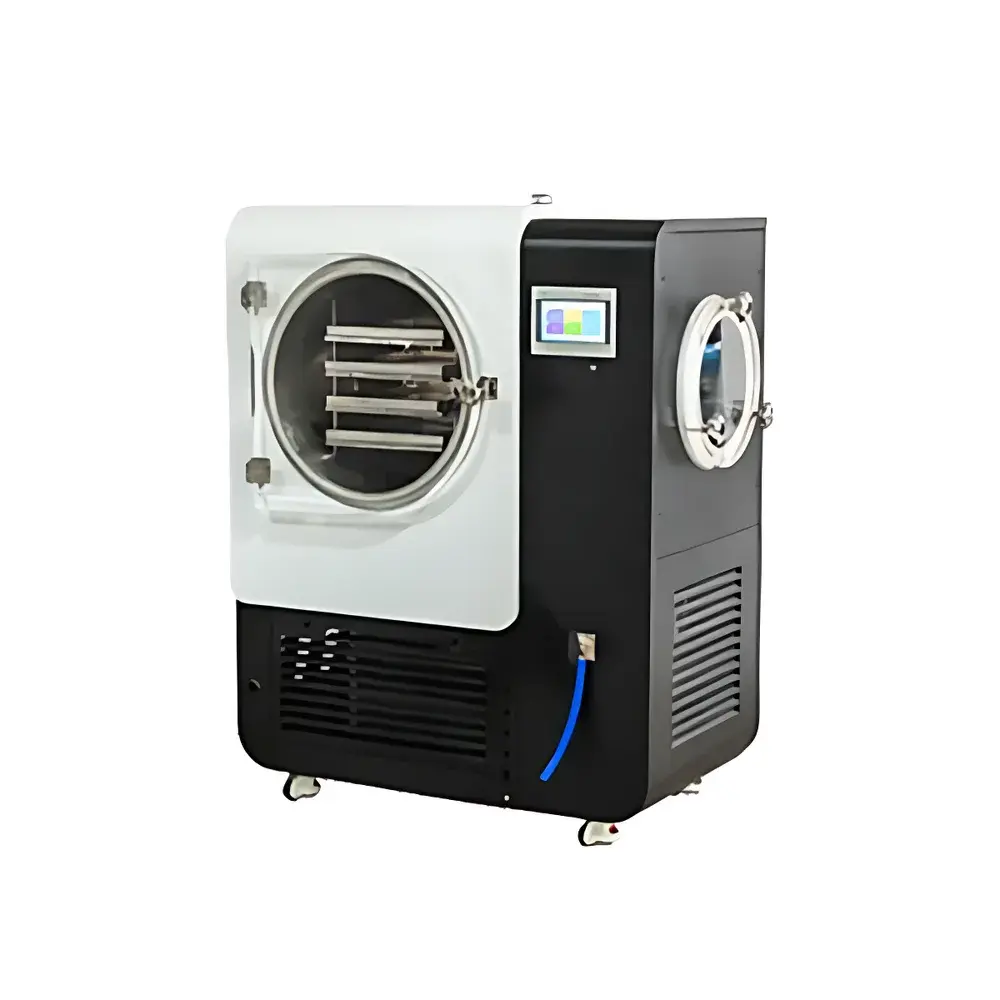
Ningbo Scientz SCIENTZ-50YG/A Benchtop Silicon-Oil Heated Pilot-Scale Freeze Dryer
| Brand | Ningbo Scientz |
|---|---|
| Origin | Zhejiang, China |
| Manufacturer Type | Direct Manufacturer |
| Instrument Type | Standard Shelf-Type Freeze Dryer |
| Application Scope | Pilot-Scale Processing |
| Lyophilization Area | 0.21 m² |
| Ultimate Vacuum (Empty Chamber) | ≤5 Pa |
| Condensate Capacity (24 h) | 4 kg/24 h |
| Cold Trap Temperature (Empty) | ≤−70 °C |
| Dimensions (L×W×H) | 750 × 640 × 1200 mm |
Overview
The Ningbo Scientz SCIENTZ-50YG/A is a pilot-scale, silicon-oil heated, in-situ freeze dryer engineered for precise thermal control and reproducible lyophilization of heat-sensitive biological, pharmaceutical, food, and environmental samples. Unlike conventional electric-heated models, this system employs a closed-loop silicon-oil circulation system to regulate shelf temperature during both freezing and primary/secondary drying stages—enabling accurate ramping, holding, and cooling profiles essential for process development and scale-up validation. Its integrated cold trap and drying chamber architecture minimizes footprint while maintaining structural rigidity and thermal isolation. Designed for laboratories requiring robust, GxP-aligned operational flexibility—notably in method optimization, stability testing, and small-batch production—the SCIENTZ-50YG/A delivers uniform shelf temperature distribution (±3 °C after equilibration), rapid condensation kinetics, and vacuum stability under dynamic load conditions.
Key Features
- Shelf heating via silicon-oil circulation ensures superior temperature uniformity and repeatability across all trays—critical for consistent ice sublimation kinetics and residual moisture control.
- PLC-based control system with color touchscreen interface supports up to 40-segment programmable freeze-drying cycles, including linear and ramp-hold temperature profiles, pressure-controlled drying, and real-time parameter logging.
- Three-tier user permission management (Operator / Technician / Administrator) complies with GLP/GMP documentation requirements and supports audit-ready data integrity.
- Integrated vacuum management logic: vacuum pump activation is gated by cold trap temperature threshold (e.g., pump starts only after trap reaches −60 °C), extending pump service life and reducing oil contamination risk.
- Transparent polycarbonate drying chamber—single-piece injection-molded, corrosion-resistant, and optically clear—enables full visual monitoring of cake formation, collapse events, and drying front progression without compromising seal integrity.
- Real-time data acquisition includes shelf temperature, product temperature (via optional PT100 probes), chamber pressure, cold trap temperature, and silicon-oil loop temperature—all automatically timestamped and exportable via USB to CSV or compatible LIMS platforms.
Sample Compatibility & Compliance
The SCIENTZ-50YG/A accommodates diverse sample formats—including glass vials (10–50 mL), serum bottles, Petri dishes, and custom T-frame configurations—making it suitable for lyophilizing microbial cultures, plant extracts, protein solutions, nucleic acid preparations, soil/sediment slurries, and pharmaceutical intermediates. Its vacuum performance (≤5 Pa) and cold trap capacity (4 kg/24 h at ≤−70 °C) meet ASTM F2338-22 and ISO 22058:2021 benchmarks for pilot-scale freeze dryer qualification. Optional features—including co-located eutectic point measurement module, nitrogen purge port, and vacuum pressure differential valve—support compliance with USP , FDA 21 CFR Part 11 (when paired with validated software), and ICH Q5C stability protocol requirements.
Software & Data Management
The embedded control firmware records all critical process variables at configurable intervals (1–60 s), storing ≥10,000 data points per cycle with automatic backup to internal flash memory. Data export is supported via USB 2.0 to external drives in comma-separated format (.csv), enabling post-processing in MATLAB, Python, or commercial CQV tools. Optional PC-based upper-computer software provides graphical overlay of multiple runs, deviation analysis against reference curves, and PDF report generation with digital signature fields. All logged events—including alarm triggers, manual interventions, and parameter overrides—are time-stamped and retained in an immutable audit trail compliant with ALCOA+ principles.
Applications
- Pharmaceutical R&D: Optimization of lyophilization cycles for monoclonal antibodies, vaccine candidates, and lyo-ready excipient blends.
- Agricultural & Environmental Analysis: Stabilization of soil microbiome samples, pesticide residue standards, and plant tissue homogenates prior to LC-MS/MS quantification.
- Foods & Nutraceuticals: Preservation of probiotic cultures, enzymatic extracts, and thermolabile phytochemicals without Maillard degradation.
- Cultural Heritage Science: Controlled dehydration of water-damaged archival documents and parchment manuscripts using low-temperature, low-pressure protocols.
- Academic Research: Method development for cryopreservation of stem cell monolayers, organoid fragments, and extracellular vesicle isolates.
FAQ
What is the maximum batch size supported by the SCIENTZ-50YG/A?
The unit supports up to 0.21 m² of shelf area, typically accommodating ~1.5–2.0 L of aqueous solution per cycle depending on container geometry and fill depth.
Does the system support validation documentation packages?
Yes—Factory Acceptance Test (FAT) and Installation Qualification (IQ) templates are provided; Operational Qualification (OQ) protocols can be executed using built-in calibration routines and third-party certified sensors.
Can shelf temperature be controlled independently per tray?
No—shelves operate in unified thermal mode via shared silicon-oil manifold; however, temperature uniformity across shelves is maintained within ±3 °C after stabilization.
Is remote monitoring supported out of the box?
Standard configuration includes local HMI only; optional Ethernet/WiFi modules enable secure web-based status viewing and alarm notification via SNMP or MQTT.
What refrigerant is used in the compressor system?
The unit employs R404A or R290 (propane) refrigerant depending on regional regulatory alignment, with dual-stage cascade option available for −80 °C cold trap operation.



