
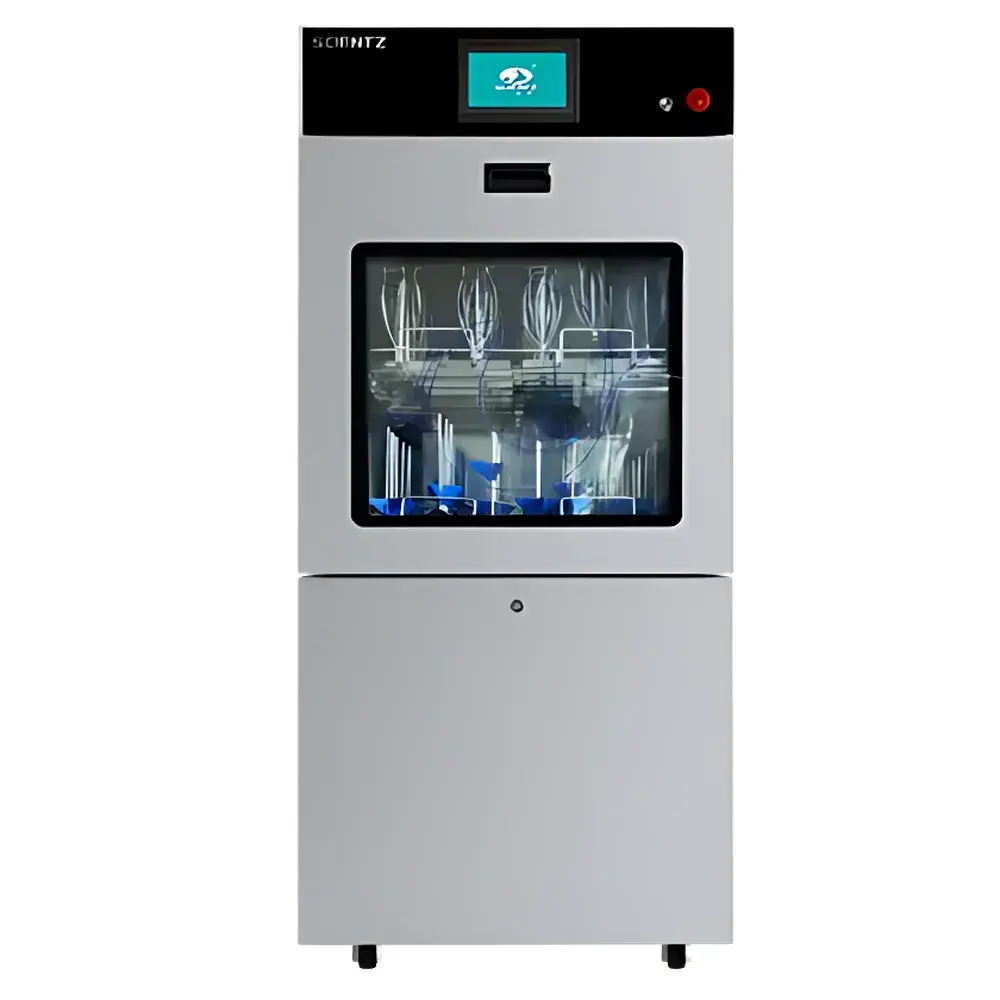
Scientz LGW-300 Laboratory Glassware Washer
| Brand | Scientz |
|---|---|
| Origin | Zhejiang, China |
| Manufacturer Type | Direct Manufacturer |
| Country of Origin | China |
| Model | LGW-300 |
| Chamber Volume | 396 L |
| Heating Power | 6 kW |
| Temperature Range | Ambient to 95 °C |
| External Dimensions (L×W×D) | 710 × 933 × 1665 mm |
Overview
The Scientz LGW-300 Laboratory Glassware Washer is an integrated, fully automated cleaning, disinfection, and drying system engineered for high-reproducibility processing of laboratory glassware in regulated environments. It operates on the principle of dynamic spray-based cleaning using pressurized aqueous solutions—typically deionized water, softened water, or purified water—combined with validated alkaline or neutral enzymatic detergents. Under controlled thermal conditions (up to 95 °C), the system delivers thermally assisted chemical degradation of organic residues, protein films, and particulate contaminants via targeted mechanical impingement from rotating spray arms and fixed multi-angle nozzles. This dual-action mechanism—combining hydrodynamic shear stress and temperature-enhanced detergent kinetics—ensures compliance with cleaning validation requirements outlined in ISO 15883-1/2, EN 15883-1, and FDA-relevant guidance for reusable labware in GxP settings. Designed for continuous operation in QC labs, biopharmaceutical cleanrooms, environmental testing facilities, and food safety laboratories, the LGW-300 replaces manual washing with a deterministic, auditable, and repeatable process.
Key Features
- Chamber constructed from seamless, mirror-finish 316L stainless steel with radius-rounded corners to eliminate crevices, prevent microbial harborage, and support routine cleaning verification (e.g., ATP swabbing or residue testing).
- Exterior housing fabricated from fingerprint-resistant 304 stainless steel with double-insulated door assembly—reducing surface temperature rise and acoustic emissions to ≤50 dB(A) during operation.
- 10.1-inch capacitive LCD touchscreen interface with intuitive icon-driven navigation, real-time display of cycle phase, fluid temperatures (via PT100 sensors), pressure status, and fault diagnostics.
- Triple-tiered permission architecture (operator, supervisor, administrator) enabling role-based parameter access control and full audit trail generation per 21 CFR Part 11 requirements.
- Dual independent peristaltic dosing pumps (standard); expandable to four for precise, programmable delivery of detergent, rinse aid, and neutralizing agents across multiple wash and rinse stages.
- Integrated HEPA filtration (99.99% @ 0.3 µm) on the drying air intake path, with real-time filter saturation monitoring and visual alert on the main display.
- Steam condenser module prevents unfiltered humid exhaust from entering the lab environment—critical for HVAC load management and indoor air quality compliance.
Sample Compatibility & Compliance
The LGW-300 accommodates standard laboratory glassware—including volumetric flasks, Erlenmeyer flasks, beakers, test tubes, pipettes, sample vials, and chromatography columns—via modular, interchangeable basket racks (three-tier configuration standard). All internal wetted surfaces meet USP Class VI biocompatibility standards. The system supports validation protocols aligned with ISO 13485, ISO 9001, and Annex 11 for computerized system qualification. Thermal disinfection cycles at ≥93 °C for ≥5 minutes satisfy EN ISO 15883-1/2 requirements for low-level disinfection of non-critical devices. Optional pure water module enables final rinse conductivity ≤0.1 µS/cm, minimizing ionic residue carryover for trace analysis applications.
Software & Data Management
The embedded control software provides up to 100 user-definable programs with adjustable parameters including pre-wash duration, main wash temperature/duration, number of intermediate rinses, final rinse conductivity threshold, drying time/temperature profile, and pump flow modulation via variable-frequency drive. Cycle logs—including timestamps, operator ID, program name, critical setpoints, actual measured values (water temp, chamber temp, inlet pressure), and alarm history—are stored internally and exportable via USB 2.0 port in CSV format. Optional thermal printer module generates hard-copy cycle reports compliant with GLP documentation standards. All data changes are timestamped and attributed, satisfying ALCOA+ principles for data integrity.
Applications
This washer serves laboratories requiring consistent, validated cleaning outcomes across diverse workflows: environmental testing labs processing soil/water samples; biopharmaceutical QA/QC units handling HPLC vials and cell culture flasks; clinical research centers managing diagnostic reagent containers; and food safety labs preparing microbiological petri dishes and homogenization bottles. Its programmability supports method transfer between instruments, while its closed-loop design minimizes exposure to hazardous solvents or aerosolized bioaerosols—enhancing occupational health and safety.
FAQ
What types of detergents are compatible with the LGW-300?
The system is validated for use with low-foaming, residue-free alkaline and enzymatic detergents meeting ASTM D5127 and ISO 15883-5 specifications. Neutral pH formulations are recommended for sensitive optics or coated glassware.
Can the LGW-300 be integrated into a facility’s central hot water supply?
Yes—dual water inlets accept both cold and pre-heated feed (≤95 °C), allowing direct connection to building hot water loops when local utility constraints require reduced electrical heating demand.
Is IQ/OQ/PQ documentation available?
Scientz provides standardized Installation Qualification (IQ) and Operational Qualification (OQ) templates. Performance Qualification (PQ) protocols must be developed by the end user in accordance with their specific load configurations and acceptance criteria.
How often does the triple-layer stainless steel filter require maintenance?
Under typical usage (2–3 cycles/day), visual inspection is recommended after each cycle; full cleaning is advised weekly. Filter replacement intervals depend on soil load but generally exceed 12 months under normal operating conditions.
Does the system support remote monitoring or network connectivity?
The base configuration includes USB data export only. Ethernet or RS485 interfaces are available as factory-installed options for integration into centralized lab monitoring systems (e.g., LabVantage, Siemens Desigo).



