
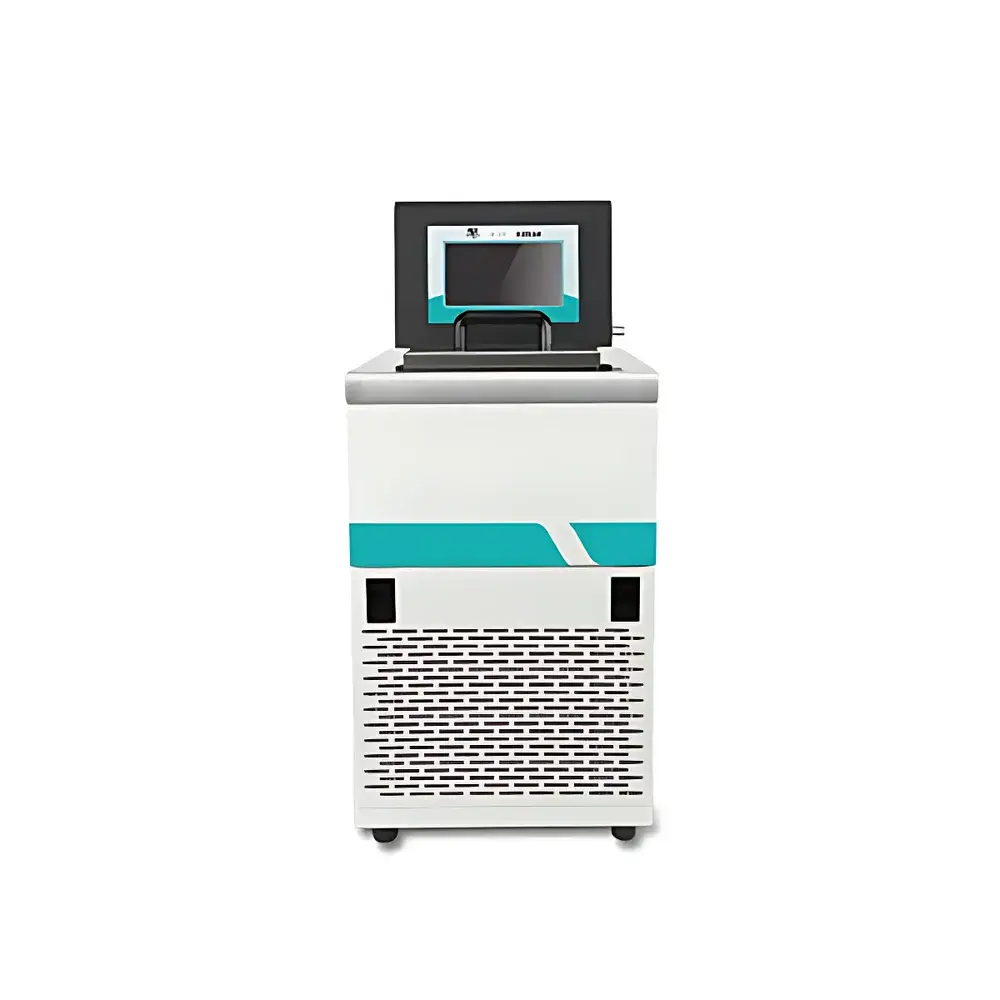
Scientz GDH-2030 High-Precision Low-Temperature Circulating Bath (Heating & Cooling)
| Brand | Scientz |
|---|---|
| Origin | Zhejiang, China |
| Manufacturer Type | Direct Manufacturer |
| Country of Origin | China |
| Model | GDH-2030 |
| Instrument Type | Circulating Temperature Bath |
| Circulation Mode | Internal & External Dual Circulation |
| Temperature Control | Heating & Refrigeration Combined |
| Bath Dimensions (L×W×H) | 440 × 325 × 200 mm |
| Temperature Range | −20 °C to +100 °C |
| Temperature Stability | ±0.005 °C to ±0.02 °C |
| Compressor | Secop (Germany) Hermetic Scroll Compressor |
| Refrigerant | R-134a (ODP = 0, GWP = 1430) |
| Control System | Microprocessor-Based PID Algorithm with Digital Display |
| Safety Protections | Compressor Overheat & Overload Protection, Low-Level Fluid Alarm, Dry-Run Prevention |
| Timer Function | Programmable Operating Duration with Auto-Shutdown |
| Power Recovery | Parameter Retention After Power Interruption |
| Pump Flow Rate | Adjustable (0–20 L/min), Max Head: 8 m |
| External Load Compatibility | Compatible with External Systems via Dual-Port Fluid Interface |
Overview
The Scientz GDH-2030 is a high-precision, dual-mode circulating bath engineered for laboratory environments requiring stringent thermal control across a broad operational range (−20 °C to +100 °C). It operates on the principle of forced convection heat transfer, utilizing a closed-loop fluid circulation system to maintain uniform temperature distribution within its stainless-steel reservoir and, optionally, external devices connected via its dual-port interface. The unit integrates a Secop (Germany)-sourced hermetic scroll compressor, optimized for low acoustic emission (<45 dB(A)) and long-term reliability under continuous operation. Its refrigeration circuit employs R-134a — a zero-ozone-depletion-potential (ODP = 0) hydrofluorocarbon refrigerant compliant with current EU F-Gas Regulation (EU No. 517/2014) and widely accepted in ISO 17025-accredited calibration laboratories. Temperature regulation is achieved through a microprocessor-driven PID algorithm with adaptive tuning, enabling dynamic compensation for ambient fluctuations, load inertia, and fluid-specific thermal mass characteristics.
Key Features
- High-stability thermal performance: Achieves ±0.005 °C short-term stability (30-min dwell at setpoint) and ±0.02 °C long-term stability (24-hr drift), verified per ASTM E1137/E1137M-22 Annex A2 protocols for liquid-bath temperature uniformity.
- Dual-circulation architecture: Switchable internal recirculation (for bath-only use) and external circulation (for jacketed reactors, viscometers, or spectroscopic cells) with flow rate adjustable from 0 to 20 L/min and head pressure up to 8 meters.
- Intelligent power management: Non-volatile memory retains user-defined setpoints, ramp rates, timer duration, and PID parameters after power loss; automatic restart resumes operation with pre-configured conditions upon re-energization.
- Comprehensive safety system: Includes compressor thermal overload cutoff, low-fluid-level detection with audible/visual alarm, dry-run prevention logic, and overtemperature hardware limiter (independent of main controller).
- Low-noise thermal management: Fully enclosed Secop compressor combined with vibration-dampened mounting and insulated condenser housing ensures acoustic output remains below 45 dB(A) at 1 m distance — critical for shared lab spaces and noise-sensitive applications such as interferometry or low-frequency acoustic measurements.
Sample Compatibility & Compliance
The GDH-2030 is compatible with water, aqueous glycol mixtures (up to 30% v/v ethylene or propylene glycol), silicone oils (up to 100 cSt), and other non-corrosive heat-transfer fluids meeting ASTM D1384 specifications. Its stainless-steel 304 reservoir and fluoropolymer-coated pump wetted parts resist oxidation and chemical degradation. The unit complies with IEC 61010-1:2010 (Safety Requirements for Electrical Equipment for Measurement, Control, and Laboratory Use) and carries CE marking under the EU Machinery Directive 2006/42/EC. For regulated environments, it supports audit-ready operation when paired with optional RS485/Modbus RTU or USB-to-serial interfaces, enabling integration into GLP/GMP workflows with timestamped temperature logging and electronic signature-capable software platforms.
Software & Data Management
While the GDH-2030 operates autonomously via its front-panel interface, optional communication modules enable bidirectional control and data acquisition using Scientz’s proprietary LabLink Pro software (Windows-based). This application supports real-time temperature plotting, multi-point setpoint sequencing, automated ramp/soak profiles, and export of CSV-formatted datasets with millisecond-resolution timestamps. All logged data includes operator ID, instrument serial number, environmental ambient reading (via optional external probe), and checksum-verified integrity flags — satisfying traceability requirements outlined in ISO/IEC 17025:2017 clause 7.7 and FDA 21 CFR Part 11 for electronic records and signatures.
Applications
- Primary and secondary thermometer calibration against NIST-traceable reference standards (e.g., PRTs, thermistors, liquid-in-glass thermometers) per ASTM E74-23 and ISO 17025 Clause 6.5.2.
- Thermal validation of analytical instrumentation: HPLC column ovens, GC injectors, rheometer temperature blocks, and differential scanning calorimeters (DSC).
- Material property testing: Coefficient of thermal expansion (CTE) determination, viscosity-temperature profiling (ASTM D445), and phase-transition analysis of polymers and pharmaceutical excipients.
- Biological sample conditioning: Precise thermal equilibration of cell culture media, enzyme reaction buffers, and cryopreservation solutions prior to assay initiation.
- Industrial QA/QC: Thermal stability verification of sensors, transducers, and embedded electronics under accelerated aging protocols (e.g., JEDEC JESD22-A108F).
FAQ
What is the maximum allowable fluid viscosity for external circulation?
The GDH-2030 supports external circulation of fluids with kinematic viscosity up to 100 cSt at operating temperature. For viscosities exceeding 50 cSt, flow rate should be reduced to ≤10 L/min to maintain stable pressure head and avoid cavitation.
Does the unit support remote start/stop via digital I/O?
Yes — optional digital I/O module (Part No. GDH-IO-01) provides TTL-level trigger inputs for start/stop/pause, along with relay outputs for status signaling (e.g., “temp stable”, “alarm active”).
Can the bath be used with flammable solvents?
No. The GDH-2030 is not rated for use with flammable, explosive, or highly volatile liquids. Only non-flammable, non-toxic, and chemically inert heat-transfer media are permitted per IEC 61010-1 Clause 6.4.2.
Is NIST-traceable calibration documentation available?
Factory calibration certificates (with uncertainty budgets per GUM) are provided with each unit. Optional on-site or third-party calibration services conforming to ISO/IEC 17025 are available upon request.
How often does the refrigerant require servicing?
R-134a is sealed for life in the GDH-2030’s welded refrigeration circuit. Under normal operation and proper maintenance (clean condenser coils, adequate ventilation), no scheduled refrigerant recharge is required for ≥10 years.



