
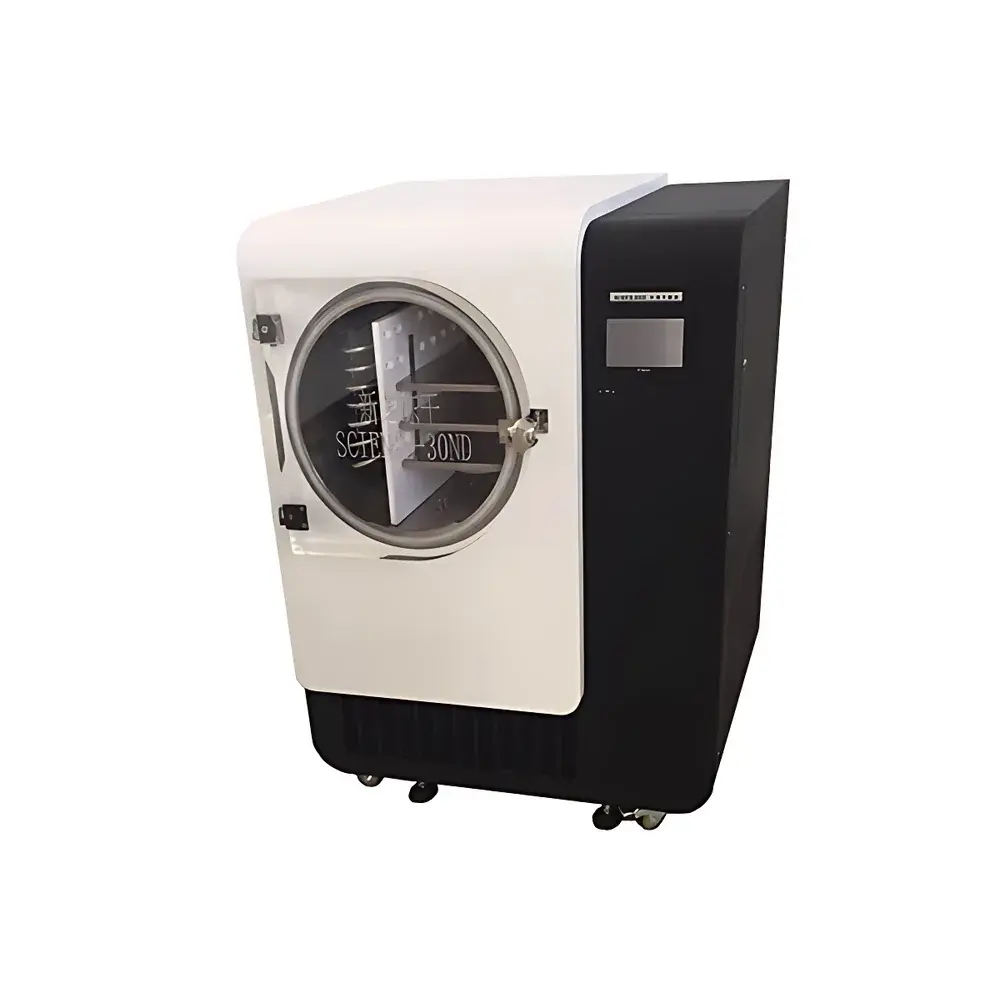
Scientz SCIENTZ-10YD/A In-Situ Electrically Heated Pilot-Scale Freeze Dryer
| [Brand | Scientz |
|---|---|
| Origin | Zhejiang, China |
| Manufacturer Type | Direct Manufacturer |
| Instrument Type | Shelf-Type Freeze Dryer |
| Application Scale | Pilot-Scale |
| Lyophilization Area | 0.2 m² |
| Ultimate Vacuum (Empty) | ≤5 Pa |
| Condensate Capacity | 3 kg/24 h |
| Cold Trap Temperature (Empty) | ≤−56 °C |
| Overall Dimensions (L×W×H) | 750 × 640 × 1200 mm |
| Shelf Temperature Range (Empty) | −50 to +60 °C |
| Shelf Dimensions | 430 × 240 mm |
| Shelf Spacing | 70 mm |
| Number of Shelves | 2 |
| Power Consumption | 1.7 kW (220 V) |
| Ambient Temperature Limit | ≤25 °C |
| Net Weight | 164 kg |
| Drainage Function | Automatic |
| Electrical Defrost | Optional] |
Overview
The Scientz SCIENTZ-10YD/A is an in-situ electrically heated pilot-scale freeze dryer engineered for reproducible, scalable lyophilization process development under controlled laboratory and pre-production conditions. It operates on the fundamental principles of sublimation-based drying: frozen aqueous samples are subjected to low-pressure vacuum environments while heat is precisely applied via electrically heated shelves—enabling direct, uniform energy transfer to the product without reliance on conduction through chamber walls or external heating jackets. This architecture eliminates manual tray transfer, reduces contamination risk, and supports systematic optimization of critical process parameters including shelf temperature ramping, primary drying duration, and secondary drying endpoint determination. Designed for translational research between benchtop feasibility studies and commercial manufacturing, the SCIENTZ-10YD/A bridges the gap between analytical-scale lyophilizers and industrial GMP-compliant systems—making it particularly suitable for formulation development, stability testing, and small-batch production in pharmaceutical, biotechnology, and academic settings.
Key Features
- Electrically heated shelves with PID-controlled temperature regulation (−50 to +60 °C, ±0.5 °C accuracy), enabling precise thermal profiling across up to 40 user-defined segments per cycle.
- High-efficiency dual-stage refrigeration system utilizing a Tecumseh (France) compressor, achieving cold trap temperatures ≤−56 °C (empty) and sustaining ≤5 Pa ultimate vacuum for efficient water vapor removal.
- 7-inch full-color touchscreen HMI integrated with industrial-grade PLC controller; supports real-time graphical monitoring of shelf temperature, chamber pressure, condenser temperature, and drying progress curves.
- Automatic data logging with timestamped storage of all operational parameters; historical cycles exportable via USB drive for offline analysis using compatible PC-based software.
- Transparent acrylic chamber door for continuous visual observation of ice morphology, cake structure formation, and potential collapse events during drying.
- Modular utility interface with standardized external ports (ISO-KF, NW25) for rapid integration of optional vacuum pumps, inert gas manifolds, or process sensors.
- Dual-mode operation—fully automated sequence control or manual override—provides flexibility during method scouting and troubleshooting.
- Multi-level access control (operator, engineer, administrator) ensures procedural integrity and audit readiness in regulated environments.
Sample Compatibility & Compliance
The SCIENTZ-10YD/A accommodates vial-based, bulk solution, and tray-loaded formats. Standard configuration includes eight universal neck freeze-drying flasks (Φ12–22 mm), supporting common pharmaceutical vial sizes (e.g., 2R–20R). Maximum loading capacity: 1300 × Φ12 mm vials, 770 × Φ16 mm vials, or 2 L of bulk solution per batch. The system meets foundational design requirements aligned with ISO 22042 (freeze-drying equipment performance specification) and supports adherence to ICH Q5C (stability testing of biotechnological products) and USP (lyophilization of sterile products). Optional co-located eutectic point measurement functionality assists in establishing optimal primary drying shelf temperatures—critical for maintaining protein conformational integrity and minimizing residual moisture content (<1.5% w/w typical). Vacuum regulation mode enhances heat transfer efficiency during sublimation, improving batch uniformity and reducing cycle time variability.
Software & Data Management
Embedded firmware records all critical process variables—including shelf setpoint vs. actual, chamber pressure, condenser temperature, and elapsed time—at configurable intervals (1–60 s). Data files conform to CSV format and include metadata headers compliant with ALCOA+ principles (Attributable, Legible, Contemporaneous, Original, Accurate, Complete, Consistent, Enduring, Available). USB export enables post-processing in third-party tools (e.g., MATLAB, Python Pandas, or commercial PAT platforms). Optional software add-ons provide advanced analytics such as drying rate calculation, endpoint prediction via pressure rise test (PRT), and comparative overlay of multiple lyophilization cycles. For regulated users, the system supports 21 CFR Part 11-compliant electronic signatures when paired with validated external authentication modules.
Applications
- Development and optimization of lyophilization cycles for monoclonal antibodies, vaccines, and recombinant proteins.
- Stability studies under ICH Q1A–Q1E guidelines, including accelerated and long-term storage condition simulation.
- Pre-formulation screening of cryoprotectants and bulking agents using controlled nucleation and annealing protocols.
- Production of reference standards, diagnostic reagents, and cell therapy intermediates requiring low-residual-moisture solid dosage forms.
- Academic research in food science (e.g., probiotic preservation), material science (aerogel synthesis), and environmental microbiology (culture bank maintenance).
FAQ
What is the maximum batch size supported by the SCIENTZ-10YD/A?
The unit supports up to 2 L of bulk solution or approximately 1300 standard 2R vials per cycle, based on its 0.2 m² shelf area and dual-shelf configuration.
Does the system support automatic pressure control during drying?
Yes—optional vacuum regulation mode maintains dynamic setpoints during primary drying, optimizing mass transfer and minimizing product collapse risk.
Can the freeze dryer be integrated into a cleanroom environment?
The compact footprint (750 × 640 × 1200 mm), sealed refrigeration circuit, and absence of oil-lubricated internal components make it suitable for ISO Class 7–8 environments when installed with appropriate HVAC and utility interfaces.
Is validation documentation available for GMP use?
While the base system is not supplied with IQ/OQ/PQ protocols, comprehensive technical specifications, electrical schematics, and FAT/SAT templates are provided to support customer-led qualification activities in accordance with Annex 15 and ASTM E2500.
What vacuum pump options are compatible?
The unit features standard NW25/KF25 flanges and is validated with Edwards RV8, Leybold TRIVAC D, or Pfeiffer DuoLine series pumps; dry scroll and hybrid turbomolecular configurations may be qualified upon request.



