
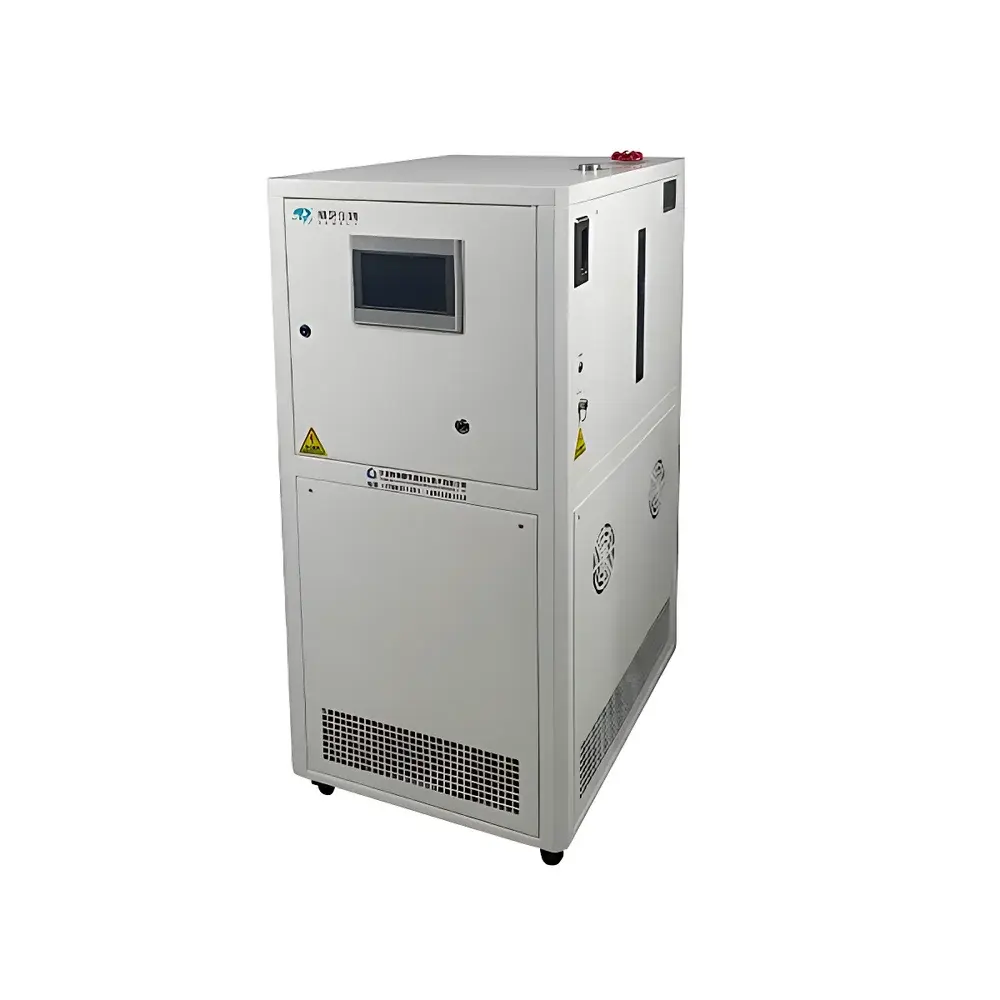
Scientz L6-10 Series Cryogenic & High-Temperature Circulating Temperature Control System (−120 °C to +70 °C)
| Brand | Scientz |
|---|---|
| Origin | Zhejiang, China |
| Manufacturer Type | Direct Manufacturer |
| Country of Origin | China |
| Model | L6-10 Series |
| Temperature Range | −120 °C to +70 °C |
| Temperature Accuracy | ±0.5 °C (heat transfer medium), ±1.0 °C (process material) |
| Control Algorithm | PID-based fuzzy logic control |
| Communication Protocol | MODBUS RTU over RS-485 |
| Display | 7-inch color touchscreen with real-time temperature curve plotting and logging |
| Programmability | Up to 5 multi-step programs, each with up to 30 segments |
| Temperature Feedback Points | Three PT100 sensors — unit internal temperature, outlet fluid temperature, and external process material temperature |
| Safety Protections | Compressor overload protection, high-pressure switch, thermal relay, overtemperature sensor fault detection, low-fluid-level alarm, and integrated self-diagnostic system |
| Fluid Operating Range | −25 °C to +200 °C |
| System Design | Fully sealed closed-loop circulation |
Overview
The Scientz L6-10 Series Circulating Temperature Control System is an engineered solution for precise, stable, and wide-range thermal management in demanding life science, chemical synthesis, and materials testing environments. Designed around a dual-sensor, three-point temperature feedback architecture—monitoring internal unit temperature, circulating fluid outlet temperature, and externally measured process material temperature—the system delivers robust thermal regulation via PID-based fuzzy logic control. Its fully sealed closed-loop design eliminates vapor loss at high temperatures and moisture ingress at cryogenic conditions, ensuring long-term fluid integrity and operational consistency across the full −120 °C to +70 °C operating envelope. Unlike open-bath or single-point controlled units, the L6-10 enables independent selection between medium-outlet and process-material temperature control modes, supporting both jacketed reactor applications and direct microchannel reaction thermal coupling.
Key Features
- Precision thermal regulation with ±0.5 °C accuracy on circulating fluid temperature and ±1.0 °C on process material temperature—validated under steady-state and dynamic ramp conditions.
- 7-inch industrial-grade color touchscreen interface with embedded data logging, real-time temperature curve visualization, and configurable alarm thresholds.
- Multi-stage programmability: up to five independent temperature profiles, each comprising up to 30 definable segments with ramp rate, hold time, and target temperature parameters.
- Integrated MODBUS RTU communication over RS-485 for seamless integration into laboratory automation networks, SCADA systems, and centralized process control platforms.
- Comprehensive safety architecture including compressor overload protection, high-pressure cut-off switches, thermal relays, low-fluid-level detection, and fault-tolerant PT100 sensor diagnostics.
- Stainless-steel-reinforced cold-rolled steel enclosure with electrostatic powder coating for corrosion resistance and mechanical durability in regulated lab and pilot-scale environments.
Sample Compatibility & Compliance
The L6-10 supports compatibility with standard heat transfer fluids—including silicone oils, glycol-water mixtures, and specialized low-temperature synthetic fluids—within its −25 °C to +200 °C fluid operating window. It is routinely deployed in ASTM E2892-compliant reactor temperature validation protocols and meets key requirements for GLP and GMP-aligned process development workflows. The system’s closed-loop construction prevents atmospheric contamination during sub-zero operation and eliminates oil mist generation above 100 °C—critical for ISO 14644-1 Class 5–7 cleanroom-compatible installations. All electrical components comply with IEC 61000-6-3 (EMC emissions) and IEC 61000-6-2 (immunity) standards. While not certified for hazardous area use (e.g., ATEX/IECEx), it is suitable for non-classified laboratory and industrial R&D settings.
Software & Data Management
Data acquisition and traceability are supported through onboard memory capable of storing ≥100 hours of timestamped temperature readings at 1-second resolution. Logged data can be exported via USB to CSV format for post-processing in MATLAB, Python, or LIMS-integrated analytics platforms. The MODBUS RTU interface enables bidirectional parameter setting and real-time telemetry—including setpoint, actual temperatures, alarm status, and pump speed—enabling synchronization with third-party controllers such as PLCs or LabVIEW-based DAQ systems. Audit trails for critical configuration changes (e.g., program edits, setpoint overrides) are retained locally and support FDA 21 CFR Part 11 compliance when paired with validated electronic signature workflows.
Applications
- Chemical Process Development: Precise thermal control for jacketed glass and stainless-steel reactors performing hydrogenation, nitration, sulfonation, and photochemical reactions; supports USP and ASTM D7094 kinetic studies.
- Microreactor Thermal Management: Stable single-fluid temperature delivery to silicon, glass, or metal microchannel devices handling exothermic oxidation, halogenation, or continuous-flow crystallization processes.
- Automotive Component Testing: Environmental stress screening of battery modules, power electronics, and thermal interface materials across −40 °C to +85 °C cycling per ISO 16750-4 and SAE J2380 specifications.
- Biopharmaceutical Process Support: Temperature stabilization of chromatography columns, bioreactor jackets, and ultra-low temperature sample storage interfaces within cGMP-compliant upstream and downstream development labs.
- Materials Characterization: Controlled thermal conditioning of polymer composites, electrolytes, and solid-state battery electrodes prior to DMA, DSC, or impedance spectroscopy analysis.
FAQ
What is the minimum achievable temperature with standard heat transfer fluid?
The system achieves −120 °C using specialized low-temperature synthetic fluid (e.g., Therminol LT); performance at extreme cryogenic ranges requires fluid compatibility verification and optional cold trap configuration.
Can the unit operate continuously at −80 °C?
Yes—continuous operation at −80 °C is supported under ambient conditions ≤25 °C and relative humidity ≤60%, provided adequate ventilation and fluid level maintenance per the operator manual.
Is remote monitoring possible without additional hardware?
Basic remote status monitoring (temperature, alarms, run state) is available via MODBUS RTU; full web-based HMI requires integration with an external gateway or industrial IoT platform.
Does the system support 21 CFR Part 11 compliance out-of-the-box?
The hardware and firmware provide foundational audit trail and electronic signature readiness; full Part 11 compliance requires site-specific validation, role-based access configuration, and integration with a qualified e-signature service.
How is temperature uniformity maintained across multiple reactor vessels?
By configuring the system in master-slave mode (via MODBUS) or using external manifold distribution with individual flow control valves, users can maintain synchronized thermal profiles across parallel reaction setups with ≤±1.5 °C inter-vessel deviation.




