
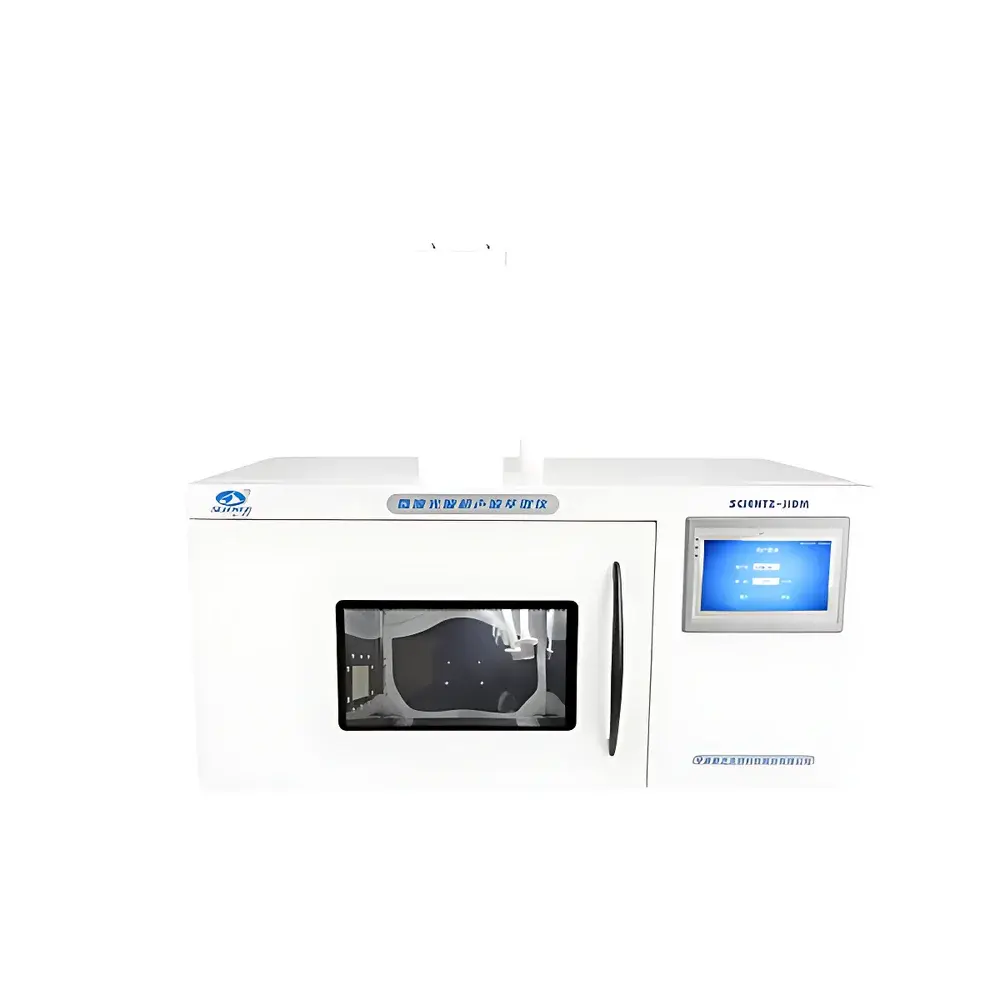
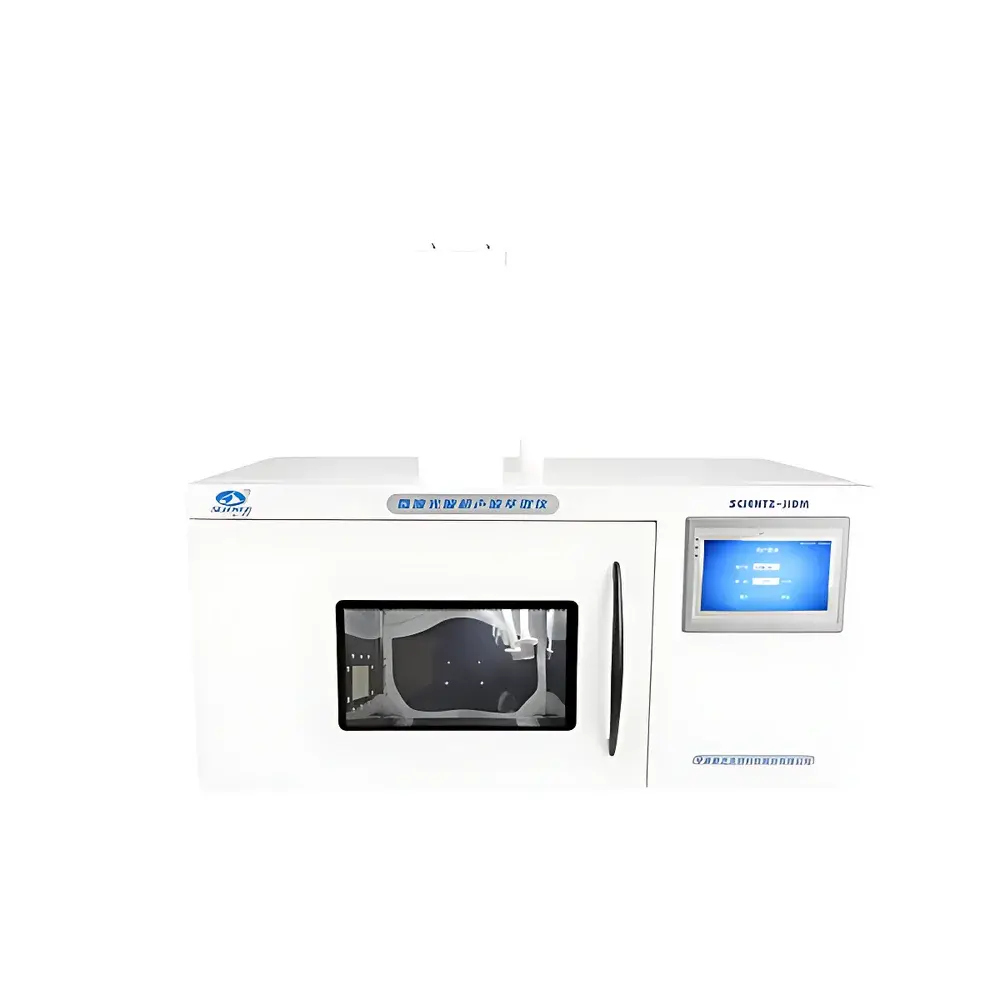
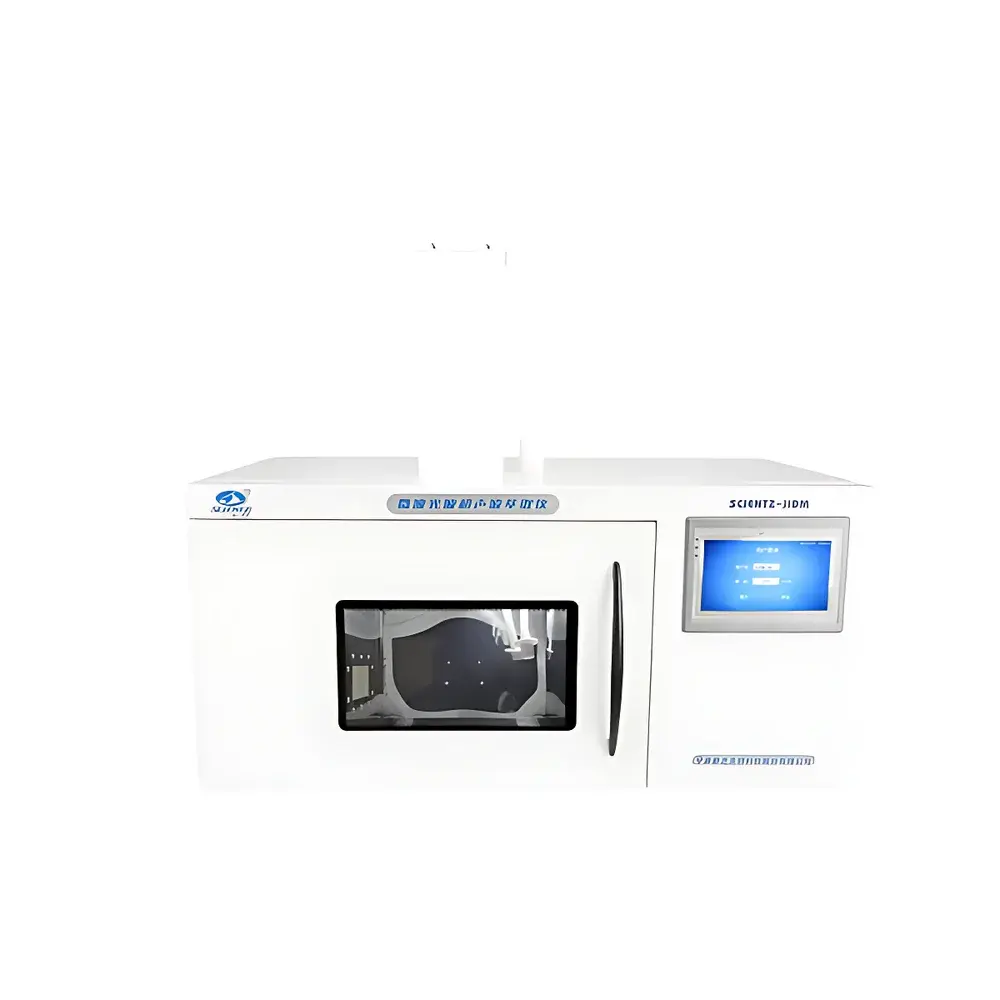
Ningbo Scientz SCIENTZ-IIDM Multi-Mode Microwave-Assisted Extraction System
| Brand | Ningbo Scientz |
|---|---|
| Origin | Zhejiang, China |
| Manufacturer Type | Original Equipment Manufacturer (OEM) |
| Country of Origin | China |
| Model | SCIENTZ-IIDM |
| Microwave Power | 1000 W |
| Microwave Frequency | 2450 MHz |
| Temperature Control Range | Ambient to 300 °C |
| Temperature Control Accuracy | ±1 °C |
| Cavity Material | Stainless Steel Interior |
Overview
The Ningbo Scientz SCIENTZ-IIDM Multi-Mode Microwave-Assisted Extraction System is an integrated laboratory platform engineered for precision-controlled, multi-energy-sample interaction in analytical sample preparation and synthetic chemistry workflows. It operates on three complementary physical energy modalities—microwave irradiation (2450 MHz), high-intensity ultrasonic cavitation (via titanium alloy probe), and infrared radiant heating—each independently or synergistically programmable via a centralized PLC-based control architecture. Unlike single-mode microwave digesters or standalone ultrasonic homogenizers, the SCIENTZ-IIDM enables real-time, parameter-synchronized application of multiple energy sources, facilitating mechanistic studies of reaction kinetics, thermal–mechanical coupling effects, and solvent-free or low-solvent extraction pathways. Its design adheres to fundamental principles of microwave dielectric heating (dipole rotation and ionic conduction), acoustic cavitation physics (transient bubble collapse generating localized hotspots >5000 K and pressures >1000 atm), and near-to-mid infrared absorption (selective vibrational excitation of functional groups). This tri-modal capability supports method development under non-equilibrium, non-thermal, or hybrid thermal activation conditions—critical for preserving thermolabile analytes, enhancing mass transfer in solid–liquid extractions, and accelerating heterogeneous catalytic reactions.
Key Features
- Triple-energy modality integration: Independent or concurrent control of microwave (1000 W, 2450 MHz), ultrasonic (probe-type, frequency-stabilized), and infrared radiant heating (broad-spectrum IR emitter)
- Precision temperature management: PID-controlled monitoring with ±1 °C accuracy across ambient to 300 °C, using embedded Pt100 sensor and real-time feedback loop
- Stainless steel cavity construction: Electropolished 304 stainless steel interior with reinforced waveguide shielding, ensuring long-term corrosion resistance and minimal microwave leakage (<5 mW/cm² at 5 cm, compliant with GB 4706.21 and IEC 60335-2-90)
- Programmable operation: 200 user-definable protocols stored locally; parameters include ramp/hold time, power modulation (% of max), rotational speed (magnetic stirrer), and multi-stage energy sequencing
- Real-time process visualization: Integrated HD camera with LED-lit viewing window and 7-inch capacitive touchscreen interface displaying live video feed alongside dynamic parameter overlays (temperature, power output, elapsed time)
- Dual-level security architecture: Role-based access control with separate operator and administrator password tiers; automatic system lockout upon overtemperature event or sensor fault detection
Sample Compatibility & Compliance
The SCIENTZ-IIDM accommodates a broad range of sample matrices—including plant tissues, soil sediments, polymer composites, metal oxides, and biological fluids—in vessels up to 1000 mL capacity (compatible with quartz, PTFE-lined, and borosilicate glass reactors). Its modular energy delivery supports both open-vessel reflux and sealed-vessel high-pressure extraction configurations. The system meets national safety standards for electromagnetic compatibility (GB/T 18268.1) and domestic microwave radiation limits (GB 10436). While not certified to ISO/IEC 17025 for calibration traceability, its temperature and power control subsystems are validated per internal SOPs aligned with ASTM E2234 (standard practice for microwave-assisted sample preparation) and USP <731> guidelines for thermal validation in extraction processes. Routine operation complies with GLP documentation requirements when paired with external audit-ready data logging software.
Software & Data Management
Control logic resides in an industrial-grade PLC with deterministic real-time scheduling, interfaced via RS-485 and USB 2.0 ports. The embedded HMI allows direct protocol editing, execution, and post-run review—including time-stamped temperature/power curves and video snapshots. Optional PC connectivity enables export of CSV-formatted logs for statistical analysis (e.g., ANOVA of extraction yield vs. power ramp rate) and integration into LIMS environments. Audit trail functionality records all parameter modifications, user logins, and safety interlock triggers—supporting FDA 21 CFR Part 11 compliance when deployed with validated third-party electronic signature modules.
Applications
- Routine sample prep for HPLC/GC-MS analysis: Accelerated extraction of polyphenols, alkaloids, pesticides, and PAHs from botanicals and environmental solids
- Green chemistry synthesis: Solvent-minimized esterifications, Suzuki couplings, and nanoparticle nucleation under controlled thermal–acoustic stress
- Materials science: Rapid digestion of ceramic precursors, graphene oxide exfoliation, and MOF framework activation
- Forensic toxicology: Simultaneous hydrolysis and extraction of conjugated drug metabolites from biological matrices
- Method optimization studies: DOE-driven evaluation of energy coupling effects on extraction efficiency, selectivity, and degradation profiles
FAQ
What vessel types are compatible with the SCIENTZ-IIDM?
Standard configurations support 50–1000 mL quartz, PTFE-coated stainless steel, and borosilicate glass reactors. Custom adapters are available for pressurized vessels rated up to 2 MPa.
Does the system support remote monitoring or networked operation?
Yes—via optional Ethernet module enabling Modbus TCP communication and integration with building-wide SCADA systems or centralized lab automation platforms.
How is ultrasonic energy calibrated and maintained?
Output amplitude is stabilized via impedance-matching circuitry and monitored through real-time current draw feedback; annual verification against reference transducer standards (e.g., NIST-traceable hydrophone) is recommended.
Can the infrared heating mode be used independently of microwave or ultrasound?
Yes—each energy source operates as a discrete channel; users may activate IR-only heating for gentle, uniform thermal treatment without electromagnetic or mechanical perturbation.
Is validation documentation provided for regulatory submissions?
Factory-installed IQ/OQ documentation is available upon request; PQ protocols must be developed in-house per specific application and matrix, consistent with ISO/IEC 17025 clause 7.8.2.
Related Products



