
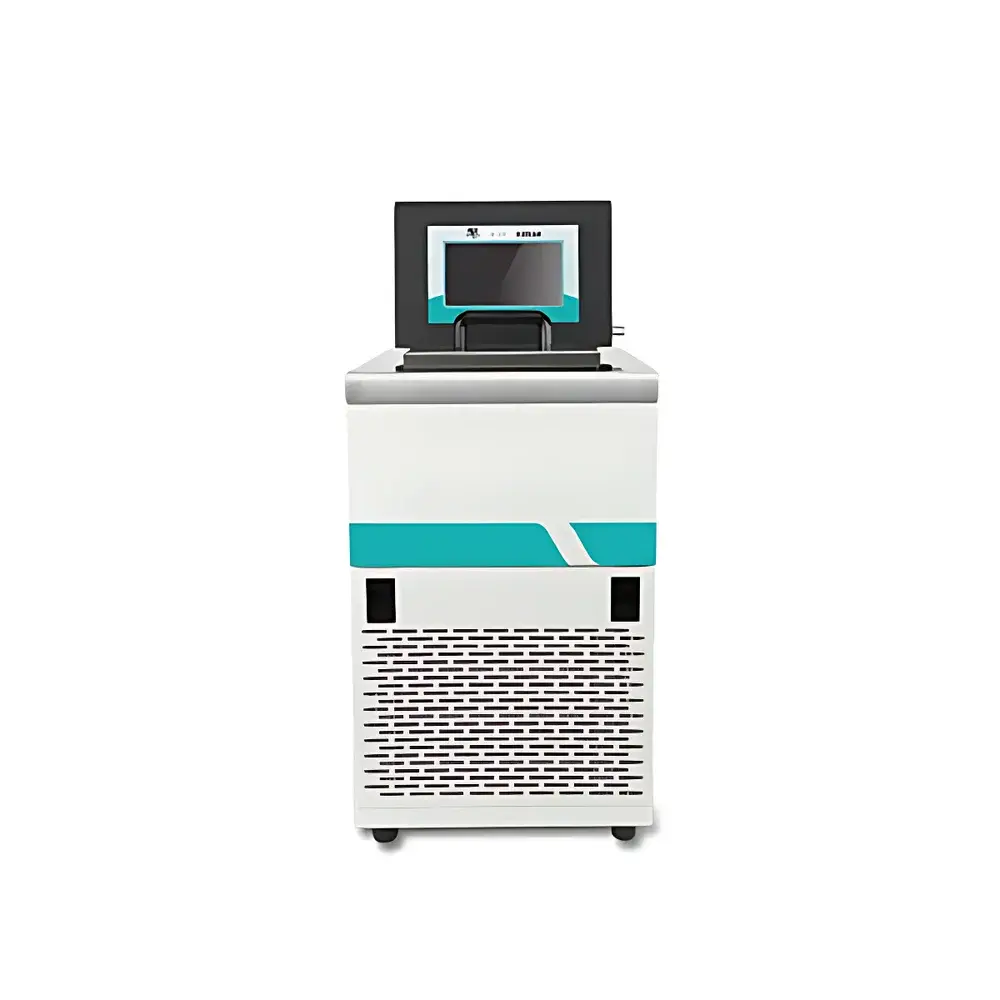
Ningbo Scientz DC-0515 Low-Temperature Constant-Temperature Circulating Bath (Heating & Cooling)
| Brand | Ningbo Scientz |
|---|---|
| Origin | Zhejiang, China |
| Manufacturer Type | Direct Manufacturer |
| Product Category | Domestic |
| Model | DC-0515 |
| Instrument Type | Constant-Temperature Bath |
| Circulation Mode | Internal & External Circulation |
| Temperature Control | Dual-mode (Heating & Refrigeration) |
| Bath Chamber Dimensions (L×W×H) | 300 × 250 × 200 mm |
| Temperature Range | –5 °C to +100 °C |
| Temperature Stability | ±0.05 °C |
| Display | 7-inch Tilted Touchscreen |
| Compressor | Secop (Germany) Hermetic Scroll Compressor |
| Refrigerant | R134a (ODP = 0, GWP = 1430) |
| Pump Flow Rate | Adjustable up to 18 L/min |
| Max. External Load Pressure | 0.2 MPa |
| Safety Protections | Compressor Overheat & Overload Protection, Dry-run Prevention, Overtemperature Alarm |
Overview
The Ningbo Scientz DC-0515 is a precision-engineered dual-function circulating bath designed for laboratory environments requiring stable, programmable thermal control across a wide operational range (–5 °C to +100 °C). It operates on the principle of forced convection heat exchange using a closed-loop liquid circulation system—capable of both active refrigeration and resistive heating—to maintain uniform temperature distribution within its stainless-steel bath chamber (300 × 250 × 200 mm). The unit integrates a high-efficiency Secop (Germany) hermetic scroll compressor with R134a refrigerant—a zero-ozone-depletion-potential (ODP = 0) working fluid compliant with current EU F-Gas Regulation Annex I thresholds—and a microprocessor-based PID controller delivering ±0.05 °C temperature stability under steady-state conditions. Its dual-circulation architecture supports both internal bath homogenization and external temperature regulation of auxiliary equipment such as rotary evaporator condensers, ultrasonic probe systems, jacketed reactors, or semiconductor test fixtures.
Key Features
- High-stability thermal control: Achieves ±0.05 °C temperature uniformity over full operating range; validated per ASTM E1137/E1137M (Standard Specification for Laboratory Thermometers)
- Dual-mode operation: Seamless transition between heating and cooling modes without manual intervention; ramp rates configurable via touchscreen interface
- Intelligent circulation management: Adjustable pump flow (0–18 L/min) with pressure monitoring; selectable internal-only or external-loop mode with quick-connect fittings
- Human-centered HMI: 7-inch capacitive touchscreen with ergonomic tilt design; real-time display of setpoint, actual bath temperature, elapsed time, and system status
- Robust safety architecture: Multi-layer protection including compressor overheat/overload cutoff, low-level fluid detection, dry-run prevention, and programmable overtemperature alarm
- Energy-efficient design: Optimized refrigerant charge and insulated chamber minimize power consumption; idle-mode power draw < 15 W
- Power recovery logic: Configurable auto-restart or standby mode following mains interruption; retains all user-defined parameters in non-volatile memory
Sample Compatibility & Compliance
The DC-0515 accommodates aqueous, ethylene glycol–water mixtures (up to 50 % v/v), silicone oils, and other non-corrosive heat-transfer fluids compatible with 316 stainless steel and EPDM seals. It meets CE marking requirements under Directive 2014/30/EU (EMC) and 2014/35/EU (LVD); refrigerant handling complies with ISO 5149-2:2014 (Refrigerating systems — Safety and environmental requirements). While not certified for use in Class I Div 1 hazardous locations, it is routinely deployed in GLP-compliant laboratories supporting USP , ISO/IEC 17025:2017, and ASTM D341 (viscosity–temperature charts) workflows. Bath volume and thermal mass support reproducible calibration of platinum resistance thermometers (PRTs), RTDs, and thermocouples per ISO/IEC 17025 Clause 6.4.3.
Software & Data Management
The embedded firmware supports time-stamped logging of temperature setpoints, actual bath readings, and alarm events at user-selectable intervals (1 s to 60 min). Data export is available via USB flash drive in CSV format for traceability and audit preparation. Optional RS485 Modbus RTU interface enables integration into centralized lab infrastructure (e.g., LabVantage, Thermo Fisher SampleManager) for automated data capture and 21 CFR Part 11–compliant electronic records—when paired with validated third-party middleware supporting digital signature, audit trail, and role-based access control.
Applications
- Condenser cooling for rotary evaporation systems requiring precise sub-ambient temperatures
- Temperature stabilization of non-contact ultrasonic disintegrators during cell lysis or nanoparticle dispersion
- Thermal control of exothermic/endothermic chemical reactions in jacketed glass reactors
- Cryopreservation and controlled-rate thawing of biological samples in life science workflows
- Calibration of temperature-sensitive sensors used in material testing (e.g., tensile testers, rheometers)
- Thermal cycling validation of electronic components and semiconductor packaging under JEDEC JESD22-A104 conditions
- Viscosity measurement standardization per ASTM D445/D446 using calibrated capillary viscometers
FAQ
What is the maximum external load pressure the DC-0515 can support?
The integrated circulation pump delivers up to 0.2 MPa static pressure at minimum flow, sufficient for most jacketed reactor and condenser applications.
Is the bath chamber compatible with silicone oil?
Yes—provided viscosity remains below 100 cSt at operating temperature and fluid is free of particulates that could clog the pump inlet filter.
Does the unit comply with FDA 21 CFR Part 11 requirements?
The base instrument does not include Part 11–specific features; however, when integrated with validated third-party LIMS or ELN platforms via Modbus, full compliance—including electronic signatures and audit trails—is achievable.
Can the DC-0515 be used for cryogenic applications below –5 °C?
No—the specified lower limit is –5 °C. Operation outside this range may cause refrigerant phase imbalance, compressor stress, or control instability.
How often should the circulating fluid be replaced?
For deionized water: every 3–6 months depending on usage frequency and ambient humidity; for glycol mixtures: annually or per manufacturer’s fluid specification sheet.



