
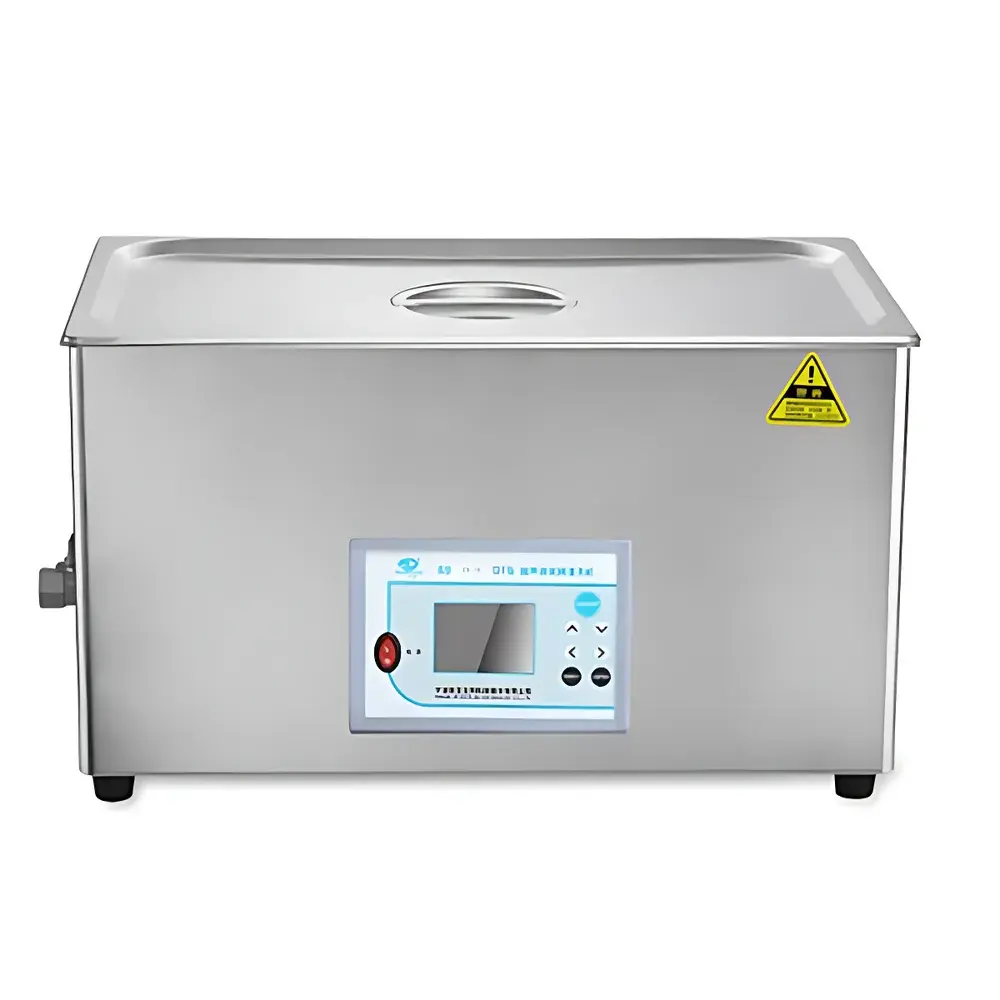
Ningbo Scientz SB25-12DTS Dual-Frequency Ultrasonic Cleaner
| Brand | Ningbo Scientz |
|---|---|
| Origin | Zhejiang, China |
| Manufacturer Type | Direct Manufacturer |
| Instrument Type | General-Purpose Ultrasonic Cleaner |
| Tank Capacity | 22.5 L |
| Ultrasonic Frequencies | 25 kHz / 40 kHz |
| Ultrasonic Power Output | 600 W / 720 W (dual-frequency mode) |
| Temperature Control Range | Ambient to 80 °C |
| Timer Range | 1–999 min |
| Sound-Dampening Lid | Included |
| Integrated Drain & Fill Fitting | Yes |
Overview
The Ningbo Scientz SB25-12DTS Dual-Frequency Ultrasonic Cleaner is an engineered laboratory-grade cleaning system designed for reproducible, non-destructive removal of particulate, organic, and oily contaminants from complex geometries—including blind holes, microchannels, porous surfaces, and delicate optical components. It operates on the physical principle of acoustic cavitation: high-frequency mechanical vibrations generated by piezoelectric transducers are transmitted through an aqueous or solvent-based cleaning medium, inducing rapid formation and implosive collapse of microscopic vapor cavities. This transient collapse generates localized shockwaves (up to ~5,000 K and ~1,000 atm), microstreaming, and intense shear forces at solid–liquid interfaces—enabling effective debridement without mechanical abrasion or thermal degradation. Unlike single-frequency systems, the SB25-12DTS integrates two independently controllable ultrasonic frequencies (25 kHz and 40 kHz), allowing users to optimize cleaning efficacy across diverse sample classes: lower frequency delivers higher energy per cavitation event (ideal for heavy particulate or tenacious grease), while higher frequency yields finer, more uniform bubble distribution (suited for precision optics, MEMS devices, or fine instrumentation).
Key Features
- Dual-frequency operation (25 kHz and 40 kHz) with independent power control—enables method-specific optimization for coarse vs. fine contamination removal.
- Adjustable ultrasonic power output (40–99% of full rated power) to prevent sample erosion or foaming in sensitive solvents.
- Precise digital temperature regulation (ambient to 80 °C) with real-time feedback via integrated Pt100 sensor; heating rate optimized for solvent compatibility and cavitation efficiency.
- Programmable timer (1–999 minutes) with auto-shutdown and audible alert; retains last-used parameters after power interruption for GLP-compliant workflow continuity.
- Stainless steel 316L tank (22.5 L capacity) with reinforced transducer mounting and corrosion-resistant sealing; compatible with water, ethanol, isopropanol, aqueous alkaline detergents, and low-surface-tension solvents.
- Integrated sound-dampening lid with safety interlock and ergonomic handle; reduces ambient noise to ≤55 dB(A) at 1 m distance during operation.
- Front-panel LED display showing real-time temperature, remaining time, active frequency, and power level—no external software required for basic operation.
Sample Compatibility & Compliance
The SB25-12DTS accommodates a broad spectrum of laboratory and industrial substrates: borosilicate glassware (vials, cuvettes, pipette tips), stainless steel surgical instruments, titanium dental tools, quartz optics, silicon wafers, ceramic filters, and polymer-based microfluidic chips. Its cleaning performance aligns with ASTM D2603 (Standard Test Method for Sonic Shear Stability of Lubricants), ISO 13406-2 (for optical surface cleanliness verification), and USP particulate matter testing preparation protocols. The unit supports GMP-relevant operational traceability through manual logbook documentation of time/temperature/frequency settings. While not FDA 21 CFR Part 11–certified out-of-the-box, its parameter retention function facilitates audit-ready recordkeeping when integrated into validated lab SOPs.
Software & Data Management
The SB25-12DTS operates as a standalone instrument with no embedded firmware update capability or network interface. All operational parameters are set and monitored via the front-panel interface; no proprietary software, drivers, or cloud connectivity are required. For laboratories requiring electronic records, users may document settings manually or integrate the unit into broader LIMS workflows using external timestamped logs. Temperature calibration is traceable to NIST-certified references (calibration certificate available upon request). No data export functionality is provided—consistent with IEC 61000-4-3 immunity standards for electromagnetic compatibility in shared lab environments.
Applications
- Pre-analytical sample preparation: degassing HPLC mobile phases, dispersing nanoparticle suspensions, homogenizing tissue lysates prior to centrifugation.
- Quality assurance: cleaning validation of reusable labware per ISO 15883-1; residue testing for pharmaceutical manufacturing equipment.
- Maintenance of analytical instrumentation: ultrasonic rejuvenation of LC column frits, GC injector liners, and mass spectrometer ion sources.
- Medical device reprocessing: adjunctive cleaning of endoscopes, orthopedic implants, and dental handpieces in accordance with AAMI ST91 guidelines.
- Materials science: surface activation of carbon fiber composites, removal of sintering aids from ceramic green bodies, and deburring of additive-manufactured metal parts.
FAQ
What is the maximum recommended operating temperature for aqueous cleaning solutions?
The unit is rated for continuous operation up to 80 °C; however, for optimal cavitation efficiency and transducer longevity, aqueous cleaning above 60 °C should be performed only with temperature-stabilized circulation or pulsed duty cycles.
Can the SB25-12DTS be used with flammable solvents such as acetone or hexane?
No. The heater and electronics are not intrinsically safe; use only with non-flammable, low-volatility solvents approved for ultrasonic cleaning (e.g., isopropanol, terpenes, or aqueous alkaline formulations).
Is the 25 kHz / 40 kHz dual-frequency mode simultaneous or sequential?
Frequencies operate sequentially—users select one active frequency per cycle; simultaneous dual-frequency excitation is not supported.
Does the unit include a degassing function?
Yes. A dedicated “degas” mode (typically 2–5 min at 40 kHz, low power, ambient temperature) is accessible via the timer interface to remove dissolved gases prior to critical cleaning steps.
What maintenance is required for long-term reliability?
Monthly inspection of tank integrity, quarterly cleaning of transducer mounting surfaces with isopropyl alcohol, and annual verification of temperature sensor accuracy using a calibrated reference thermometer.



