
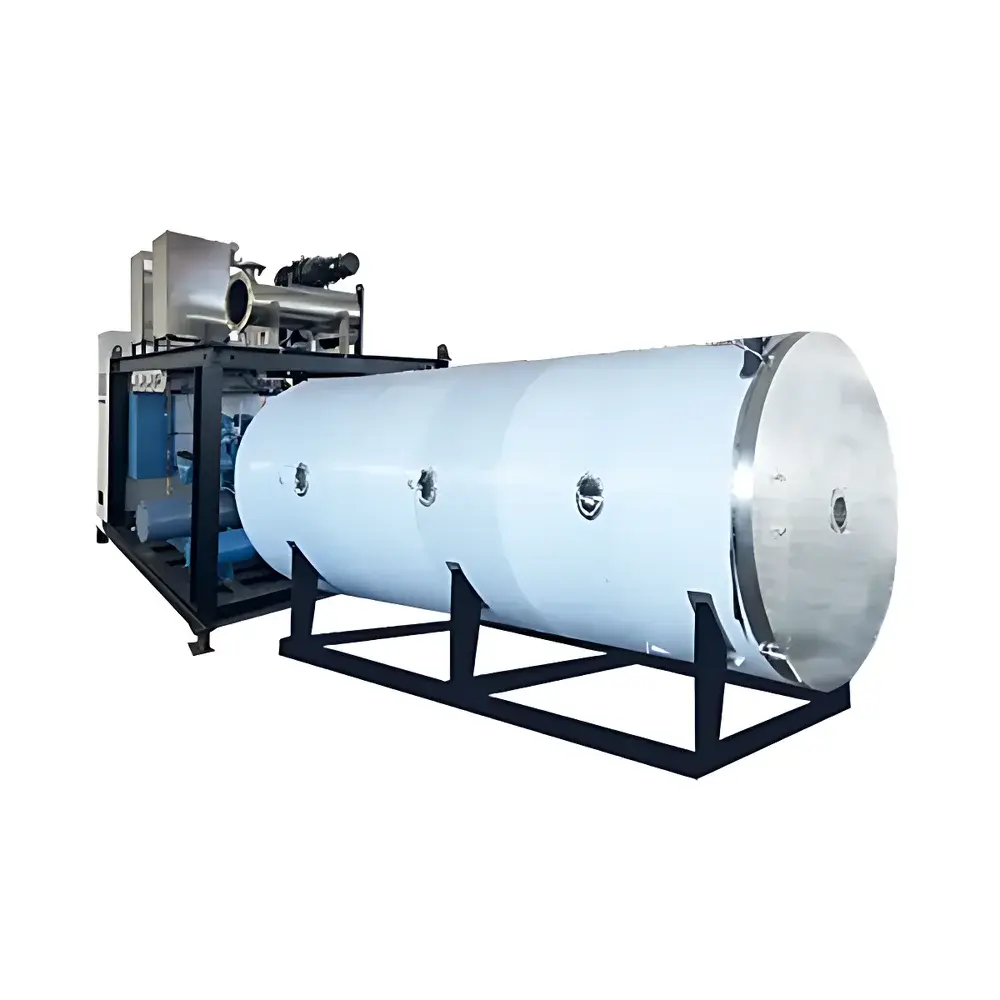
Ningbo Scientz SCIENTZ-SG Pilot-Scale Freeze Dryer
| Brand | Ningbo Scientz |
|---|---|
| Origin | Zhejiang, China |
| Manufacturer Type | Direct Manufacturer |
| Equipment Type | Standard Shelf-Type Freeze Dryer |
| Scale | Pilot-Scale |
| Lyophilization Area | 0.21 m² |
| Ultimate Vacuum (Empty Chamber) | ≤5 Pa |
| Condensate Capacity (24 h) | 4 kg/24 h |
| Cold Trap Temperature (Empty) | ≤−70 °C |
| Dimensions (L×W×H) | 750 × 640 × 1200 mm |
| Refrigerant | R404a |
| Compressor Type | High-Efficiency Piston or Screw Compressor (International Brand) |
| Chamber Construction | Full 316L Stainless Steel Interior |
| Vacuum System | Dual-Stage Oil-Sealed Rotary Vane Pump + Optional Roots Booster Pump with Oil–Water Separation |
| Cold Trap | High-Efficiency Copper-Coil Condenser with Electric Defrost Function |
| Optional Feature | AGV-Compatible Mobile Loading/Unloading Cart |
Overview
The Ningbo Scientz SCIENTZ-SG is a pilot-scale shelf-type freeze dryer engineered for reproducible, GMP-aligned lyophilization processes in applied research, process development, and small-batch production environments. It operates on the fundamental principles of sublimation under deep vacuum and controlled thermal management: frozen samples are subjected to low-pressure conditions while heat is precisely delivered via thermostatically regulated shelves, enabling direct phase transition from ice to vapor without liquid intermediate formation. Designed for scalability between laboratory and early-stage manufacturing workflows, the SCIENTZ-SG bridges the gap between benchtop feasibility studies and commercial process validation—supporting formulation optimization, stability testing, and sterile product development across food science, biopharmaceuticals, diagnostics, and natural product preservation.
Key Features
- Full 316L stainless steel chamber and shelf assembly—meets stringent hygienic design requirements for food-grade and pharmaceutical applications; resistant to corrosion, easy to clean, and compatible with CIP/SIP protocols.
- R404a refrigerant system integrated with high-efficiency international-brand piston or screw compressors—ensures stable condenser performance and long-term operational reliability under continuous load.
- Shelf temperature control during both freezing and primary drying phases—enables precise thermal profiling (±0.5 °C uniformity across shelves), critical for maintaining protein conformation, microbial viability, or sensory attributes in sensitive food matrices.
- Dual-stage vacuum architecture: primary oil-sealed rotary vane pump paired with an optional Roots booster pump—delivers rapid evacuation to ≤5 Pa (empty) and maintains stable low-pressure conditions during extended cycles; built-in oil–water separation prevents contamination and extends pump service intervals.
- High-capacity copper-coil cold trap operating at ≤−70 °C (empty)—achieves 4 kg/24 h condensate removal capacity, suitable for moderate-load pilot batches including viscous solutions, suspensions, or high-moisture foods.
- Electrically actuated defrost system—minimizes downtime between cycles; eliminates manual intervention and reduces risk of cross-contamination during maintenance.
Sample Compatibility & Compliance
The SCIENTZ-SG accommodates a broad range of sample formats—including glass vials (2–50 mL), aluminum trays (up to 0.21 m² total area), and custom containers—making it suitable for freeze-drying dairy powders, fruit purees, probiotic cultures, enzyme preparations, and functional food ingredients. Its construction and operational parameters align with key regulatory expectations: stainless steel surfaces conform to ASME BPE surface finish standards (Ra ≤ 0.8 µm); vacuum integrity supports ISO 20517-compliant leak rate verification; and thermal mapping capability (when used with calibrated PT100 sensors) facilitates IQ/OQ documentation per FDA Guidance for Industry: Process Validation (2011). While not pre-certified for cGMP manufacturing, its architecture supports GLP-compliant data recording and audit-ready operation when integrated with validated software systems.
Software & Data Management
The SCIENTZ-SG is equipped with an embedded industrial-grade PLC-based controller featuring real-time monitoring of shelf temperature, chamber pressure, condenser temperature, and cycle stage progression. All critical parameters are logged at user-defined intervals (minimum 10 s) and stored internally for ≥3 months. Data export is supported via USB interface in CSV format, enabling traceability and offline analysis in Excel or statistical process control (SPC) platforms. Optional Ethernet connectivity allows remote supervision and integration into centralized lab informatics systems. The system supports electronic signatures and audit trail functionality when deployed with compliant third-party LIMS or MES interfaces—meeting foundational requirements of FDA 21 CFR Part 11 for electronic records and signatures in regulated environments.
Applications
- Development and scale-up of freeze-dried functional foods (e.g., probiotics, vitamins, botanical extracts) requiring retention of bioactivity and organoleptic properties.
- Stability studies for shelf-life prediction under accelerated and real-time storage conditions.
- Preparation of reference standards and calibration materials for analytical laboratories (e.g., LC-MS, HPLC).
- Preservation of thermolabile enzymes, starter cultures, and fermentation broths in food biotechnology R&D.
- Lyophilization of model systems for drying kinetics modeling, mass transfer analysis, and shelf-life predictive algorithm training.
FAQ
What is the maximum batch volume this unit can handle?
Based on a lyophilization area of 0.21 m² and typical loading density (e.g., 5–10 mm solution depth), the SCIENTZ-SG supports batch sizes ranging from 1.5 to 3.5 L of aqueous solution—depending on solute concentration and desired residual moisture.
Is the system compatible with steam sterilization (SIP)?
The chamber and shelves are constructed from 316L stainless steel and rated for thermal cycling; however, SIP capability requires optional jacketed chamber design and external steam supply—not standard on the base SCIENTZ-SG configuration.
Can the unit be validated for GMP use?
Yes—the mechanical design, material certifications, and data logging architecture support IQ/OQ/PQ execution by qualified personnel using vendor-supplied protocols or client-defined SOPs.
What vacuum pump oil maintenance is required?
With oil–water separation enabled, oil change intervals extend to 500–800 operating hours depending on moisture load; routine checks of oil level and clarity are recommended before each cycle.
Is remote monitoring available out-of-the-box?
Basic local HMI operation is standard; Ethernet-enabled remote access and alarm notification require optional communication module installation and configuration.



