
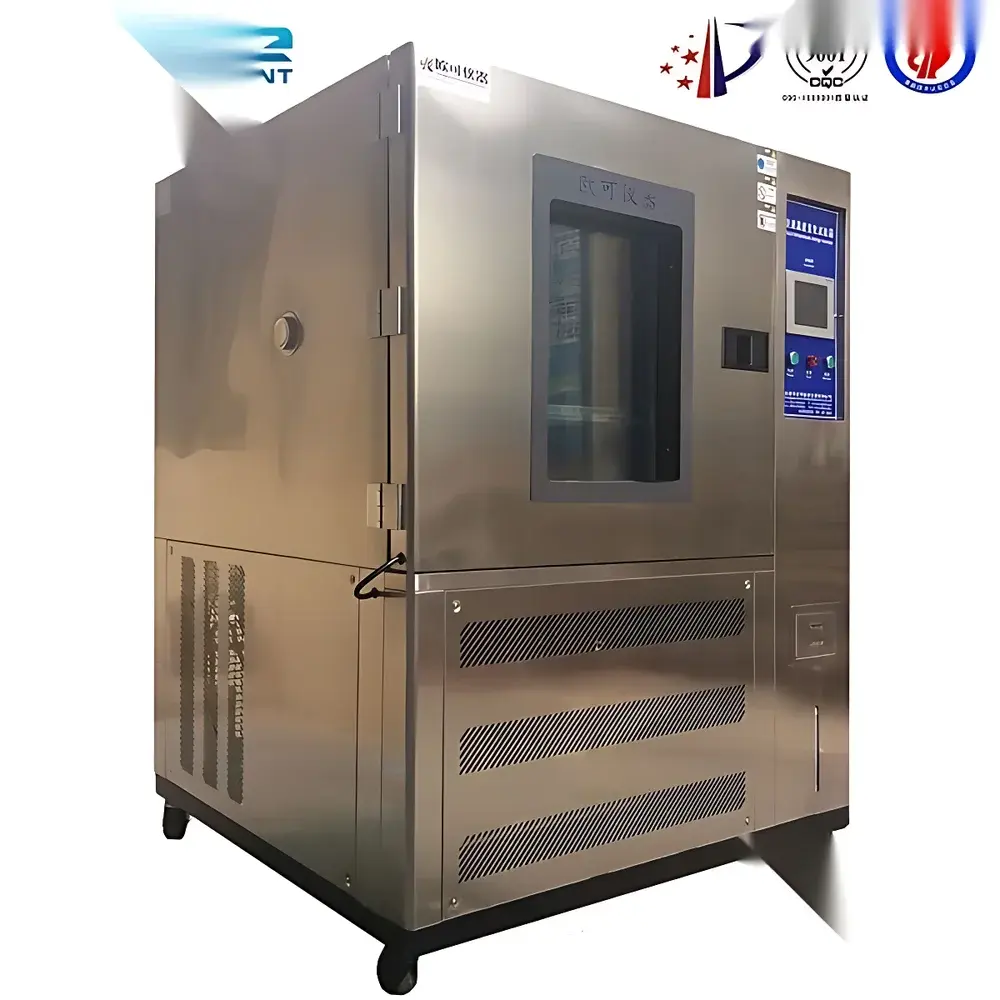
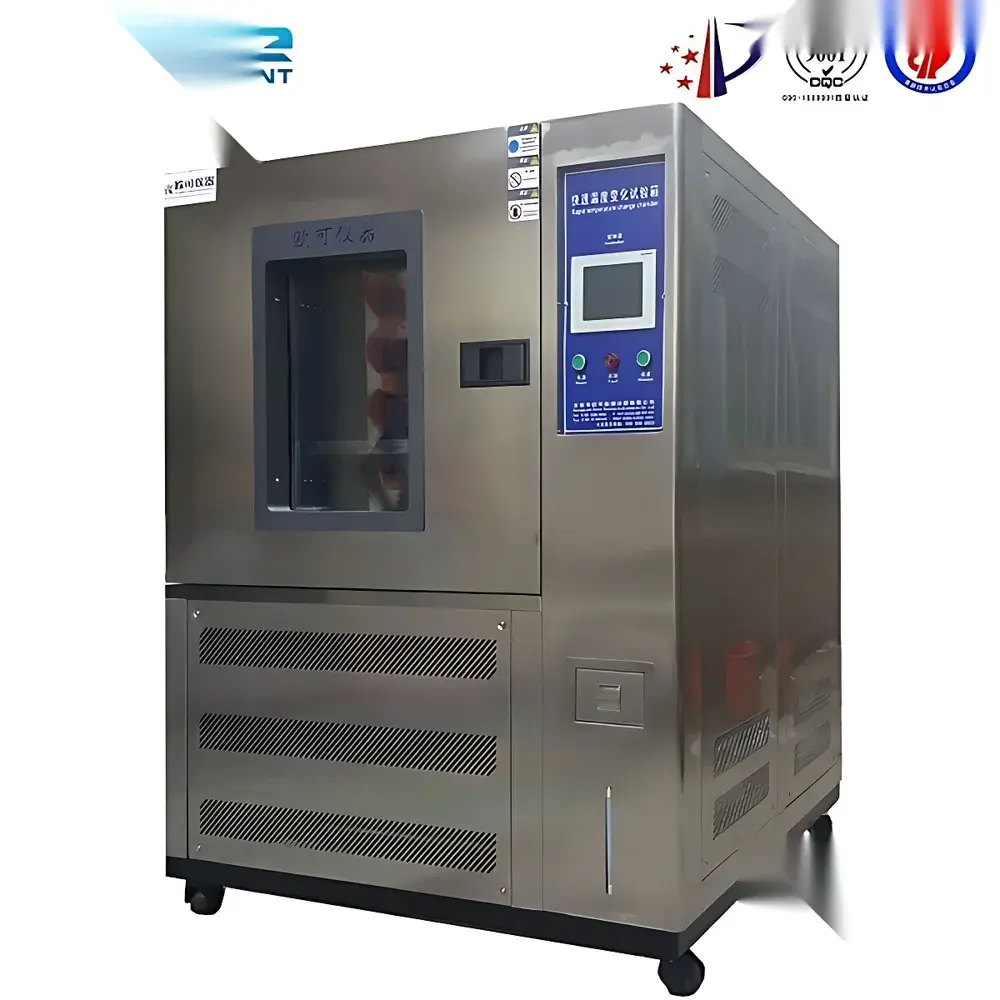
OK-TH Series Rapid Temperature Change Environmental Test Chamber
| Brand | OK |
|---|---|
| Origin | China |
| Manufacturer Type | Authorized Distributor |
| Origin Category | Domestic (China-manufactured) |
| Price | USD 14,000 (FOB China, ex-factory |
| Temperature Range | −70 °C to +150 °C |
| Humidity Range | 20–98% RH (optional: 5–98% RH or 10–98% RH) |
| Rapid Temperature Transition Range | −45 °C to +85 °C or −20 °C to +85 °C |
| Ramp Rates | 5–25 °C/min (configurable) |
| Temperature Uniformity | ±2 °C |
| Temperature Stability | ±0.5 °C |
| Humidity Uniformity | ±3.0% RH (at ≥75% RH) |
| Humidity Stability | ±2.5% RH |
| Interior Material | SUS#304 Stainless Steel |
| Refrigeration System | Hermetic Dual-Stage Compressor with Eco-Friendly Refrigerants (R404A/R23) |
| Controller | Touchscreen LCD with English/Chinese Interface |
| Power Supply | AC 380 V ±5%, 50 Hz ±0.5 Hz, 3-phase 5-wire |
Overview
The OK-TH Series Rapid Temperature Change Environmental Test Chamber is an engineered solution for accelerated thermal stress screening of electronic components, automotive modules, aerospace subsystems, and industrial materials. Designed in accordance with fundamental principles of thermal fatigue testing, the chamber subjects test specimens to precisely controlled, high-rate temperature transitions—inducing cyclic thermal expansion and contraction within material interfaces, solder joints, laminates, and encapsulants. This accelerates the manifestation of latent defects including microcracks, interfacial delamination, void formation, and coefficient-of-thermal-expansion (CTE) mismatch failures. Unlike standard thermal cycling chambers, the OK-TH series delivers programmable ramp rates up to 25 °C/min across a wide operational envelope (−70 °C to +150 °C), enabling compliance with rigorous qualification protocols such as MIL-STD-810H Method 503.6 (Temperature Shock), IEC 60068-2-14 (Change of Temperature), and JEDEC JESD22-A106 (Thermal Shock). Its integrated humidity control (20–98% RH) further supports combined environmental stress testing per IEC 60068-2-30 (Damp Heat, Cycling) and GB/T 2423.22 (Temperature Change).
Key Features
- High-fidelity thermal ramping: Configurable transition rates from 5 °C/min to 25 °C/min, validated per ASTM E2787 for thermal gradient reproducibility.
- Dual-stage refrigeration architecture: Hermetically sealed compressors with R404A (low-temp stage) and R23 (ultra-low-temp cascade stage) ensure stable sub-zero operation down to −70 °C without liquid nitrogen dependency.
- Uniformity-optimized chamber design: Airflow distribution system with adjustable vane diffusers and recirculation ducting achieves ≤±2 °C temperature uniformity (measured per IEC 60068-3-5) across all standard chamber volumes (225 L to 1000 L).
- Corrosion-resistant interior: Fully welded SUS#304 stainless steel construction—including floor pan, walls, and ceiling—with electropolished finish to withstand long-term humidity exposure and cleaning agents.
- Intuitive touchscreen controller: 7-inch capacitive LCD interface supporting real-time graphing, multi-segment profile programming, data logging (≥100,000 points), and USB export. Firmware complies with IEC 62443-3-3 for basic cyber security hygiene.
- Electrical safety & redundancy: Integrated over-temperature cut-off (independent of main controller), phase failure protection, ground fault interruption (GFCI), and emergency stop per EN 60204-1.
Sample Compatibility & Compliance
The OK-TH chamber accommodates test samples ranging from PCB assemblies and battery packs to automotive ECUs and medical device housings. Internal dimensions (W×H×D) span 50×75×60 cm (225 L) to 100×100×100 cm (1000 L), with customizable access ports, cable feedthroughs (IP65-rated), and load-bearing shelves (rated to 50 kg uniformly distributed). All models are designed and verified against national and international standards including GB/T 2423.1 (Cold Test), GB/T 2423.2 (Dry Heat), GB/T 2423.22 (Temperature Change), GJB 150.3–150.5 (MIL-STD-810 derivatives), and GB/T 10589 / GB/T 11158 (Chamber Performance Requirements). Optional validation packages include IQ/OQ documentation aligned with ISO/IEC 17025 and GLP-compliant audit trails for regulated industries.
Software & Data Management
The embedded controller supports full-cycle test sequencing—including dwell, ramp, hold, and conditional branching—with up to 999 segments per profile. Logged data (temperature, humidity, time, alarm status) is timestamped with millisecond resolution and stored internally with automatic rollover. Optional PC-based software (OK-LogSuite) enables remote monitoring via Ethernet, CSV/Excel export, statistical process control (SPC) charting, and PDF report generation compliant with FDA 21 CFR Part 11 requirements (electronic signatures, audit trail, user role management). Data integrity safeguards include write-protected memory, cyclic redundancy check (CRC) on stored logs, and configurable auto-backup to network drives.
Applications
- Qualification testing of avionics hardware under DO-160 Section 4 (Temperature Variation) and RTCA/DO-160G environmental categories.
- Reliability screening of power electronics (IGBTs, SiC modules) per AEC-Q100 stress test conditions.
- Accelerated life testing of lithium-ion battery cells and packs under thermal abuse scenarios (UN 38.3 T1–T5 simulation).
- Process validation of conformal coating adhesion and potting compound cure integrity under thermal cycling.
- Material compatibility assessment for medical device enclosures subjected to sterilization and storage temperature extremes (ISO 13485 Annex C).
FAQ
What is the difference between rapid temperature change and thermal shock testing?
Rapid temperature change (RTCT) uses controlled ramp rates (e.g., 10–25 °C/min) within a single chamber, minimizing mechanical shock while maximizing thermal stress accumulation. Thermal shock typically involves transfer between separate hot/cold chambers (<15 s transfer time), inducing higher transient strain. OK-TH supports both methodologies via programmable profiles.
Can the chamber be calibrated to ISO/IEC 17025-accredited standards?
Yes—factory calibration certificates traceable to NIM (National Institute of Metrology, China) are provided. Third-party accredited calibration services (e.g., CNAS-certified labs) are available upon request with full uncertainty budgets.
Is remote firmware update supported?
Firmware updates require local USB drive upload; no cloud connectivity or OTA capability is implemented to maintain air-gapped operational security per IEC 62443-3-3 SL1.
What maintenance intervals are recommended for the refrigeration system?
Compressor oil analysis and filter dryer replacement every 24 months; annual inspection of refrigerant charge, condenser coil cleanliness, and door gasket integrity per manufacturer’s PM checklist.
Does the controller support Modbus TCP for integration into factory MES systems?
Yes—the standard Ethernet port supports Modbus TCP slave mode (function codes 03h/04h) for real-time setpoint/status readout and basic alarm triggering. Custom protocol mapping is available under engineering services agreement.



