
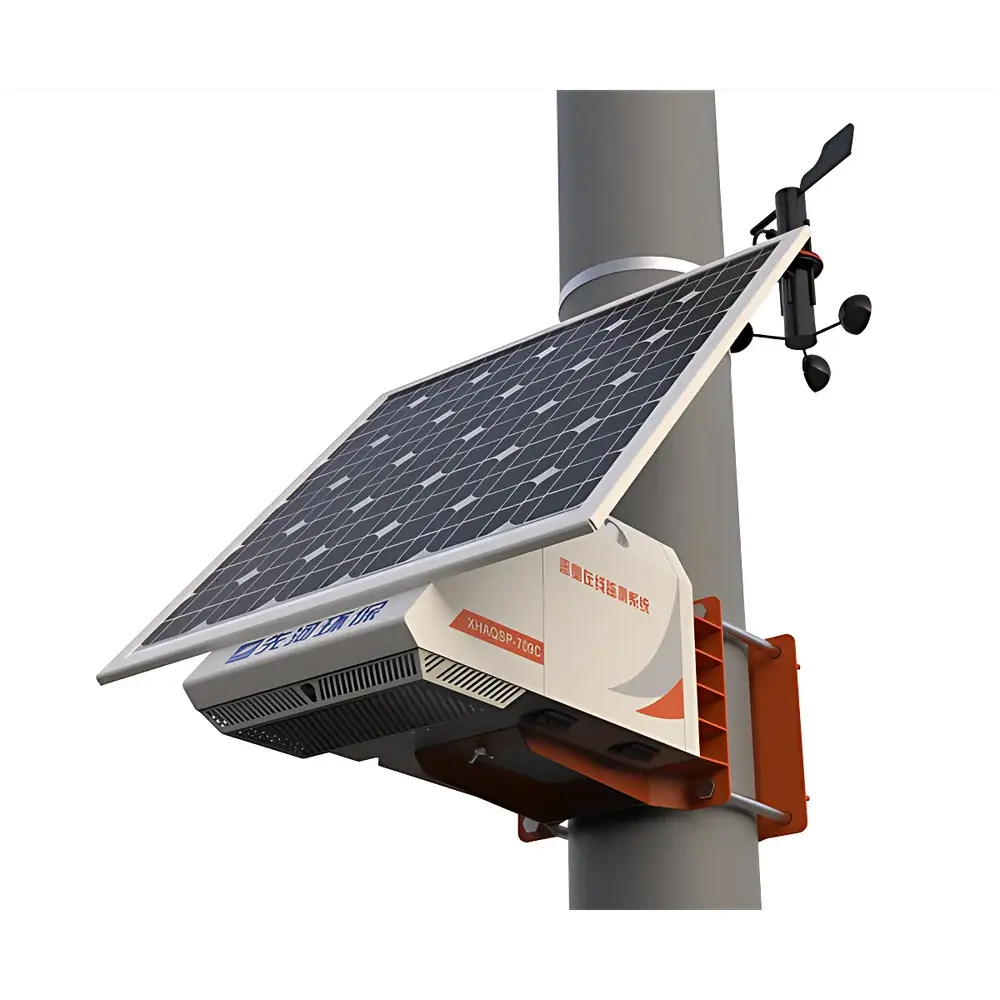
SAIL HERO XHAQSP-709C On-Road Odor Monitoring System
| Brand | SAIL HERO |
|---|---|
| Origin | Hebei, China |
| Manufacturer Type | Original Equipment Manufacturer (OEM) |
| Country of Origin | China |
| Model | XHAQSP-709C |
| Instrument Type | Online Continuous Monitoring System |
| Detection Principle | Multi-sensor Array (Electrochemical, Metal Oxide Semiconductor – MOS, Photoionization Detector – PID) |
| Target Analytes | NH₃, H₂S, Trimethylamine, Methanethiol, Dimethyl Sulfide, Dimethyl Disulfide, Carbon Disulfide, Styrene, Odor Intensity (OUₑ) |
| Optional | TVOC, Cl₂, HCl |
| Compliance | GB 14554–1993 “Emission Standard of Malodorous Pollutants” |
| Power Options | Rechargeable Li-ion or Sealed Lead-Acid Battery |
| Sampling Method | Pump-aspirated with Constant-Flow Control |
| Temperature Control | Sensor Block Heated to 30 °C ±1 °C |
| Data Connectivity | Dual-mode (4G/Wi-Fi + RS485/Ethernet) |
| Remote Access | Web-based Platform & Mobile APP (iOS/Android) |
Overview
The SAIL HERO XHAQSP-709C On-Road Odor Monitoring System is a field-deployable, continuous ambient air monitoring instrument engineered for real-time quantification of odor-active compounds and odor intensity (expressed in European Odor Units, OUₑ) at roadside, industrial perimeters, municipal waste transfer stations, and landfill boundary zones. Unlike laboratory olfactometry (e.g., dynamic dilution olfactometry per EN 13725), this system employs a multi-modal sensor architecture—integrating electrochemical (EC), metal oxide semiconductor (MOS), and photoionization detector (PID) technologies—to deliver rapid, on-site estimation of key malodorous constituents. Its operational design prioritizes robustness under variable environmental conditions, including temperature fluctuations, particulate loading, and transient humidity shifts common in unsheltered roadside deployments. The system is explicitly validated against the Chinese national standard GB 14554–1993, which defines emission limits and measurement protocols for eight regulated odorants and specifies calculation methodology for composite odor concentration.
Key Features
- Multi-sensor array architecture enables simultaneous detection of NH₃, H₂S, trimethylamine, methanethiol, dimethyl sulfide, dimethyl disulfide, carbon disulfide, and styrene—with cross-sensitivity compensation via embedded neural network algorithms trained on multivariate gas response matrices.
- Sensor block thermostatic control maintains critical sensing elements at 30 °C ±1 °C, minimizing baseline drift and enhancing long-term signal stability across seasonal ambient temperature ranges (−20 °C to +50 °C operating envelope).
- Pump-aspirated sampling with active flow regulation ensures consistent volumetric intake (typically 0.5–1.0 L/min), independent of wind speed or atmospheric pressure variations—critical for representative time-integrated data acquisition at open-air locations.
- Dual-power architecture supports both lithium-ion (LiFePO₄) and maintenance-free sealed lead-acid batteries, enabling extended autonomous operation (>72 h typical runtime on full charge) without grid dependency—ideal for temporary deployments or remote infrastructure-limited sites.
- Hybrid communication interface integrates cellular (4G LTE CAT1) and wired (RS485 Modbus RTU / Ethernet TCP/IP) protocols, ensuring redundant telemetry paths and compatibility with SCADA, EMS, and municipal environmental data platforms.
- Embedded edge-processing firmware performs real-time odor intensity calculation using the GB 14554–1993 weighted summation model, with optional integration of ISO 16000-29-compliant VOC profiling for supplementary chemical speciation.
Sample Compatibility & Compliance
The XHAQSP-709C is calibrated and verified for gaseous-phase analysis of ambient air samples collected directly from open environments. It is not intended for stack or duct applications requiring high-temperature or high-particulate sampling conditioning. All sensor modules undergo factory calibration traceable to NIM (National Institute of Metrology, China) reference standards. The system supports regulatory reporting aligned with GB 14554–1993 Annex B procedures for ambient odor assessment. While not certified to EN 13725 or ASTM D6920, its output can serve as screening-level data for trigger-based follow-up with standardized olfactometric verification. Firmware includes audit-trail logging (timestamped calibration events, sensor diagnostics, configuration changes) compliant with basic GLP documentation requirements.
Software & Data Management
Data acquisition, visualization, and alerting are managed through the SAIL HERO Cloud Platform—a secure, role-based web application supporting TLS 1.2 encryption and OAuth 2.0 authentication. Raw sensor outputs, calculated odor intensity values, diagnostic flags (e.g., low-flow warning, sensor saturation), and GPS-tagged location metadata are stored with configurable retention (default: 180 days). The platform provides automated report generation (PDF/CSV), threshold-based SMS/email alerts, and API access (RESTful JSON) for integration into third-party environmental information systems (EIS). Mobile applications for iOS and Android offer live dashboard views, historical trend replay, and remote device reboot/calibration initiation—all without requiring local software installation.
Applications
- Roadside ambient air quality surveillance near wastewater treatment plants, composting facilities, and rendering operations.
- Perimeter monitoring at municipal solid waste landfills to assess off-site odor migration and support community complaint investigations.
- Temporary deployment during construction-related excavation or dredging activities where organic decay may generate transient odor plumes.
- Baseline characterization prior to permitting of new industrial facilities handling sulfur- or amine-containing feedstocks.
- Research-grade temporal profiling of diurnal odor patterns in urban-rural transition zones for epidemiological exposure modeling.
FAQ
Does the XHAQSP-709C meet international odor standards such as EN 13725?
No. It is designed and validated for compliance with GB 14554–1993. For legally defensible odor concentration reporting in EU jurisdictions, dynamic olfactometry per EN 13725 remains the mandated method.
Can sensor modules be replaced in the field without factory recalibration?
Yes—each sensor cartridge includes an embedded EEPROM storing individual calibration coefficients; replacement requires only mechanical insertion and platform-confirmed firmware handshake.
Is the system suitable for indoor or enclosed-space monitoring?
It is optimized for outdoor, open-air deployment. Indoor use is not recommended due to lack of integrated humidity/CO₂ compensation and potential for localized condensation affecting MOS sensor response.
What is the typical maintenance interval for pump filters and sensor arrays?
Pump inlet filters require cleaning every 7–14 days in high-dust environments; sensor arrays are rated for 12–18 months of continuous operation under normal ambient conditions, with performance validation recommended quarterly.
Does the platform support FDA 21 CFR Part 11 or EU Annex 11 compliance?
The current firmware version does not include electronic signature, audit trail immutability, or role-based electronic approval workflows required for Part 11/Annex 11. It meets foundational data integrity principles but is not qualified for regulated GxP environments.







