
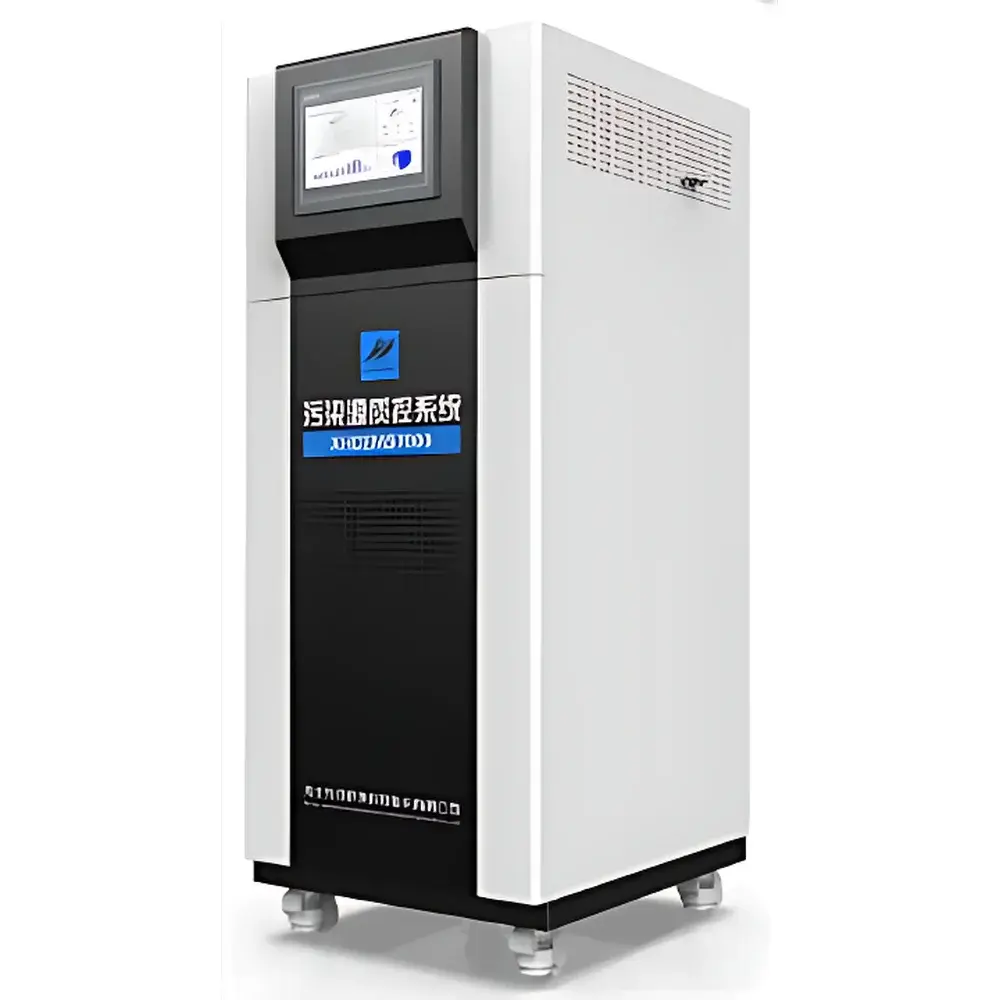
SAIL HERO XHCEMS7000 Stack Emission Quality Control System
| Brand | SAIL HERO |
|---|---|
| Origin | Hebei, China |
| Manufacturer Type | OEM Manufacturer |
| Country of Origin | China |
| Model | XHCEMS7000 |
| Instrument Category | Continuous Emission Monitoring System (CEMS) Quality Assurance/Quality Control (QA/QC) Platform |
| Communication Protocol | Compliant with HJ/T 212-2017 |
| Data Storage | Local + Remote Sync |
| Calibration Gas Generation | SO₂ and NOₓ standard gas mixtures, programmable concentration range, high repeatability and accuracy |
Overview
The SAIL HERO XHCEMS7000 Stack Emission Quality Control System is an engineered QA/QC platform designed for regulatory-grade validation of Continuous Emission Monitoring Systems (CEMS) deployed at stationary combustion sources. It operates on the principle of dynamic, traceable gas standard generation—using precision mass flow controllers (MFCs), certified zero air, and certified calibration gases (SO₂ and NOₓ) to synthesize reference gas mixtures of known, programmable concentrations directly at the stack sampling point or analyzer inlet. Unlike static span-gas challenges, the XHCEMS7000 enables real-time, on-demand, and repeatable introduction of challenge gases across the full analytical signal path—including sample probe, heated line, conditioning system, and analyzer detector—thereby verifying end-to-end CEMS performance per ISO 14956, EN 15267, and EPA Performance Specification 2 (PS-2) requirements.
Key Features
- End-to-end CEMS verification: Simultaneous QA/QC assessment of sampling train integrity, gas analysis subsystem response, and data acquisition & transmission (DAQ) functionality.
- Blind-sample capability: Remotely triggered generation of undisclosed SO₂/NOₓ concentrations within user-defined ranges (e.g., 10–100% of full-scale), eliminating operator bias and enabling statistically valid method validation under GLP-compliant conditions.
- Remote command execution: Full operational control via secure web-based central software or mobile client—supporting single-unit or fleet-wide scheduling, ad-hoc challenge initiation, and automated pass/fail flagging based on preconfigured tolerance thresholds (e.g., ±5% of target value).
- Traceable calibration gas synthesis: Integrated dual-MFC architecture with NIST-traceable flow calibration; real-time temperature and pressure compensation ensures volumetric accuracy per ISO 6145-7.
- HJ/T 212-2017 protocol compliance: Native support for Chinese environmental data transmission standards, including data frame structure, encryption handshake, and alarm event reporting—enabling seamless integration with provincial and national pollution source monitoring platforms.
- Low consumables footprint: Designed for >12 months of continuous operation without gas cylinder replacement under typical utility-cycle usage (e.g., 3–5 daily challenges), minimizing operational overhead and lifecycle cost.
Sample Compatibility & Compliance
The XHCEMS7000 is compatible with all major CEMS configurations used in coal-fired power plants, waste-to-energy facilities, sintering plants, cement kilns, and industrial boilers—including UV-DOAS, NDIR, electrochemical, and chemiluminescence analyzers. It meets mandatory QA/QC requirements under China’s “Technical Specifications for Continuous Monitoring of Flue Gas Emissions from Fixed Pollution Sources” (HJ 75-2017 and HJ 76-2017), and supports audit readiness for ISO 14001 environmental management systems and China’s “Pollutant Discharge Permit Regulations.” All internal gas pathways are constructed from electropolished 316L stainless steel and PTFE-lined components to prevent adsorption or catalytic interference—ensuring metrological integrity for reactive species such as NO and SO₂.
Software & Data Management
The remote control terminal provides role-based access (e.g., field technician, QA officer, provincial regulator) with full audit trail functionality compliant with 21 CFR Part 11 principles—capturing user ID, timestamp, command type, target concentration, measured response, deviation calculation, and electronic signature upon report generation. All QA/QC events are time-stamped and synchronized with CEMS data streams using GPS-derived UTC timestamps. Reports export in PDF and CSV formats, with optional integration into enterprise LIMS or environmental data warehouses via RESTful API or OPC UA interface. Historical challenge logs are retained for ≥36 months on local SD card and mirrored to cloud storage with TLS 1.2 encryption.
Applications
The system serves as a critical tool for environmental protection bureaus conducting routine CEMS certification, third-party verification bodies performing annual PS-2 audits, and facility operators maintaining compliance with emission limits under China’s “Ultra-Low Emission” policy. It is routinely deployed in thermal power generation (subcritical, supercritical, and ultra-supercritical units), municipal solid waste incineration (MSWI), iron ore sintering, lime production, and glass melting operations—where accurate NOₓ/SO₂ quantification directly impacts emissions trading, penalty avoidance, and public disclosure obligations.
FAQ
Does the XHCEMS7000 require external calibration gas cylinders?
Yes—it uses certified SO₂ and NOₓ standard gases (typically 100 ppm or 1000 ppm in N₂) and zero air (hydrocarbon-free, <0.1 ppm THC). Cylinder change frequency depends on challenge volume and frequency, but typical deployment achieves ≥12 months between replacements.
Can it validate both extractive and in-situ CEMS configurations?
Yes—the system injects challenge gas either upstream of the probe (for extractive systems) or directly into the optical path (for in-situ DOAS systems), with configurable injection timing and dwell duration to match analyzer response kinetics.
Is remote firmware update supported?
Yes—over-the-air (OTA) updates are delivered via secure HTTPS channel with digital signature verification, preserving configuration integrity and meeting IEC 62443-3-3 SL2 cybersecurity requirements.
What data security protocols are implemented?
All communications use TLS 1.2+ encryption; local storage employs AES-256 encryption; user authentication follows PBKDF2-HMAC-SHA256 key derivation with minimum 8-character password enforcement and 5-minute session timeout.
How does it handle ambient temperature and pressure variations during gas synthesis?
Integrated PT100 temperature sensor and piezoresistive pressure transducer feed real-time compensation values to the MFC controller, ensuring volumetric flow accuracy remains within ±0.5% of setpoint across –10°C to 50°C and 80–106 kPa operating ranges.
Related Products







