
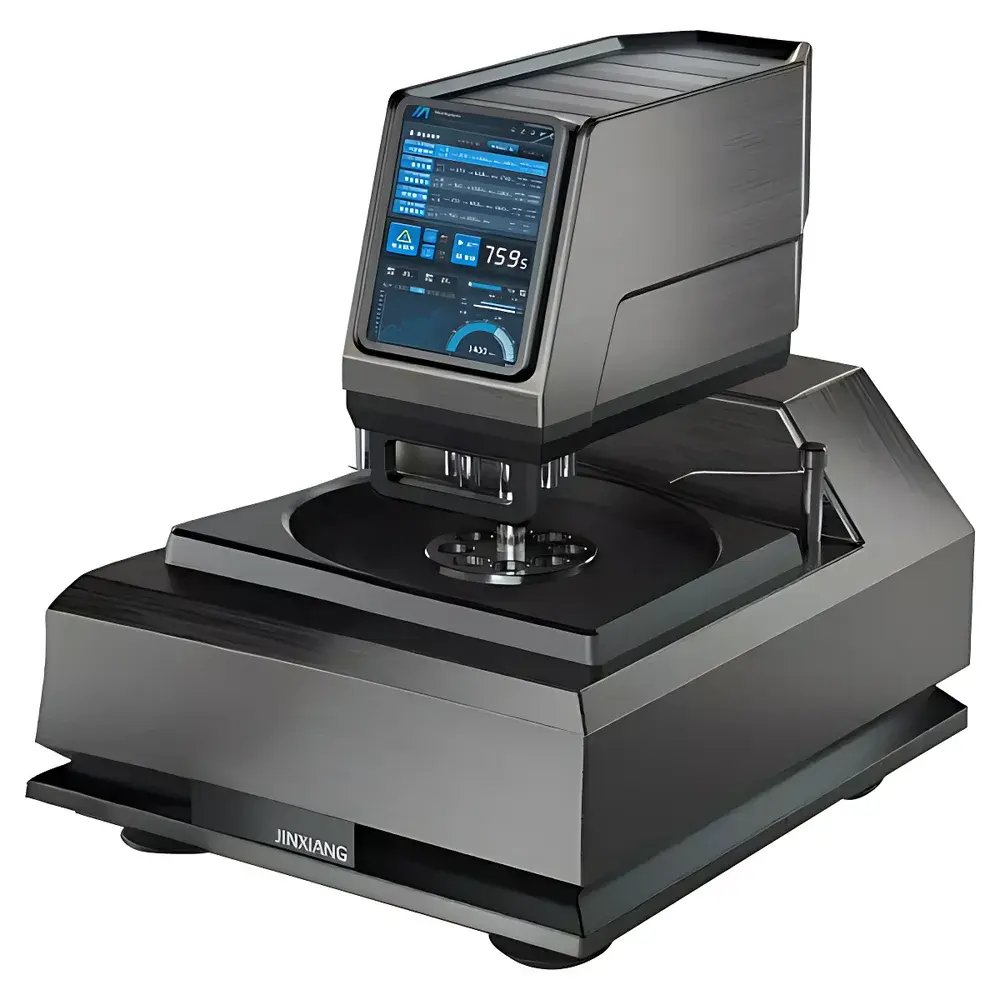
MP-1ZS Single-Plate Intelligent Automatic Polishing and Grinding Machine
| Brand | WEIYEE |
|---|---|
| Origin | Guangdong, China |
| Model | MP-1ZS |
| Platen Diameter | 250 mm (10") |
| Number of Platens | 1 |
| Speed Range (Platen) | 50–1500 rpm (infinitely variable) + 6 preset speeds (250/500/750/1000/1250/1500 rpm) |
| Speed Range (Head) | 20–120 rpm (infinitely variable) |
| Rotation | Bidirectional (forward/reverse) |
| Pressure Control | Pneumatic single-point loading with adjustable pressure |
| Display | 9" high-resolution touchscreen interface |
| Sample Capacity | Up to 8 specimens simultaneously |
| Drive Motor | Panasonic servo motor with electric vertical lift |
| Startup Profile | Programmable soft-start curve |
| Housing Material | 304 stainless steel |
| Liquid Dispensing | Dual-channel integrated reagent dispensing bottles |
| Power Supply | 220 V AC |
Overview
The MP-1ZS Single-Plate Intelligent Automatic Polishing and Grinding Machine is an engineered solution for precision sample preparation in metallurgical, geological, ceramic, and advanced materials laboratories. Designed around the principles of controlled mechanical abrasion and reproducible surface conditioning, the MP-1ZS employs a coaxial platen-head architecture where rotational motion—combined with programmable pneumatic load application—enables consistent material removal and surface finish optimization. Unlike conventional dual-disk systems, its single-platen configuration minimizes cross-contamination risk and simplifies maintenance while retaining full process control over speed, pressure, direction, and dwell time. The system supports both standardized metallographic workflows (e.g., ASTM E3, ISO 14487, GB/T 13298) and custom protocols for research-grade specimen preparation.
Key Features
- Triple-mode operation: fully automatic, semi-automatic, and manual modes for maximum procedural flexibility across routine QC and exploratory R&D applications.
- High-precision Panasonic servo motor driving the main platen, coupled with electric vertical lift mechanism for repeatable head positioning and consistent contact geometry.
- Infinitely variable platen speed (50–1500 rpm) plus six factory-calibrated fixed-speed presets optimized for common abrasive sequences (e.g., coarse grinding → fine grinding → polishing).
- Independent head rotation (20–120 rpm), enabling differential motion between specimen and platen to reduce edge rounding and improve planarity uniformity.
- Pneumatic single-point loading system with digitally adjustable pressure (0–20 N range typical), ensuring stable force application without mechanical drift or hysteresis.
- 9-inch capacitive touchscreen HMI with intuitive icon-based navigation, real-time parameter monitoring, and multi-user access levels (operator, technician, administrator).
- Programmable soft-start curve to eliminate torque shock during initiation—critical for brittle or layered specimens such as thin-film coatings or sintered composites.
- Dual independent reagent dispensing channels with programmable flow timing and volume control, compatible with water-based slurries, colloidal silica, diamond suspensions, and electrolytic solutions.
- 304 stainless steel enclosure meeting IP54 ingress protection standards, corrosion-resistant hardware, and CE-compliant electrical architecture.
Sample Compatibility & Compliance
The MP-1ZS accommodates standard metallographic mounts (up to 30 mm diameter) and large-format specimens (e.g., 25 × 30 mm rectangular sections), supporting up to eight samples per cycle using optional multi-specimen holders. It complies with foundational sample preparation standards including ASTM E3-22 (Standard Guide for Preparation of Metallographic Specimens), ISO 14487:2021 (Metallographic polishing methods), and GB/T 13298-2015 (Microstructure inspection of metals). Its programmable logic controller (PLC) architecture supports audit-ready operation logs, making it suitable for GLP environments where traceability of grinding/polishing parameters (speed, pressure, time, reagent type) is required. While not FDA 21 CFR Part 11-certified out-of-the-box, the system’s data export capability (CSV via USB) enables integration into validated LIMS or ELN platforms.
Software & Data Management
The embedded firmware includes a non-volatile memory module storing ≥100 user-defined protocols, each containing up to five sequential steps with independent settings for platen speed, head speed, pressure, duration, and dispensing schedule. All operational events—including mode selection, parameter changes, emergency stops, and power cycles—are timestamped and logged locally. Protocol files can be exported/imported via USB flash drive for inter-laboratory method harmonization. Optional Ethernet connectivity (via add-on module) allows remote status monitoring and centralized protocol deployment in multi-unit installations. No cloud dependency or proprietary software installation is required—configuration remains fully local and deterministic.
Applications
- Metallographic specimen preparation for optical and electron microscopy (SEM/TEM cross-section analysis).
- Surface planarization of semiconductor wafers, ceramic substrates, and additive-manufactured alloys prior to microhardness testing (ASTM E384).
- Preparation of geological thin sections (petrographic slides) requiring minimal relief and birefringence preservation.
- Quality control of thermal spray coatings, brazed joints, and diffusion-bonded interfaces.
- R&D of battery electrode materials, solid-state electrolytes, and composite laminates where interfacial integrity must be preserved during sectioning.
FAQ
What types of consumables are compatible with the MP-1ZS?
Standard 250 mm (10″) grinding/polishing discs—including silicon carbide papers, diamond-impregnated pads, alumina cloths, and colloidal silica polishing films—are mechanically and dimensionally compatible.
Is the machine capable of unattended overnight operation?
Yes—when configured with appropriate cooling and reagent supply, the MP-1ZS supports scheduled multi-step protocols with automatic termination and audible/visual alerts upon completion.
Can pressure be calibrated or verified internally?
The pneumatic system includes a factory-trimmed pressure transducer; calibration verification requires external dead-weight testing per ISO 6789-2, though routine checks may be performed using certified load cells.
Does the system support integration with laboratory information management systems (LIMS)?
Direct API-level integration is not provided, but CSV-formatted logs and protocol exports enable manual or scripted ingestion into third-party LIMS platforms.
What safety certifications does the MP-1ZS hold?
It carries CE marking per Machinery Directive 2006/42/EC and Low Voltage Directive 2014/35/EU, with full documentation available upon request.



