
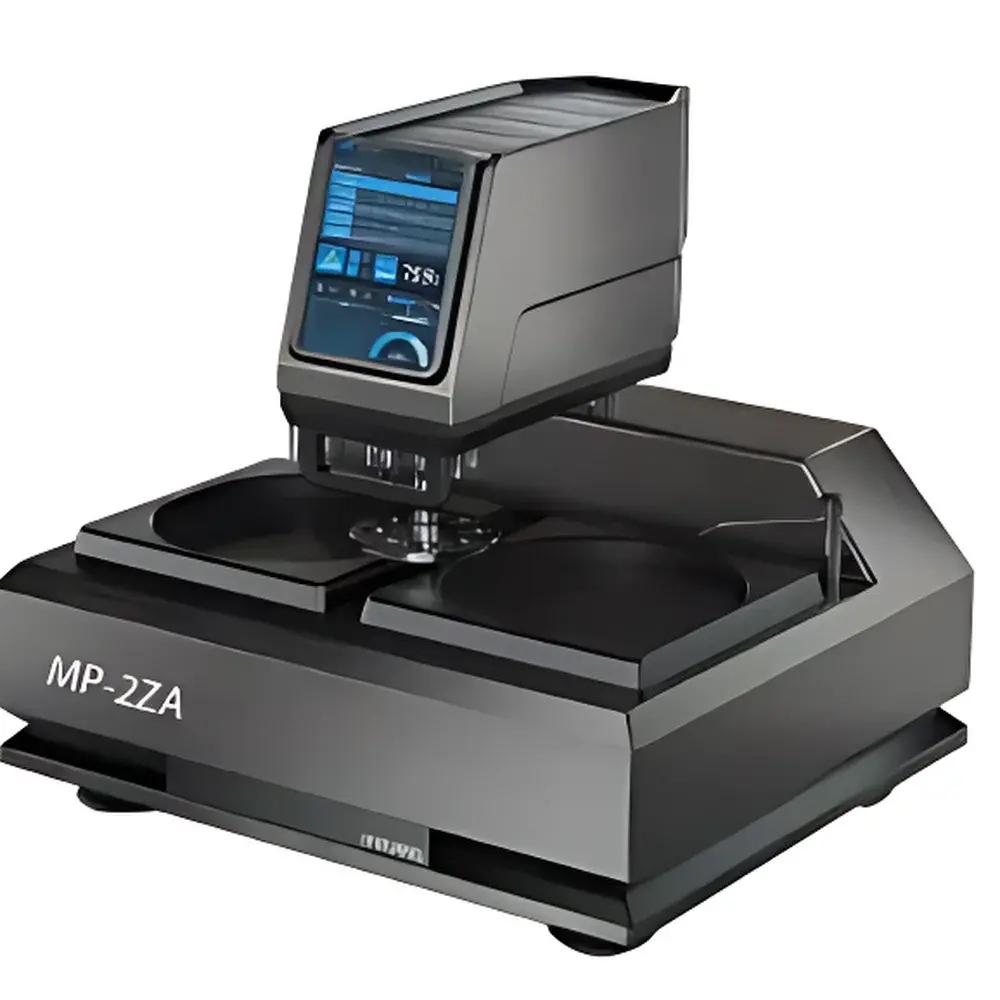
WEIYEE MP-2ZA Dual-Plate Intelligent Automatic Grinding and Polishing System
| Brand | WEIYEE |
|---|---|
| Origin | Guangdong, China |
| Model | MP-2ZA |
| Platen Diameter | 250 mm (10") |
| Number of Platens | 2 |
| Speed Range (Platen) | 50–1500 rpm (infinitely variable) + 6 preset speeds (250/500/750/1000/1250/1500 rpm) |
| Platen Rotation | Forward/Reverse selectable |
| Head Rotation Speed | 20–120 rpm (infinitely variable) |
| Sample Capacity | up to 8 specimens simultaneously |
| Pressure Control | Pneumatic single-point loading with adjustable pressure |
| Control Interface | 9" 2K HD capacitive touchscreen running Android OS |
| Drive Motor | Panasonic servo motor with electric vertical lift |
| Startup Profile | Programmable curve-start mode |
| Housing Material | 304 stainless steel |
| Liquid Dispensing | Dual-channel integrated reagent dispensing bottles |
| Power Supply | 220 V AC |
Overview
The WEIYEE MP-2ZA Dual-Plate Intelligent Automatic Grinding and Polishing System is an engineered solution for high-throughput, reproducible metallographic and geological sample preparation in quality control laboratories, R&D facilities, and accredited testing centers. Designed around a dual-platen architecture with independent motion control, the system implements standardized grinding and polishing protocols based on ASTM E3, ISO 13025, and GB/T 13298–2015. Its core operational principle integrates synchronized platen rotation, programmable head kinematics, and pneumatically regulated normal force—enabling precise material removal rate control and consistent surface finish across heterogeneous specimen sets. Unlike conventional manual or semi-automatic units, the MP-2ZA eliminates operator-induced variability through closed-loop servo positioning, real-time speed regulation, and digital process logging—making it suitable for GLP-compliant workflows where traceability and repeatability are mandated.
Key Features
- Dual independent 250 mm (10″) platens with separate speed and direction control—enabling simultaneous coarse grinding on one station and fine polishing on the other.
- Panasonic servo-driven main spindle with electric vertical lift mechanism ensures repeatable specimen-to-platen contact geometry and eliminates mechanical backlash.
- Programmable curve-start mode mitigates torque surge during initial engagement, extending consumable life and reducing edge rounding artifacts.
- Android-based 9-inch 2K HD touchscreen interface supports intuitive drag-and-drop protocol building, multi-user profile management, and firmware over-the-air (OTA) updates.
- Integrated dual-channel liquid dispensing system enables automated, time-synchronized delivery of lubricants, abrasives, or electrolytes—critical for diamond suspension consistency and oxide film control.
- Stainless steel 304 enclosure meets IP54 ingress protection standards and resists corrosion from acidic polishing slurries and organic solvents.
- Full bidirectional rotation capability (forward/reverse) minimizes directional scratch bias and improves flatness uniformity across large-area specimens (e.g., turbine blade cross-sections or PCB laminates).
Sample Compatibility & Compliance
The MP-2ZA accommodates standard metallographic mounts (up to 30 mm diameter), cylindrical rods, rectangular blocks (max. 40 × 60 mm), and thin-film substrates mounted on conductive stubs. It supports all common abrasive media—including silicon carbide papers (P80–P2500), diamond suspensions (0.25–9 µm), alumina colloids (0.05–0.3 µm), and electrochemical polishing electrolytes. The system complies with electrical safety requirements per IEC 61000-6-2/6-4 and is designed for integration into ISO/IEC 17025-accredited laboratories. Process parameters—including speed, pressure, duration, and dispensing volume—are logged with timestamped metadata, satisfying audit requirements under FDA 21 CFR Part 11 when paired with validated software configuration.
Software & Data Management
The embedded Android OS runs a dedicated sample prep application with role-based access control (administrator, technician, auditor). Each grinding/polishing cycle generates a structured JSON log containing platen RPM history, applied load profile, head rotation trajectory, dispensing event timestamps, and user authentication tokens. Logs export via USB or network share in CSV and PDF formats. Optional cloud synchronization enables centralized fleet monitoring and preventive maintenance scheduling based on cumulative motor runtime and actuator cycle counts. Audit trails retain full edit history with immutable hash signatures—supporting GMP-aligned documentation practices.
Applications
- Metallographic analysis of ferrous and non-ferrous alloys (e.g., ASTM E112 grain size evaluation, ASTM E1245 inclusion rating).
- Preparation of ceramic composites and cemented carbides for SEM-EDS cross-sectional imaging.
- Surface planarization of geological thin sections prior to microprobe analysis.
- Quality assurance of additive manufacturing build plates and post-processed Ti-6Al-4V components.
- Routine QC of solder joint integrity and intermetallic layer thickness in electronics packaging.
- Standardized polishing of optical glass substrates prior to interferometric flatness measurement.
FAQ
What safety certifications does the MP-2ZA hold?
The unit conforms to IEC 61000-6-2 (immunity) and IEC 61000-6-4 (emission) standards; CE marking is pending final EU Representative registration.
Can the system be integrated into a LIMS environment?
Yes—via RESTful API endpoints supporting JSON-formatted parameter upload and log retrieval; custom middleware development is available upon request.
Is remote diagnostics supported?
Built-in Ethernet and Wi-Fi modules enable secure SSH access and VNC-based technician support sessions with end-user consent.
What is the expected service interval for the pneumatic pressure regulator?
Under typical lab usage (≤8 hrs/day), calibration verification is recommended every 12 months; full replacement advised at 36-month intervals or after 10,000 pressure cycles.
Does the Android OS support third-party keyboard input for barcode scanning?
Yes—the system recognizes HID-compliant USB and Bluetooth scanners; keyboard wedge emulation is enabled by default.



