
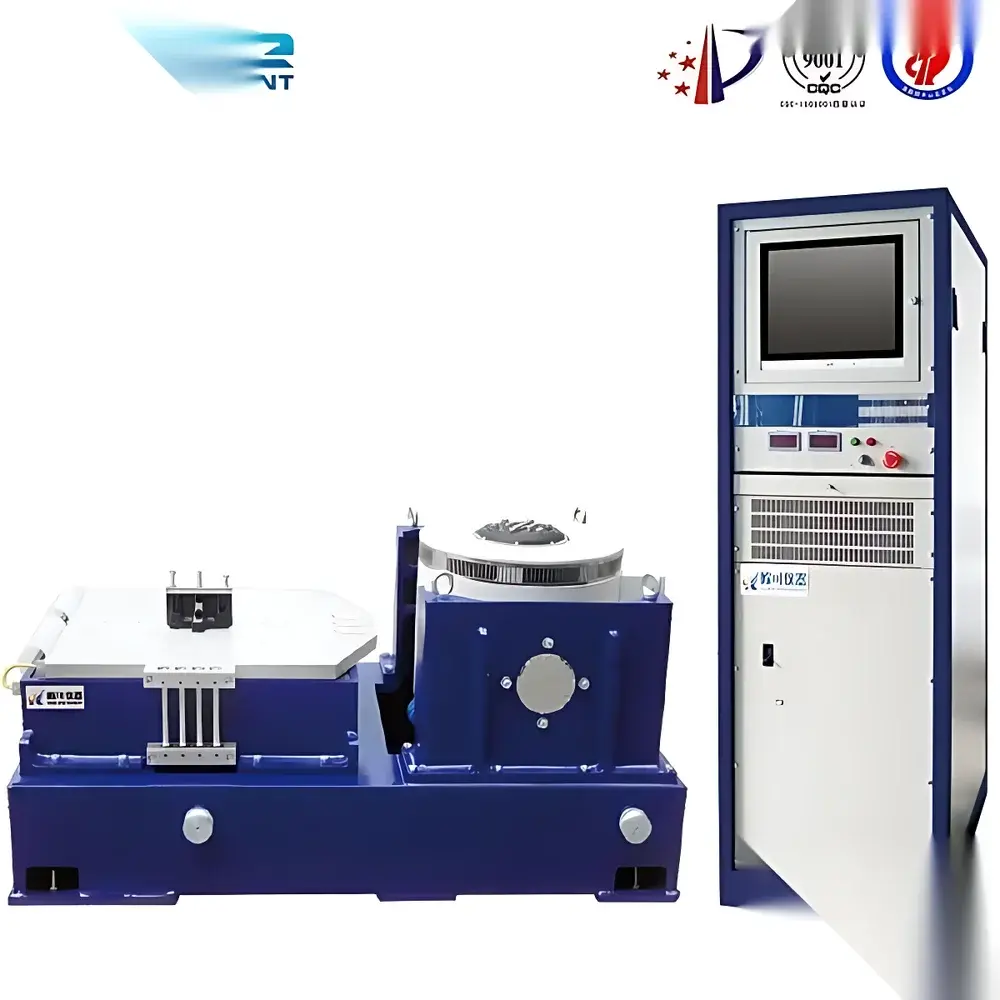
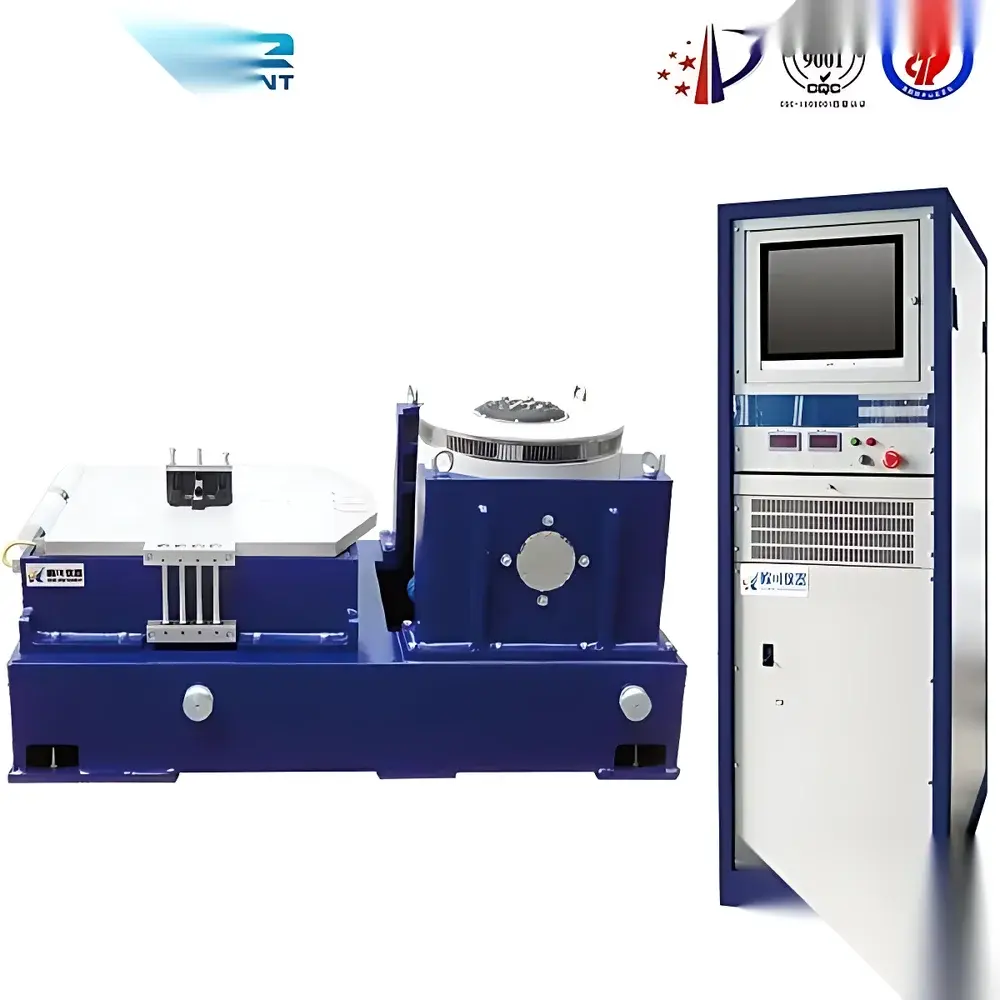
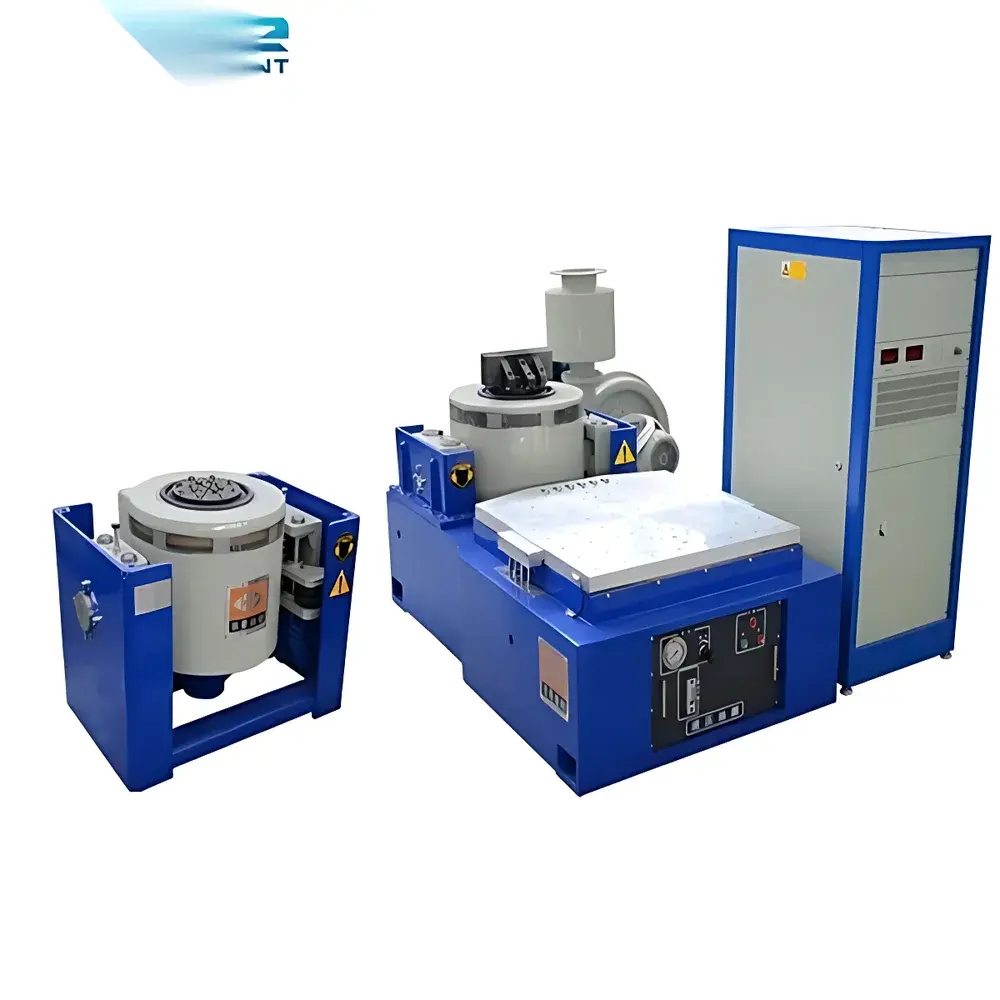
Horizontal Vibration Testing System
| Key | Max. Load: 100 kg (customizable) |
|---|---|
| Frequency Range | 1–600 Hz / 1–3000 Hz / 1–5000 Hz |
| Sweep Range | 1–600 Hz / 1–3000 Hz / 1–5000 Hz |
| Peak-to-Peak Amplitude | 0–5 mm |
| Max. Acceleration | 20 g |
| Vibration Axes | Vertical (Z) + Horizontal (X/Y) |
| Waveform | Sine |
| Programmable Segments | 1–15 segments, each with user-defined frequency & duration, loopable |
| Octave Sweep Modes | 5-step logarithmic (low→high, high→low, low→high→low, repeatable) |
| Power Rating | 2.2 kW |
| Table Dimensions (L×W) | 500×500 mm (customizable) |
| Unit Dimensions (L×H×W) | Vertical unit: 500×200×500 mm |
| Horizontal unit | 500×250×500 mm |
| Input Voltage | 1φ AC 220 V, 50/60 Hz |
| Max. Current | 6 A |
| Frequency Resolution | 0.01 Hz, Accuracy: ±0.1 Hz |
| Table Mounting Pattern | Customizable M6/M8 threaded holes |
| Optional Accessories | Magnesium alloy fixtures, FEM-optimized fixtures, circular/square/octagonal extension tables, thermal isolation pads for environmental chamber integration |
Overview
The Horizontal Vibration Testing System is a dual-axis electrodynamic shaker engineered for precision mechanical stress evaluation under controlled sinusoidal excitation. It operates on the principle of electromagnetic force generation—where coil current interacting with a permanent magnetic field produces linear motion proportional to input signal amplitude and frequency. Unlike single-axis systems, this configuration enables simultaneous or independent vertical (Z-axis) and horizontal (X/Y-axis) vibration testing, replicating real-world transport, handling, and operational dynamics encountered by electronic assemblies, automotive components, aerospace subassemblies, and packaged goods. Its design adheres to fundamental vibration test standards including ISO 10816 (mechanical vibration evaluation), IEC 60068-2-6 (environmental testing – vibration), and MIL-STD-810H Method 514.8 (vibration testing for military equipment). The system supports both deterministic (programmed sine) and sweep-based test profiles, making it suitable for resonant frequency identification, fatigue life assessment, and qualification-level durability validation.
Key Features
- Dual-axis capability: Independent or coupled control of vertical and horizontal vibration axes ensures comprehensive dynamic loading simulation aligned with ISO 2041 and ASTM D999 test methodologies.
- High-frequency performance: Configurable frequency range up to 5 kHz enables evaluation of high-resonance structures such as PCBs, MEMS devices, and miniature sensors.
- Precision amplitude control: Linear peak-to-peak displacement adjustable from 0 to 5 mm with closed-loop feedback ensures repeatability across test cycles (typical inter-cycle deviation < ±1.5% per ASTM E1856).
- Programmable multi-segment sequencing: Up to 15 user-defined frequency/time segments per test profile support complex duty-cycle simulations—including dwell, ramp, and hold phases required in automotive EMC pre-compliance and consumer electronics drop-vibration correlation studies.
- FEM-optimized fixture architecture: Finite element modeled magnesium alloy mounting fixtures minimize parasitic mass and modal interference, preserving test fidelity especially above 1 kHz where structural coupling effects dominate.
- Thermal compatibility: Integrated thermal isolation interface allows seamless integration with environmental chambers (e.g., temperature-controlled enclosures per IEC 60068-3-5), enabling combined vibration–temperature stress screening without mechanical decoupling loss.
- Robust mechanical construction: Precision-machined aluminum table surface (Ra ≤ 0.8 µm) ensures uniform load distribution; customizable mounting hole patterns (M6/M8) accommodate industry-standard test fixtures per IPC-9701A guidelines.
Sample Compatibility & Compliance
The system accommodates samples ranging from small printed circuit boards (≥50 mm × 50 mm) to full-size automotive ECUs (up to 100 kg mass). Fixture selection follows ISO 16750-3 and JEDEC JESD22-B103 for board-level reliability testing. All configurations comply with CE marking requirements (2014/30/EU EMC Directive and 2006/42/EC Machinery Directive) and support audit-ready documentation for GLP/GMP-regulated environments. Optional traceable calibration certificates conform to ISO/IEC 17025:2017 and are available upon request for regulated sectors including medical device manufacturing (FDA 21 CFR Part 820) and avionics certification (DO-160G Section 8).
Software & Data Management
Control and analysis are performed via PC-based software compliant with IEEE 1588-2019 time synchronization standards. The interface supports real-time waveform monitoring, FFT spectral analysis (1600-line resolution), and automated report generation in PDF/XLS formats. Data logging meets FDA 21 CFR Part 11 requirements through configurable electronic signatures, audit trails, and role-based access control. Exported datasets include time-history traces, resonance maps, and pass/fail status per user-defined acceptance criteria—enabling direct import into statistical process control (SPC) platforms such as Minitab or JMP.
Applications
- Resonance scanning and mode shape identification for structural dynamics modeling
- Vibration fatigue testing of solder joints, connectors, and encapsulated ICs per IPC-9701
- Transport simulation for packaging per ISTA 3A/3E and ASTM D4169
- Qualification of inertial sensors, gyroscopes, and navigation modules under dynamic acceleration loads
- Pre-compliance screening for automotive ECU vibration robustness (ISO 16750-3, LV-124)
- High-frequency micro-vibration characterization of optical mounts and laser alignment systems
FAQ
What is the maximum payload capacity for high-frequency operation above 2 kHz?
Payload must be reduced to ≤30 kg when operating continuously above 2 kHz to maintain mechanical integrity and thermal stability of the voice coil assembly.
Can the system perform random vibration testing?
No—this model is optimized exclusively for sinusoidal and swept-sine waveforms. Random vibration capability requires a separate controller and amplifier configuration.
Is third-party calibration certification included with purchase?
Factory calibration is provided; ISO/IEC 17025-accredited calibration certificates are available as an optional add-on with NIST-traceable reference standards.
How is mechanical resonance of the shaker itself mitigated during low-frequency testing?
The base frame incorporates tuned mass dampers and elastomeric isolation mounts, suppressing foundation-coupled resonances below 5 Hz per ISO 10816-1 Annex B recommendations.
Are custom fixture designs supported?
Yes—engineering support includes FEM-based fixture design review and modal analysis reports to ensure minimal transmissibility distortion at target test frequencies.



