
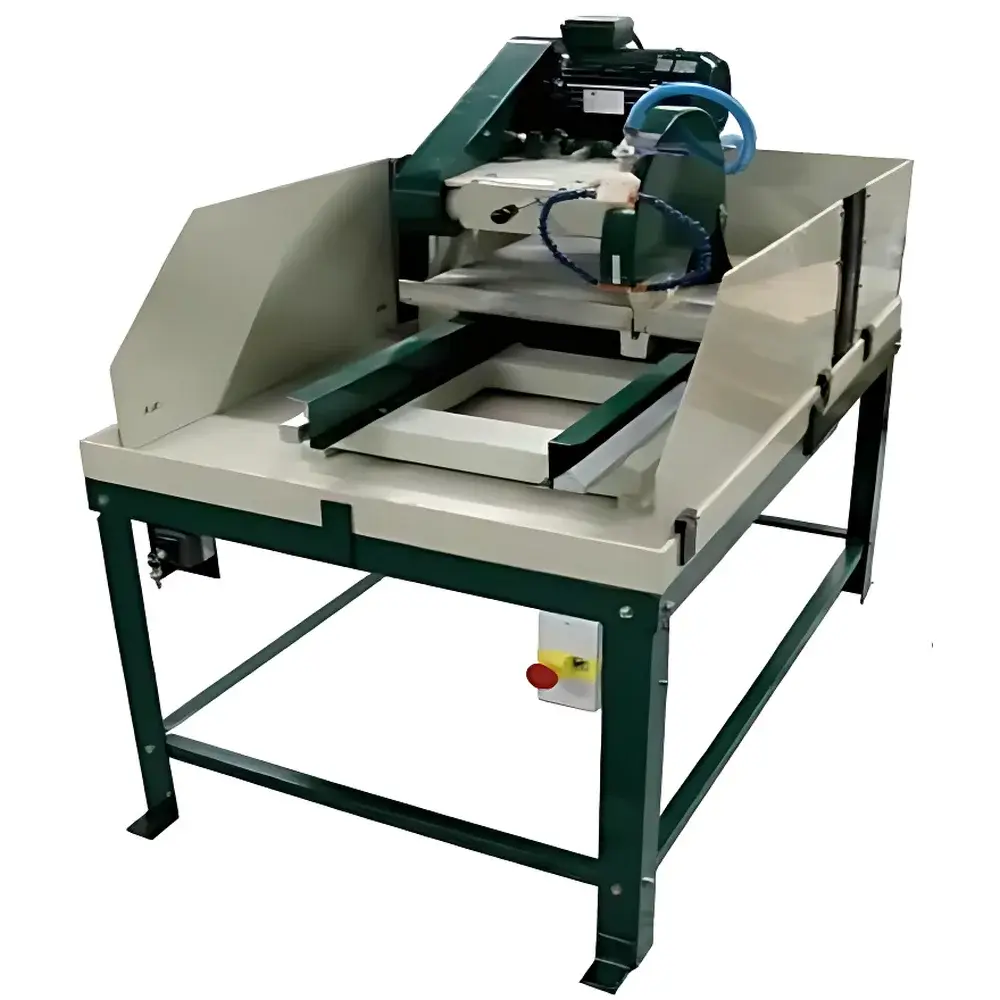
BROT-LAB 10204G Medium-Sized Rock and Core Cutting Machine
| Brand | French BROT-LAB |
|---|---|
| Origin | France |
| Model | 10204G |
| Motor | 3 kW, 400 V, 50 Hz, IP55 |
| Blade Diameter Range | 200–500 mm |
| Max Core Length | 350 mm |
| Working Surface | 350 × 680 × 900 mm |
| Table Top Dimensions | 620 × 500 mm (metal) |
| Blade Speeds | 1440 rpm / 2160 rpm |
| Cooling | Integrated recirculating water system with polypropylene splash-proof collection reservoir |
| Sample Stage | Dual prismatic sliding rails with four copper roller bearings |
| Compliance | CE-marked, designed for ISO/IEC 17025-compliant laboratories |
| Safety Features | Emergency stop, protective guard frame, anti-vibration mounting ring, dust extraction interface (dry-cut mode), splash shield (wet-cut mode) |
Overview
The BROT-LAB 10204G is a CE-certified, medium-duty rock and core cutting machine engineered for precision sample preparation in geological, mining, petrographic, and materials research laboratories. It operates on the principle of controlled abrasive diamond-blade cutting under either dry or wet conditions—enabling reproducible sectioning of heterogeneous, high-hardness specimens including basalt, granite, quartzite, concrete cores, and cementitious composites. Its dual-speed induction motor (1440 rpm / 2160 rpm) delivers consistent torque across variable load conditions, while the adjustable vertical spindle accommodates blade diameters from 200 mm to 500 mm—supporting both thin-sectioning and bulk-core segmentation workflows. Designed for integration into ISO/IEC 17025-accredited labs, the 10204G meets mechanical safety requirements per EN 60204-1 and incorporates structural rigidity to minimize vibration-induced kerf deviation during extended operation.
Key Features
- Robust cast-iron base with anti-vibration mounting ring and reinforced steel frame for dimensional stability during high-torque cutting cycles
- Adjustable vertical spindle assembly enabling precise blade height positioning—critical for repeatable cut depth control and minimizing specimen chipping
- Dual-mode operation: Dry-cut mode with integrated dust extraction port (compatible with standard lab fume hoods or external cyclonic separators); Wet-cut mode with recirculating water system, stainless-steel spray nozzles, and polypropylene splash-resistant collection reservoir
- Sample stage featuring dual prismatic aluminum rails and four hardened copper roller bearings—ensuring low-friction, linear translation and secure clamping of irregularly shaped rock specimens up to 350 mm in length
- Modular tooling interface supporting interchangeable diamond blades (e.g., 350 mm or 500 mm diameter, segmented or continuous rim), arbor adapters, and custom jig mounts
- IP55-rated 3 kW three-phase motor (400 V, 50 Hz) with thermal overload protection and electromagnetic braking for rapid, safe shutdown
- Full perimeter protective guard frame with interlocked access doors and certified emergency stop circuit compliant with EN ISO 13850
Sample Compatibility & Compliance
The 10204G accommodates a broad spectrum of geologic and industrial specimens—including unconsolidated sediments (when pre-stabilized), metamorphic and igneous rocks, drill cores (NQ, HQ, PQ sizes), refractory ceramics, and construction aggregates. Its 620 × 500 mm metal tabletop supports fixtures conforming to ASTM D3665 (core sample preparation) and ISO 14688-1 (geotechnical classification). All wet-cut components are corrosion-resistant (316 stainless steel nozzles, PP reservoir), and the dry-cut dust interface meets EN 60335-1 emission thresholds for laboratory particulate containment. The system is fully traceable for GLP/GMP environments: serial-numbered components, documented calibration intervals for blade runout and table flatness (±0.05 mm/m), and audit-ready maintenance logs.
Software & Data Management
While the 10204G is a manually operated mechanical system—intentionally omitting digital controls to maximize reliability and reduce electromagnetic interference in sensitive lab settings—it includes a dedicated logbook template aligned with ISO/IEC 17025 Clause 7.5.2 (equipment records). Each unit ships with a QR-coded asset tag linking to downloadable documentation: CE Declaration of Conformity, EN 60204-1 compliance report, preventive maintenance schedule, and blade wear assessment protocol. Optional accessories include a laser alignment guide kit (for verifying blade perpendicularity) and a calibrated depth gauge set (traceable to NIST standards), both supporting ALAC-accredited calibration workflows.
Applications
- Preparation of petrographic thin sections and polished blocks for SEM-EDS, micro-CT, and cathodoluminescence analysis
- Segmentation of drill cores for geochemical assay subsampling in exploration and resource evaluation
- Controlled cross-sectional slicing of concrete, asphalt, and composite repair materials per ASTM C42/C1090
- Manufacture of standardized test specimens for uniaxial compressive strength (UCS), Brazilian tensile strength, and point load index testing
- Sectioning of paleontological or archaeological matrix-embedded samples where thermal or mechanical shock must be minimized
FAQ
Is the 10204G compatible with automated sample positioning systems?
No—the 10204G is a manually actuated platform optimized for operator-controlled feed rate and visual alignment; it does not feature CNC or servo-driven axes.
What blade specifications are recommended for cutting granitic rock?
A 400 mm continuous-rim diamond blade with 25–30 µm diamond concentration and metal bond matrix is advised for optimal life and surface finish on granite (typical feed rate: 0.1–0.3 mm/s).
Can the cooling system be connected to a centralized lab water supply?
Yes—the recirculating pump accepts inlet connections for external deionized water loops (max pressure: 3 bar); however, standalone operation with the included 12 L PP reservoir is standard.
Does the machine support vacuum chucking for fragile specimens?
Not natively—but optional vacuum platen adapters (part #VAC-10204-PP) are available for mounting on the existing rail system, rated for ≤80 kPa vacuum.
What is the recalibration interval for mechanical alignment verification?
BROT-LAB recommends annual verification of blade runout (<0.1 mm TIR), table flatness (±0.05 mm/m), and rail parallelism—performed using certified dial indicators and granite surface plates.



