
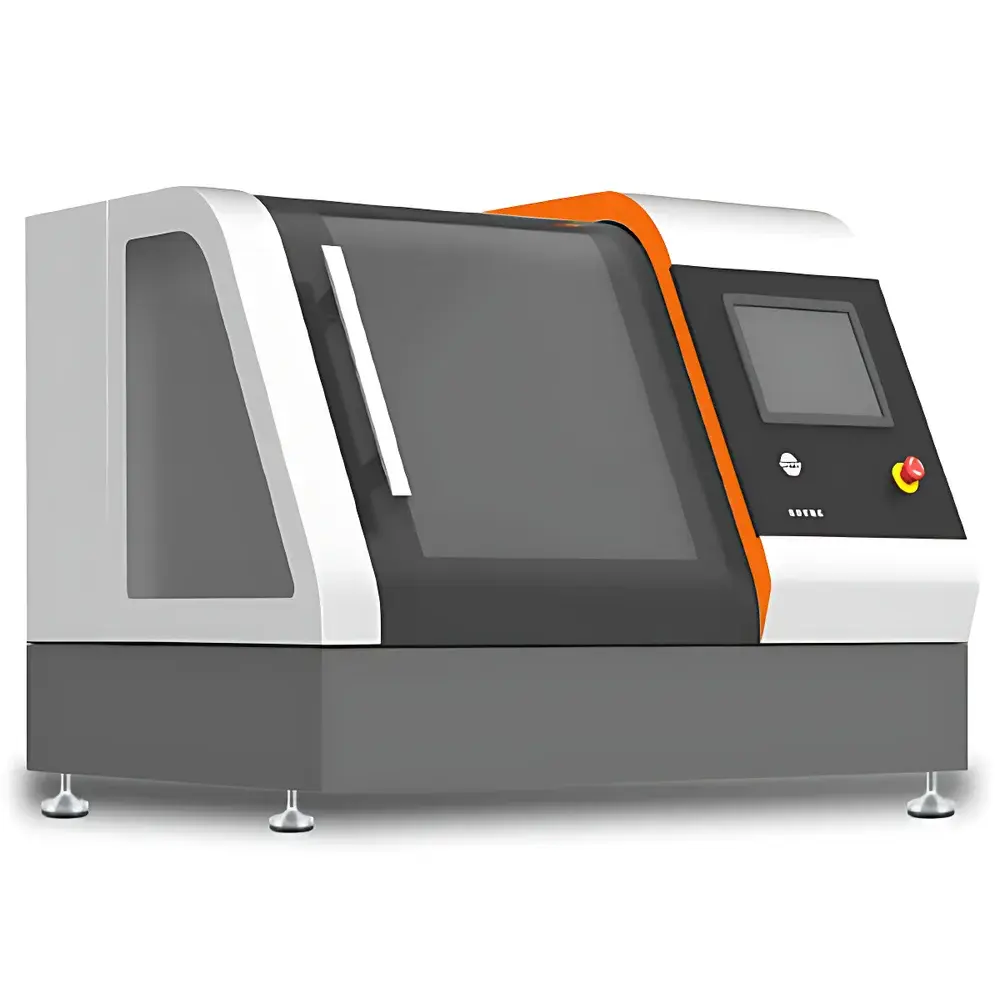
WEIYEE Q-100B Automatic Metallographic Cutting Machine
| Brand | WEIYEE |
|---|---|
| Origin | Guangdong, China |
| Model | Q-100B |
| Maximum Cutting Diameter | Φ100 mm |
| Control Interface | Color Touchscreen |
| Operation Modes | Manual & Automatic |
| Cutting Enclosure | Fully Enclosed |
| Power Supply | 380 V AC, 3 kW |
| Motor Brake System | Integrated |
| Coolant Reservoir Capacity | 60 L (Recirculating) |
| Cutting Wheel Dimensions | Φ350 × 32 × 2.5 mm |
Overview
The WEIYEE Q-100B Automatic Metallographic Cutting Machine is an engineered solution for precise, repeatable, and safe sectioning of metallic, ceramic, and composite specimens in metallurgical laboratories, quality control facilities, and R&D centers. Designed around the principles of controlled abrasive cutting under continuous coolant flow, the Q-100B employs a high-torque, brake-equipped motor to deliver consistent rotational deceleration—critical for minimizing specimen edge deformation and thermal damage during cutoff. Its fully enclosed cutting chamber meets ISO 13857 and IEC 60204-1 safety requirements for mechanical hazard protection, while the integrated 60 L recirculating cooling system ensures stable thermal management across extended operation cycles. The machine supports both manual override and programmable automatic mode, enabling users to define feed rate, cutting depth, dwell time, and final stop position via an intuitive color touchscreen interface—eliminating reliance on external controllers or PC-based software for routine operations.
Key Features
- Fully enclosed cutting chamber with interlocked safety door and transparent polycarbonate viewport for real-time observation without exposure to abrasive debris or coolant mist.
- High-efficiency 3 kW motor with electromagnetic braking system for rapid, controlled wheel stop within <1.5 seconds—reducing post-cut vibration and preserving specimen integrity.
- 60 L stainless-steel coolant reservoir with integrated filtration, temperature monitoring, and level sensor; compatible with water-soluble coolants and oil-based lubricants per ASTM D4700 guidelines.
- Adjustable vertical feed mechanism with micrometer-scale positioning (0.01 mm resolution), enabling reproducible cuts across heterogeneous microstructures.
- Color TFT touchscreen HMI (7-inch, 800×480 resolution) supporting multi-language UI (English, Spanish, German, Chinese), user-defined preset protocols, and password-protected parameter editing.
- Modular wheel arbor design accommodating standard Φ350 × 32 × 2.5 mm cutting wheels—including resin-bonded SiC, diamond-impregnated, and reinforced alumina types per ISO 6344 and EN 12413 specifications.
Sample Compatibility & Compliance
The Q-100B accommodates specimens up to Φ100 mm in diameter or 100 × 100 mm in cross-section, including hardened steels (HRC ≤ 65), aluminum alloys, titanium grades (e.g., Ti-6Al-4V), sintered carbides, and fiber-reinforced composites. Specimen clamping utilizes dual-axis mechanical vise with adjustable jaw inserts (soft brass, hardened steel, and rubber-faced options) to prevent marring while maintaining alignment tolerance within ±0.1°. All operational parameters—including feed force, cycle duration, and coolant flow rate—are configurable to comply with ASTM E3–22 (Standard Guide for Preparation of Metallographic Specimens) and ISO 14489 (Metallographic Sampling and Sectioning). The unit is CE-marked and conforms to EMC Directive 2014/30/EU and Low Voltage Directive 2014/35/EU. Full documentation—including Declaration of Conformity, risk assessment report, and maintenance log templates—is provided for GLP/GMP audit readiness.
Software & Data Management
While the Q-100B operates autonomously via its onboard controller, it features RS-232 and optional Ethernet (TCP/IP) interfaces for integration into laboratory information management systems (LIMS). Cut cycle logs—including timestamp, operator ID, specimen ID, selected protocol, actual feed rate, motor current draw, and coolant temperature—are stored internally (≥10,000 cycles) and exportable as CSV files. Audit trail functionality complies with FDA 21 CFR Part 11 requirements when used with validated third-party LIMS platforms. Firmware updates are performed via USB flash drive with SHA-256 signature verification to ensure integrity.
Applications
- Routine metallographic sample preparation for optical microscopy (OM) and scanning electron microscopy (SEM) analysis.
- Sectioning of weld joints, heat-affected zones (HAZ), and clad materials for hardness profiling and microstructural evaluation per ISO 9015-1.
- Preparation of specimens for tensile testing coupons, fatigue crack initiation studies, and corrosion resistance assessment (e.g., ASTM G46, ISO 10289).
- Cutting of additively manufactured (AM) metal parts to expose build layers and assess porosity distribution.
- High-volume QC workflows in foundries, forging plants, and aerospace component suppliers requiring traceable, SOP-driven sectioning.
FAQ
What types of cutting wheels are compatible with the Q-100B?
The machine accepts standard Φ350 × 32 × 2.5 mm wheels with ISO 5211-compliant mounting flanges—including silicon carbide, aluminum oxide, diamond, and cubic boron nitride (CBN) variants.
Does the Q-100B support automated multi-step cutting sequences?
Yes—up to 10 independent cutting programs can be saved, each defining feed speed, plunge depth, dwell time, and retract behavior for complex geometries.
Is the coolant system compatible with biodegradable coolants?
Yes—the 60 L reservoir and pump assembly are constructed from corrosion-resistant materials (316 stainless steel, EPDM seals) and certified for use with NSF H1-registered and ISO 15380 HEES-class coolants.
Can the Q-100B be integrated into a centralized lab automation network?
Via optional Ethernet module and Modbus TCP protocol support, enabling remote start/stop, status polling, and alarm forwarding to SCADA or MES platforms.
What maintenance intervals are recommended for daily operation?
Daily: coolant level and filter inspection; weekly: wheel flange torque verification and vise lubrication; annually: motor bearing inspection and brake system calibration by authorized service technician.



