
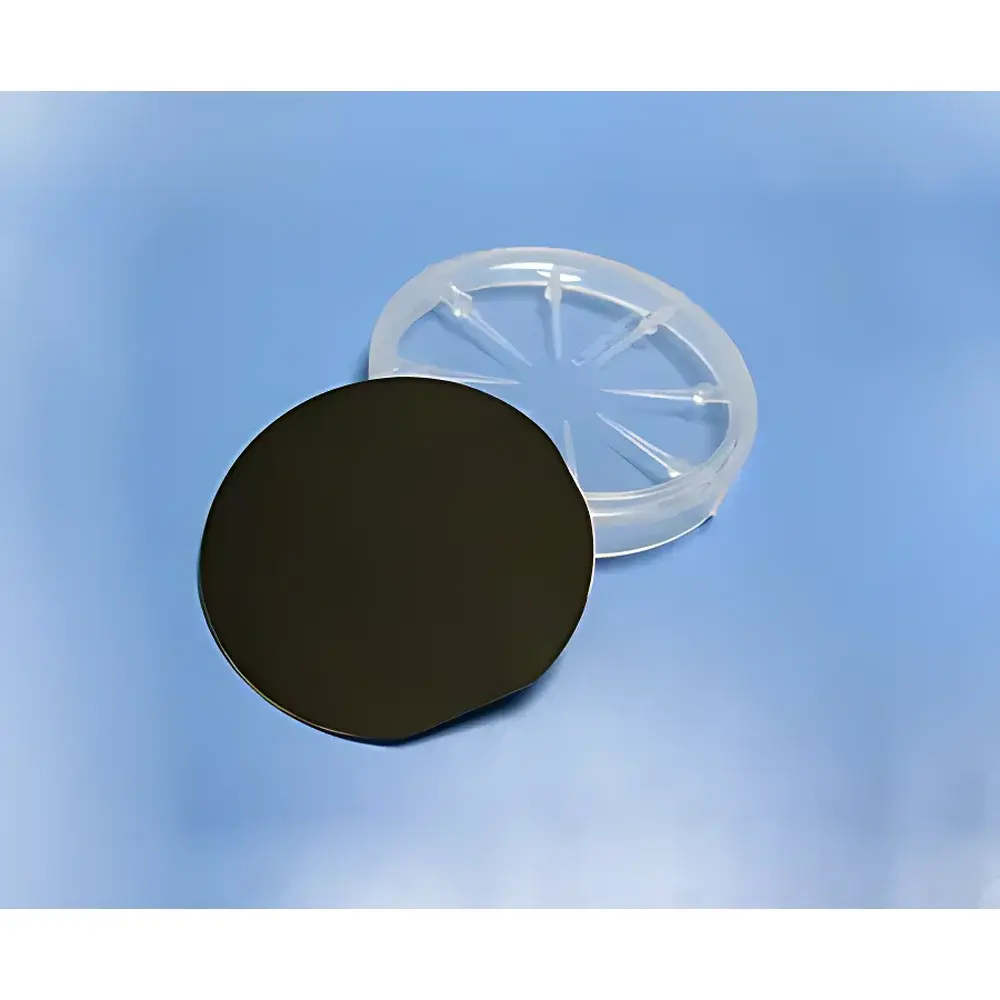
GaSb Crystal Substrates (合肥科晶 | Hefei Kejing)
| Brand | Hefei Kejing |
|---|---|
| Origin | Anhui, China |
| Manufacturer Type | Authorized Distributor |
| Origin Category | Domestic (China) |
| Model | GaSb Crystal Substrates |
| Pricing | Upon Request |
| Doping Types | Undoped, Zn-doped (p-type), Te-doped (n-type) |
| Conductivity Types | P, P⁻, P⁺, N |
| Carrier Concentration | 1×10¹⁶ – 5×10¹⁸ cm⁻³ |
| Dislocation Density | <1×10³ cm⁻² |
| Growth Method | Liquid Encapsulated Czochralski (LEC) |
| Max Diameter | 3 inches |
| Standard Orientations | <100> |
| Thickness | 0.5 mm |
| Surface Finish | Single-side polished |
| Surface Roughness (Ra) | <15 Å |
| Packaging | Class 1000 cleanroom processed |
Overview
GaSb (gallium antimonide) crystal substrates are narrow-bandgap III–V semiconductor wafers engineered for high-performance optoelectronic and infrared device fabrication. With a direct bandgap of ~0.73 eV at 300 K, GaSb supports operation across the mid-infrared (2–5 µm) spectral range—making it indispensable for thermophotovoltaics, infrared detectors, quantum cascade lasers (QCLs), and heterostructure-based photodiodes. These substrates are grown via the Liquid Encapsulated Czochralski (LEC) method under controlled stoichiometric conditions to ensure low dislocation density (<1×10³ cm⁻²) and high crystalline integrity. The material exhibits excellent lattice match with key ternary and quaternary alloys—including InGaAsSb, AlGaAsSb, and InAsSb—enabling epitaxial growth of strain-engineered active layers with minimal interfacial defects.
Key Features
- High-purity single-crystal structure with orientation as standard; custom orientations (e.g., , ) available upon request
- Controlled doping profiles: undoped (high resistivity >10⁷ Ω·cm), Zn-doped (p-type, carrier concentration 1×10¹⁶–5×10¹⁸ cm⁻³), and Te-doped (n-type, 2×10¹⁷–6×10¹⁷ cm⁻³)
- Consistent thickness tolerance: 0.50 ± 0.02 mm, with parallelism ≤5 µm across 2-inch and 3-inch diameters
- Surface quality certified to Ra <15 Å (measured by atomic force microscopy), meeting stringent requirements for molecular beam epitaxy (MBE) and metalorganic chemical vapor deposition (MOCVD)
- Class 1000 cleanroom processing and Class 100 clean packaging minimize particle contamination (<0.1 µm particles per cm²)
- Full traceability documentation provided, including wafer map, XRD rocking curve FWHM data, and Hall effect measurement reports
Sample Compatibility & Compliance
GaSb substrates are compatible with standard semiconductor fabrication workflows, including photolithography, dry etching (Cl₂/BCl₃-based chemistries), and dielectric passivation (SiO₂, SiNₓ). All wafers comply with SEMI MF1530-03 (specifications for compound semiconductor substrates) and meet baseline requirements for ISO 14644-1 Class 5 cleanroom handling. For regulated R&D environments, substrates support GLP-compliant documentation packages—including lot-level certificates of analysis (CoA), material safety data sheets (MSDS), and supplier qualification records. While not inherently FDA-regulated, GaSb wafers used in diagnostic sensor development may be integrated into systems subject to IEC 62304 (medical device software lifecycle) and ISO 13485 (quality management for medical devices).
Software & Data Management
Although GaSb substrates themselves are passive materials, their integration into thin-film deposition systems (e.g., MBE, sputtering, PLD) requires precise substrate identification and process logging. Hefei Kejing provides optional digital wafer tracking via QR-coded labels, enabling linkage to internal LIMS or MES platforms. Each shipment includes a structured CSV metadata file containing batch ID, growth date, dopant type, carrier concentration range, dislocation density, surface roughness, and polishing side designation. This facilitates automated QA/QC workflows compliant with ISO/IEC 17025 clause 7.7 (reporting of results) and supports audit readiness for GMP-aligned research facilities.
Applications
- Epitaxial growth of type-II superlattices (T2SLs) for high-operating-temperature (HOT) infrared focal plane arrays (FPAs)
- Substrate platform for monolithic integration of mid-IR laser diodes and photodetectors
- Base material for electrochemical sensors targeting redox-active species in non-aqueous electrolytes
- Reference substrates in quartz crystal microbalance (QCM) studies involving Sb-terminated surface functionalization
- Template for van der Waals heterostructures incorporating 2D materials (e.g., graphene/GaSb interfaces for tunable Schottky barriers)
- Calibration standards in X-ray diffraction (XRD) and Raman spectroscopy for lattice parameter validation
FAQ
What is the typical etch rate of GaSb in bromine-methanol solution?
Typical etch rates range from 0.5–2.0 µm/min depending on Br₂ concentration (0.1–1.0 vol%) and temperature (20–25 °C); full process optimization requires in-house characterization due to surface oxidation sensitivity.
Can these substrates be used in ultra-high vacuum (UHV) MBE systems without outgassing concerns?
Yes—wafers undergo pre-bake conditioning at 300 °C under vacuum prior to packaging; residual gas analysis confirms total hydrocarbon outgassing rates <1×10⁻⁹ Torr·L/s·cm² after 1-hour bake at 400 °C.
Is orientation-dependent etching behavior documented for GaSb?
Yes—-oriented GaSb exhibits anisotropic etching in NH₄OH:H₂O₂:H₂O (1:1:5), yielding smooth {111}B facets; detailed etch selectivity data is available upon technical inquiry.
Do you provide EDS or SIMS depth profiling data for doped wafers?
Upon request and subject to additional lead time, cross-sectional SIMS profiling (with <1 nm depth resolution) and quantitative EDS mapping (using WDS calibration standards) can be arranged through certified third-party labs.
Related Products





