
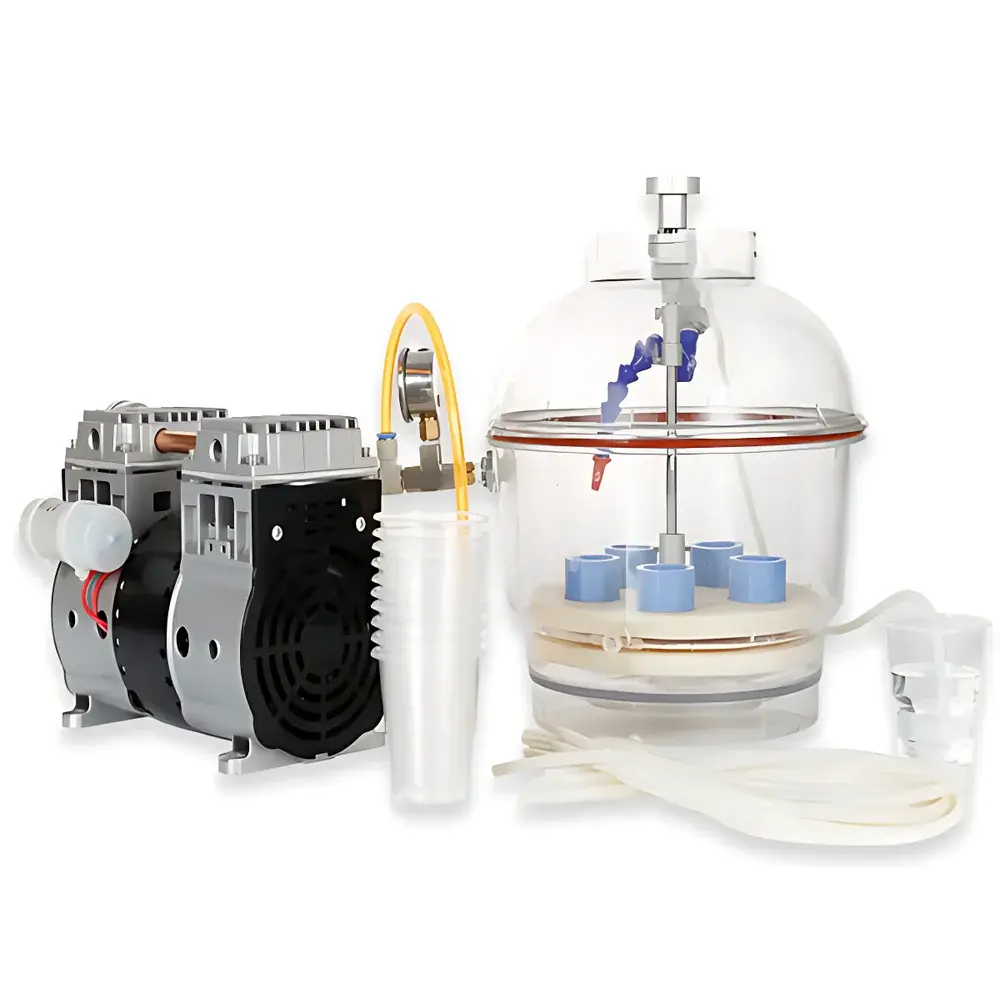
Vacuum Cold Mounting Press CXQ-2500 by WEIYEE
| Brand | WEIYEE |
|---|---|
| Model | CXQ-2500 |
| Type | Cold Mounting Press |
| Vacuum Level | −0.08 MPa |
| Sample Tray Diameter | Φ210 mm |
| Capacity | 8 Specimens Simultaneously |
| Vacuum Pump | Integrated Negative-Pressure Pump |
| Power Supply | AC 220 V |
| Origin | Guangdong, China |
| Equipment Category | Cold Mounting Press for Metallographic/Composite Sample Preparation |
Overview
The WEIYEE CXQ-2500 Vacuum Cold Mounting Press is an engineered solution for reproducible, void-free embedding of sensitive or heat-sensitive specimens—including soft metals, polymers, composites, electronic components, and biological tissues—without thermal degradation. Unlike hot mounting systems that rely on thermosetting resins and elevated temperatures (typically 130–180 °C), this cold mounting press utilizes vacuum-assisted resin infiltration at ambient temperature. The principle hinges on controlled negative pressure (−0.08 MPa) to evacuate air from porous specimen surfaces and interstitial voids, enabling low-viscosity epoxy or acrylic resins to fully penetrate microstructural features prior to polymerization. This process preserves delicate phase boundaries, prevents resin shrinkage-induced edge rounding, and eliminates thermal distortion—critical for high-resolution SEM, optical microscopy, and hardness testing preparation.
Key Features
- Vacuum chamber with integrated negative-pressure pump delivering stable −0.08 MPa vacuum level, verified per ISO 27427:2017 guidelines for vacuum integrity in mounting equipment.
- Large-diameter sample tray (Φ210 mm) accommodating up to eight standard 30 mm or 40 mm diameter metallographic mounts simultaneously—optimized for batch processing in QC labs and academic core facilities.
- Robust aluminum alloy frame with sealed silicone gasket and quick-clamp lid mechanism ensuring long-term vacuum retention and operator safety during resin curing cycles.
- No heating elements or cooling jackets—designed exclusively for ambient-temperature cold mounting workflows using two-part epoxies, fast-cure acrylics, or low-shrink polyester resins.
- Compliance-ready electrical architecture: CE-marked power interface (AC 220 V, 50 Hz), grounded chassis, and overload-protected circuitry meeting IEC 61010-1 safety requirements for laboratory equipment.
Sample Compatibility & Compliance
The CXQ-2500 supports a broad spectrum of specimen types unsuitable for hot mounting: elastomers, adhesives, solder joints, PCB cross-sections, fiber-reinforced composites, and mineralogical thin sections. Its vacuum performance meets ASTM E3-22 Annex A2 criteria for void minimization in embedded samples intended for quantitative metallography. When used with ISO/IEC 17025-accredited mounting protocols—including documented resin batch traceability, vacuum dwell time logs, and post-cure dimensional verification—the system contributes to GLP-compliant sample preparation workflows. While not FDA 21 CFR Part 11–certified as standalone software, its manual operation mode ensures full auditability in regulated environments where electronic records are maintained externally.
Software & Data Management
The CXQ-2500 operates as a hardware-only platform with no embedded firmware or digital control interface. All operational parameters—including vacuum initiation, dwell duration, and release timing—are managed manually via front-panel mechanical valves and analog vacuum gauge feedback. This design eliminates software validation burdens and aligns with ISO/IEC 17025 Clause 6.4.9 (non-automated equipment qualification). Users maintain full procedural control through standardized SOPs, and vacuum cycle logs (date/time, operator ID, specimen IDs, resin lot number) are recorded in paper-based or LIMS-integrated electronic notebooks. For laboratories requiring traceability, optional external USB vacuum data loggers (e.g., calibrated pressure transducers with ±0.002 MPa accuracy) may be interfaced via analog output ports.
Applications
- Preparation of failure analysis specimens for SEM-EDS and FIB-SEM cross-sectioning, where thermal artifacts must be avoided.
- Routine QC mounting of automotive gaskets, aerospace sealants, and medical device polymers per ASTM D3410 and ISO 527-2 test standards.
- Embedding of brittle ceramic matrix composites (CMCs) and sintered carbides prior to precision sectioning and Vickers/Knoop microhardness mapping.
- Archival embedding of forensic evidence (e.g., bullet fragments, tool marks) under chain-of-custody protocols requiring non-destructive stabilization.
- Academic research in additive manufacturing, where support-structure removal residues and layer-bond integrity must be preserved for interfacial characterization.
FAQ
What resin types are compatible with the CXQ-2500?
Epoxy resins (e.g., EpoThin 2), methyl methacrylate (MMA)-based acrylics (e.g., Technovit 5071), and low-viscosity polyester formulations—provided viscosity remains below 500 mPa·s at 25 °C to ensure effective vacuum-assisted infiltration.
Does the unit include vacuum oil or require periodic maintenance?
The integrated diaphragm-type vacuum pump is oil-free and maintenance-light; only periodic inspection of the silicone gasket and filter element (every 6 months under daily use) is recommended per manufacturer service bulletin WX22009-REV3.
Can the CXQ-2500 be used for vacuum impregnation of porous ceramics or concrete cores?
Yes—when paired with low-surface-tension impregnation resins (e.g., modified silanes or fluorinated monomers), the −0.08 MPa vacuum enables deep pore penetration in materials with porosity >5% and average pore diameter >10 µm.
Is the Φ210 mm tray compatible with standard automated grinding/polishing systems?
The tray’s outer dimensions (250 × 250 mm) conform to ISO 1127 standard mounting plate footprints, enabling direct transfer to Struers, Buehler, or ATM auto-polishers without adapter plates.
What safety certifications does the CXQ-2500 hold?
It complies with IEC 61010-1:2010 for electrical safety and carries CE marking under the EU Low Voltage Directive 2014/35/EU; no ATEX or explosion-proof rating is assigned, as it is not intended for flammable solvent environments.



