
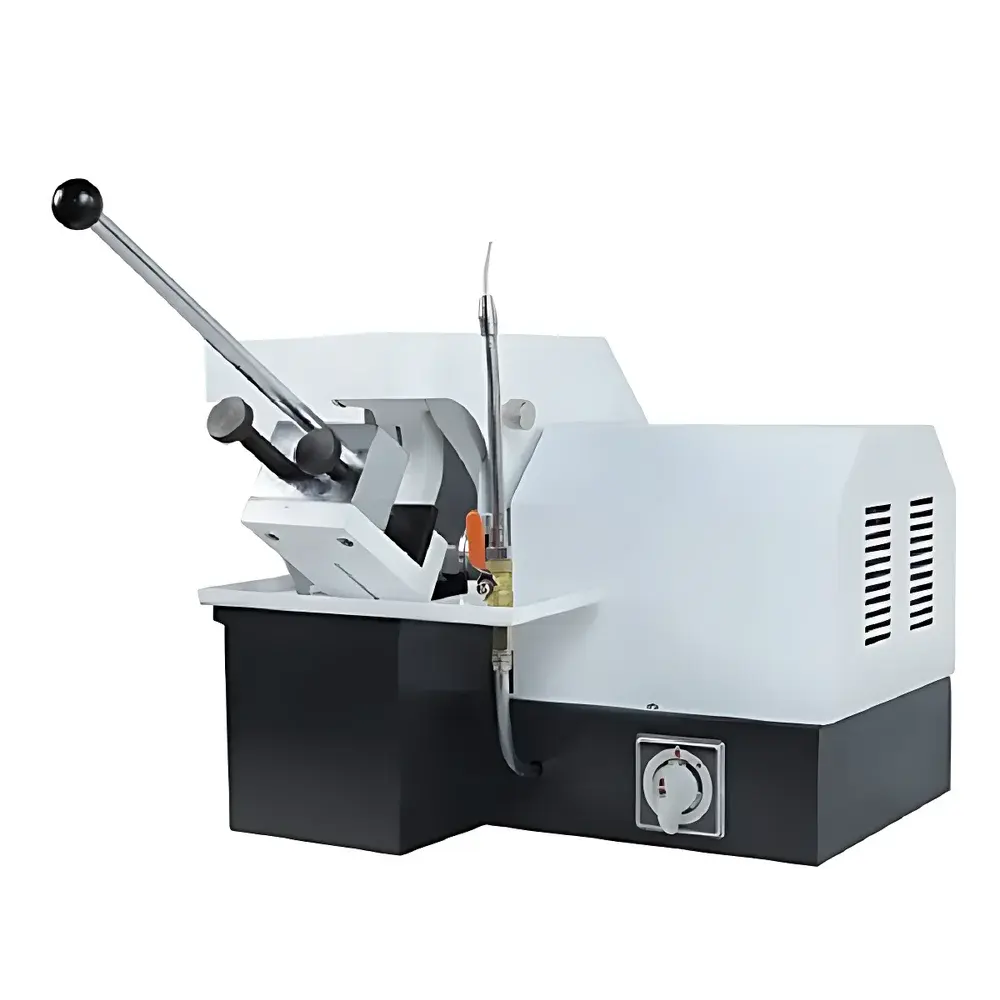
WEIYEE Q-2A Benchtop Metallographic Sample Cutting Machine
| Brand | WEIYEE |
|---|---|
| Origin | Guangdong, China |
| Manufacturer Type | Authorized Distributor |
| Country of Origin | China |
| Model | Q-2A |
| Instrument Type | Metallographic Cutting Machine |
| Max. Cutting Diameter | Φ50 mm |
| Power Supply | 380 V AC, 50/60 Hz |
| Motor Power | 2.1 kW |
| Coolant System | Integrated Water Cooling |
| Cutting Wheel Dimensions | Φ300 × 32 × 2.0 mm |
Overview
The WEIYEE Q-2A is a benchtop metallographic sample cutting machine engineered for precision sectioning of metallic, ceramic, and composite specimens in metallurgical, materials science, and quality control laboratories. It operates on the principle of high-speed abrasive wheel cutting under controlled coolant flow, ensuring minimal thermal distortion and mechanical damage to the microstructure—a critical requirement for subsequent grinding, polishing, and microscopic analysis. Designed for routine preparation of specimens prior to optical or electron microscopy, the Q-2A delivers reproducible cross-sections with sharp edge integrity and low subsurface deformation. Its compact footprint and rigid cast-iron base provide vibration damping essential for dimensional stability during cutting, while the integrated water-cooling system actively suppresses localized heating at the cut interface—preserving phase distribution and preventing oxide layer formation common in uncooled sectioning.
Key Features
- Benchtop configuration optimized for space-constrained laboratory environments without compromising structural rigidity or operational safety.
- High-torque 2.1 kW three-phase motor (380 V AC) enabling consistent rotational speed under variable load conditions, supporting stable feed rates across diverse material hardnesses.
- Maximum specimen diameter capacity of Φ50 mm accommodates standard metallographic mounts, billets, weld coupons, and small castings.
- Standard abrasive wheel specification: Φ300 × 32 × 2.0 mm (hub diameter × thickness × bore), compatible with aluminum oxide, silicon carbide, and diamond-impregnated wheels per ASTM E3–22 guidelines.
- Integrated water-cooling circuit with adjustable flow rate and directional nozzles ensures targeted delivery to the wheel-workpiece interface, reducing kerf loss and extending wheel service life.
- Manually operated vertical feed mechanism with calibrated depth scale allows precise control over cut depth and repeatable positioning for serial sectioning.
- Transparent polycarbonate safety guard with interlocked door switch meets EN 60204-1 and ISO 13857 requirements for operator protection during operation.
Sample Compatibility & Compliance
The Q-2A supports a broad range of conductive and non-conductive solid materials including ferrous and non-ferrous alloys (e.g., stainless steels, aluminum, titanium), sintered powders, refractory ceramics, and fiber-reinforced composites. Specimen geometry is limited only by the Φ50 mm maximum diameter and 120 mm maximum height (with standard clamping fixture). The machine complies with general electrical safety standards applicable to industrial laboratory equipment (IEC 61000-6-2/6-4 for EMC; IP2X enclosure rating). While not certified to UL or CE as a standalone unit due to regional distributor-supplied configuration, it is fully compatible with GLP-compliant workflows when operated within documented SOPs—including logbook entries for wheel replacement, coolant maintenance, and preventive servicing intervals.
Software & Data Management
As a manually operated mechanical cutting system, the Q-2A does not incorporate embedded firmware, touchscreen interface, or digital data output. All operational parameters—including feed rate, cut count, wheel type, coolant concentration, and maintenance history—are recorded externally in laboratory notebooks or LIMS-integrated electronic records. This analog architecture ensures long-term reliability, eliminates software obsolescence risk, and simplifies audit readiness for ISO/IEC 17025-accredited facilities where traceability of manual interventions is explicitly required. Optional accessories include calibrated depth gauges and standardized specimen alignment jigs, both traceable to NIST-certified references.
Applications
- Preparation of transverse and longitudinal sections for weld evaluation per AWS D1.1 and ISO 5817.
- Routine sectioning of heat-treated components to assess case depth, grain structure, and decarburization zones.
- Sampling of additively manufactured parts for porosity and microstructural homogeneity assessment.
- Cutting of coated substrates (e.g., thermal barrier coatings, PVD layers) with minimal delamination using low-feed, high-coolant protocols.
- Sectioning of geological core samples and mineral aggregates for petrographic analysis.
- Supporting failure analysis workflows in aerospace, power generation, and automotive QA/QC labs where microstructural fidelity is non-negotiable.
FAQ
What types of cutting wheels are compatible with the Q-2A?
The machine accepts standard Φ300 × 32 × 2.0 mm abrasive wheels with 32 mm arbor hole—compatible with resin-bonded aluminum oxide, silicon carbide, and diamond wheels rated for 3,600 rpm maximum operating speed.
Is the water-cooling system recirculating or single-pass?
The Q-2A uses a gravity-fed single-pass cooling system requiring connection to a continuous municipal or deionized water source; optional external chillers or reservoir tanks may be integrated via user-modified plumbing.
Can the Q-2A be used for non-metallic samples such as polymers or biological tissues?
It is not recommended for soft or heat-sensitive organic materials; the mechanical energy input and localized frictional heating exceed safe thresholds for polymer integrity or histological preservation.
Does the Q-2A meet FDA 21 CFR Part 11 requirements?
No—this is a non-computerized instrument with no electronic record generation or user authentication capability; compliance must be achieved through procedural controls and external documentation systems.
What maintenance schedule is recommended for sustained performance?
Daily: Clean coolant tank and inspect nozzle clearance; Weekly: Check belt tension and wheel flange fasteners; Quarterly: Replace coolant filter (if installed) and verify electrical grounding resistance ≤4 Ω.



