
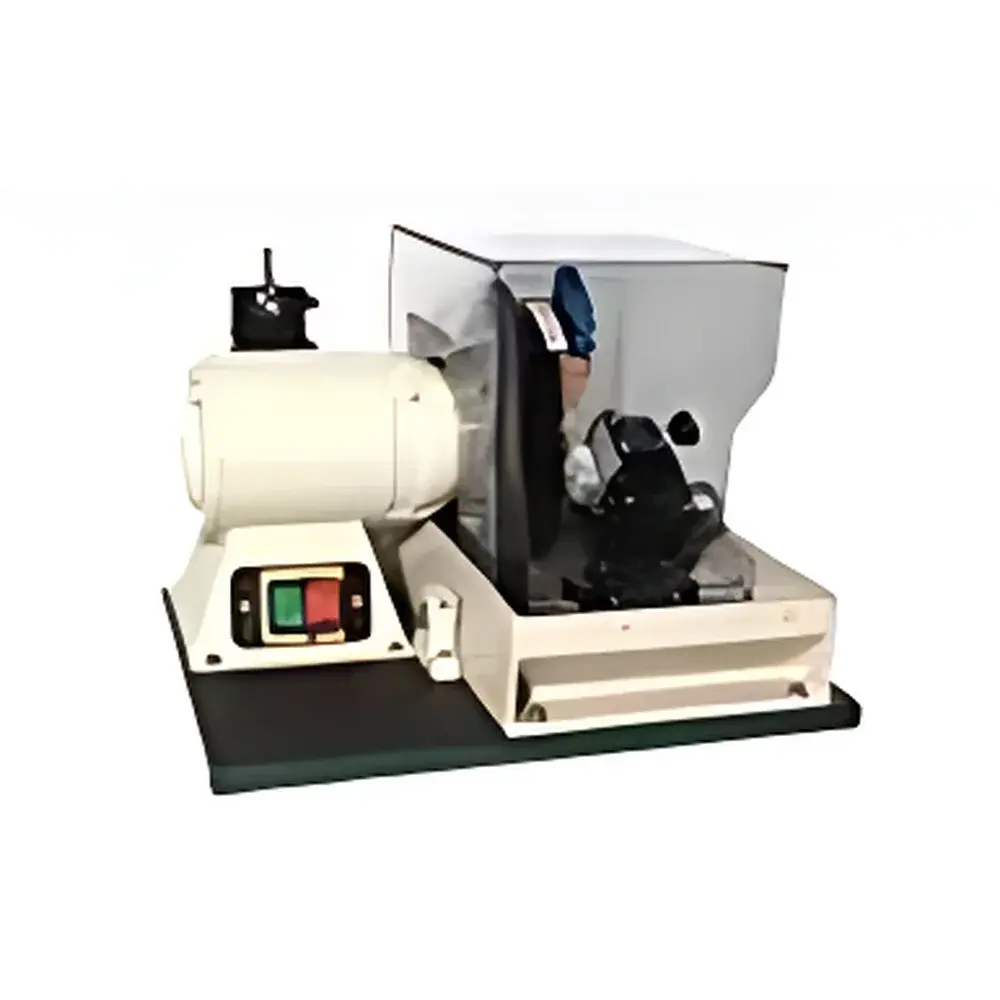
Geological Thin Section & Impregnated Rock Slice Microtome
| Origin | France |
|---|---|
| Manufacturer Type | Authorized Distributor |
| Origin Category | Imported |
| Model | J0223 |
| Price | Upon Request |
| Motor | 3-phase, 300 V / 50 Hz, 0.5 HP (J0223) |
| Diamond Blade Diameter | 200 mm (J0223), 175 mm (J0215) |
| Rotational Speed | 2950 rpm |
| Minimum Thickness Setting | 0.01 mm |
| Maximum Sample Thickness | 30 mm |
| Cooling System | Circulating tap water (J0223), 30 L recirculating coolant reservoir (J0215) |
| Sample Holder Capacity | Two 30 × 45 mm slides or one 45 × 60 mm slide (J0223) |
| Compliance | Designed for ISO/IEC 17025-compliant geological sample preparation workflows |
Overview
The Geological Thin Section & Impregnated Rock Slice Microtome (Model J0223 and companion J0215) is a precision-engineered benchtop and upright microtome system purpose-built for the reproducible preparation of petrographic thin sections and impregnated rock slices used in optical microscopy, cathodoluminescence (CL), and electron microprobe analysis. Unlike general-purpose rotary microtomes, this dual-platform system integrates diamond-blade cutting mechanics with geologically optimized kinematics—leveraging controlled feed rates, rigid sample immobilization, and thermal management to preserve microstructural integrity during sectioning of brittle, heterogeneous, and cemented sedimentary or metamorphic specimens. The J0223 operates on the principle of linear-feed diamond sawing, where the specimen—adhered to a glass carrier—is advanced incrementally into a rotating 200 mm diamond-impregnated blade under continuous water cooling. The J0215 employs a vertical vacuum-stage architecture that enables precise depth-controlled slicing of mounted samples down to 100 µm thickness, with fine-resolution micrometer adjustment (0.01 mm increments) and programmable stop limits. Both instruments are engineered for integration into accredited geological laboratories adhering to ASTM D3407 (Standard Practice for Preparation of Rock Thin Sections) and ISO 14688-1 (Geotechnical Investigation and Testing – Identification and Classification of Soil).
Key Features
- Benchtop J0223 configuration with compact footprint (W × D × H ≈ 650 × 520 × 480 mm), ideal for space-constrained core logging labs and teaching facilities.
- Upright J0215 system featuring electro-pneumatic vacuum chuck (≥65 kPa holding force) compatible with standard 26 × 76 mm and custom-sized glass slides, eliminating epoxy creep or lateral shift during sectioning.
- Industrial-grade 3-phase induction motors—0.5 HP (J0223) and 1.0 kW (J0215)—deliver consistent torque across variable load conditions, minimizing blade deflection and chatter-induced surface artifacts.
- Diamond blades certified to ISO 527-2 for abrasive wear resistance; replaceable segmented rim design allows localized reconditioning without full blade replacement.
- Adjustable feed rate control (mechanical vernier scale) coupled with calibrated depth-stop mechanism ensures repeatable slice thickness within ±2 µm tolerance over consecutive cuts under GLP audit conditions.
- Integrated coolant delivery: J0223 utilizes direct tap-water flow (0.8–1.2 L/min) routed through blade shroud; J0215 includes a 30 L closed-loop reservoir with temperature stabilization (<±1.5°C drift over 4 h) and particulate filtration (5 µm).
Sample Compatibility & Compliance
The microtome accommodates unconsolidated sediments (after resin impregnation), carbonate-cemented limestones, silicified cherts, volcanic tuffs, and low-grade metamorphic schists. Samples must be fully cured in epoxy (e.g., Epofix or Araldite® variants) prior to mounting. The vacuum stage (J0215) supports both permanent acrylic mounts and temporary wax-based adhesives for rapid turnaround in routine QC applications. All mechanical adjustments—including blade angle, sample tilt (±5°), and Z-axis clearance—are lockable with stainless steel set screws to maintain calibration between maintenance intervals. The system complies with CE machinery directive 2006/42/EC and meets electrical safety requirements per IEC 61000-6-2/6-4. Documentation packages include Factory Calibration Certificates traceable to NIST standards and conformity declarations for ISO/IEC 17025 method validation support.
Software & Data Management
While hardware-driven for operational robustness, the J0215 variant optionally integrates with LabSolutions™ PrepSuite v3.2—a validated Windows-based application supporting 21 CFR Part 11 compliance via electronic signatures, role-based access control, and immutable audit trails. Users may log cut parameters (thickness, feed speed, coolant temp, blade revolutions), associate metadata (sample ID, lithology code, operator initials), and export timestamped CSV reports compatible with LIMS platforms (e.g., Thermo Fisher SampleManager, LabWare LIMS). No proprietary firmware updates are required; all calibration constants reside in EEPROM with write-protection enabled by default.
Applications
- Preparation of 30 µm standard thin sections for transmitted light petrography (TL) and polarized light microscopy (PLM) per ASTM D5777.
- Cutting of 100–200 µm thick impregnated slices for scanning electron microscopy (SEM) backscattered electron (BSE) imaging and energy-dispersive X-ray spectroscopy (EDS) mapping.
- Routine sectioning of drill core plugs (up to Ø38 mm × 50 mm) for porosity-permeability correlation studies in reservoir characterization labs.
- Production of serial sections for digital rock physics (DRP) workflows requiring sub-voxel geometric fidelity in µCT reconstruction pipelines.
- Teaching laboratory use in undergraduate geoscience curricula for hands-on instruction in structural geology and sedimentology sample preparation protocols.
FAQ
What is the minimum achievable slice thickness on the J0215 system?
The micrometer-adjustable feed mechanism permits settings as low as 100 µm for routine thin-section production; sub-100 µm slicing (down to ~70 µm) is feasible with optimized epoxy hardness and blade conditioning—but requires empirical validation per sample batch.
Can the J0223 accommodate cylindrical core samples directly?
No—the J0223 is designed exclusively for flat-mounted specimens on glass carriers. Cylindrical cores must first be cut into rectangular blocks using a rock saw, then impregnated and bonded to slides prior to thin-sectioning on either platform.
Is blade alignment verification part of routine maintenance?
Yes—each unit ships with an alignment jig and dial indicator kit. Quarterly verification of blade parallelism (≤0.02 mm deviation over 100 mm travel) is recommended and documented in the included Maintenance Logbook template.
Does the system support automated thickness profiling across a single sample?
Not natively—the J0215 does not include motorized Z-axis scanning. Thickness profiling requires manual repositioning and independent measurement via digital micrometer or optical interferometry post-sectioning.
Are spare diamond blades supplied with initial purchase?
One OEM-certified 200 mm blade (J0223) or 175 mm blade (J0215) is included. Additional blades are available under part numbers DB-J0223-200 and DB-J0215-175, each supplied with individual calibration certificates.



