
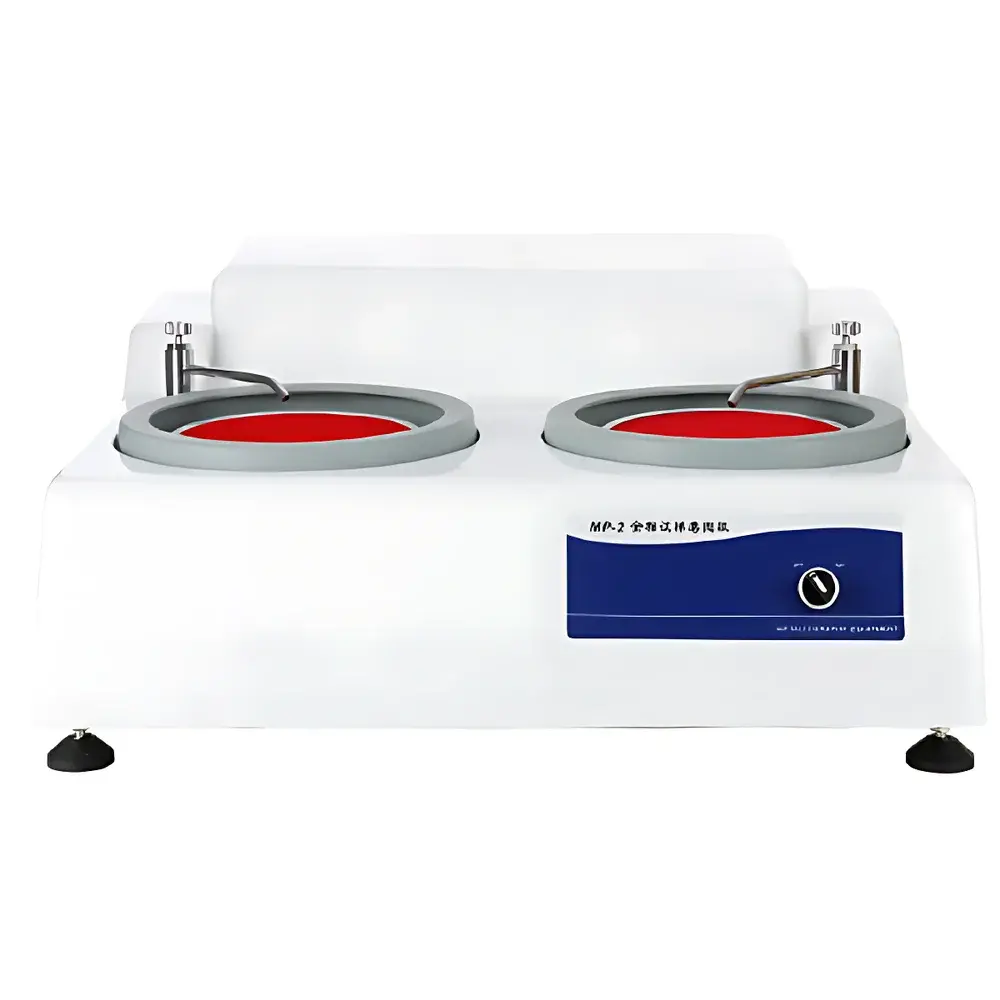
Dual-Disk Specimen Pre-Grinding Machine M-2 by WEIYEE
| Brand | WEIYEE |
|---|---|
| Origin | Guangdong, China |
| Manufacturer Type | Authorized Distributor |
| Country of Origin | China |
| Model | M-2 |
| Rotational Speed | 450 rpm |
| Grinding Disk Diameter | 203 mm (8") |
| Number of Grinding Disks | 2 |
Overview
The WEIYEE M-2 Dual-Disk Specimen Pre-Grinding Machine is an engineered solution for standardized, reproducible specimen surface preparation in metallurgical, materials science, and quality control laboratories. Designed for the initial stage of metallographic sample preparation—pre-grinding—the M-2 employs a fixed-speed, dual-disk configuration to remove bulk material efficiently while minimizing subsurface deformation and heat-induced microstructural alteration. Its operation follows the fundamental principle of controlled abrasive removal via rotational shear between the specimen (mounted on a holder) and rotating abrasive disks. The machine operates at a constant 450 rpm, ensuring consistent tangential velocity across the disk surface—a critical parameter for inter-laboratory method harmonization per ISO 16075 and ASTM E3-22 guidelines for metallographic specimen preparation.
Key Features
- Dual independent grinding stations with identical 203 mm (8 inch) diameter aluminum alloy disks, enabling parallel processing or sequential coarse/fine pre-grinding using different abrasive media.
- Fixed-speed drive system delivering stable 450 rpm rotation—optimized to balance material removal rate and thermal management for ferrous and non-ferrous alloys, ceramics, and composites.
- Robust cast-iron base and precision-machined spindle assembly ensure mechanical stability and long-term runout tolerance ≤ 0.05 mm, supporting repeatable planarity during extended operation.
- Integrated splash guard and drain channel design facilitates safe containment of coolant or lubricant (e.g., water-based grinding fluids), complying with OSHA 1910.132 and ISO 12100 safety requirements.
- Single-phase 220 V AC input with thermal overload protection and emergency stop circuitry—certified to IEC 61000-6-2/6-4 electromagnetic compatibility standards.
Sample Compatibility & Compliance
The M-2 accommodates specimens up to 40 mm in height and 25 mm in diameter when mounted in standard metallographic holders (e.g., phenolic, bakelite, or cold-mounting resins). It supports common pre-grinding abrasives including silicon carbide (SiC) papers (P80–P220), diamond-impregnated pads, and alumina-based lapping films. All operational parameters align with ISO 14577-1 (hardness testing specimen prep), ASTM E3-22 (standard guide for preparation of metallographic specimens), and GB/T 13298-2015 (Chinese national standard for metallographic specimen preparation). The unit is suitable for GLP-compliant environments where documented procedural consistency is required, though it does not include built-in audit trail functionality.
Software & Data Management
The M-2 is a manually operated, hardware-only instrument with no embedded microprocessor or digital interface. It requires no software installation, firmware updates, or data logging capabilities. This analog architecture ensures operational simplicity, minimal maintenance overhead, and immunity to cybersecurity vulnerabilities—advantageous in regulated settings where validation of electronic records (per FDA 21 CFR Part 11) is not mandated for pre-grinding steps. Process documentation (e.g., operator ID, start/end time, abrasive type, and cycle count) must be recorded externally in laboratory notebooks or LIMS-integrated worksheets.
Applications
- Routine pre-grinding of cross-sectioned metallic components (e.g., weld joints, castings, rolled sheets) prior to fine grinding and polishing stages.
- Standardized thickness reduction of ceramic substrates and sintered powder metallurgy parts before microstructural analysis via SEM or EBSD.
- High-volume specimen throughput in QC labs performing incoming material verification per ASTM A370 or ISO 6892-1 tensile test specimen preparation.
- Preparation of geological thin sections and mineralogical samples requiring planar surface uniformity prior to petrographic microscopy.
- Training platform in academic metallurgy labs due to its mechanical transparency, ease of maintenance, and alignment with ISO/ASTM teaching protocols.
FAQ
Is the M-2 compatible with automatic specimen mounting systems?
No—the M-2 is designed for manual placement and pressure application using standard metallographic holders. It does not integrate with automated loading arms or robotic sample handlers.
Can the rotational speed be adjusted?
No—speed is fixed at 450 rpm to maintain compliance with standardized pre-grinding protocols defined in ASTM E3-22 Annex A1.
What cooling options are supported?
The unit features threaded ports for connection to external recirculating coolant systems; drip-feed or flood-cooling with water or water-glycol mixtures is recommended for ferrous alloys.
Does the M-2 meet CE or UL certification requirements?
It complies with IEC 61000-6-2/6-4 EMC standards and carries CCC (China Compulsory Certification); CE or UL listing is not applicable as it is distributed exclusively for use in markets accepting CCC-marked laboratory equipment.
How often should the grinding disks be replaced?
Disk service life depends on abrasive type and load—typically 200–500 cycles for SiC paper under standard load conditions; visual inspection for glazing or warping is the primary replacement criterion.



