
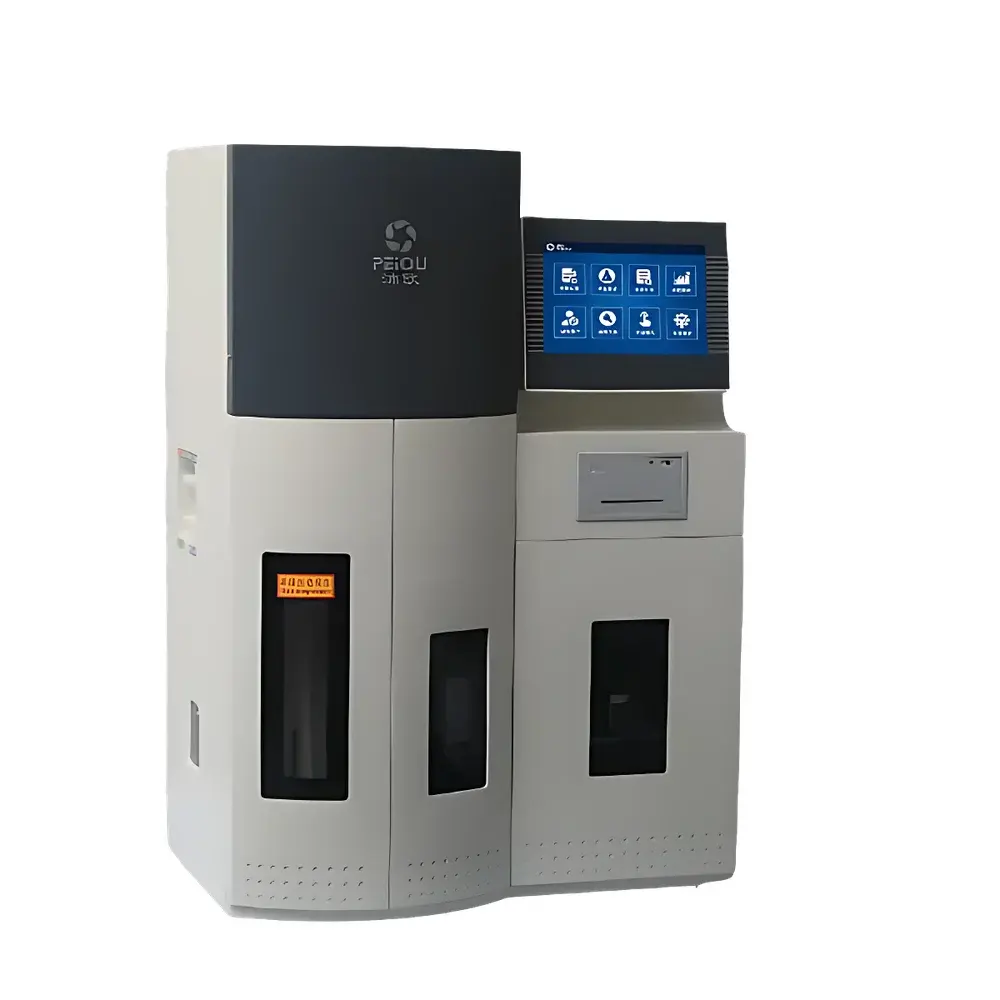
Peiou SKD-3000 Fully Automated Kjeldahl Nitrogen Determinator
| Brand | Peiou |
|---|---|
| Origin | Shanghai, China |
| Model | SKD-3000 |
| Automation Level | Fully Automated |
| Nitrogen Determination Range | 0.1–240 mg N |
| Sample Throughput | 1 sample per 3–8 min |
| Repeatability | RSD < 0.5% |
| Sample Weight Capacity | ≤6 g (solid) or ≤16 mL (liquid) |
| Nitrogen Recovery Rate | >99.5% |
| Dimensions (L×W×H) | 500 × 350 × 720 mm |
| Titration Resolution | ≤0.001 µL/step |
| Minimum Titration Volume | 0.8 µL/step (auto-adjusted per titrant concentration) |
| Distillation Flow Rate | 15–30 mL/min (adjustable) |
| Data Storage | Unlimited (on-board + wireless PC sync) |
| Compliance | Designed for GLP/GMP-aligned workflows with audit trail, user-level access control (3-tier password), and full data traceability |
Overview
The Peiou SKD-3000 Fully Automated Kjeldahl Nitrogen Determinator is an engineered solution for precise, reproducible quantification of total nitrogen—and by extension, protein content—based on the internationally standardized Kjeldahl digestion and distillation methodology (AOAC 984.13, ISO 8968-1, ASTM D1122, USP & EP monographs). It integrates controlled acid digestion (performed off-instrument), automated alkaline distillation under inert steam environment, colorimetric endpoint detection via high-stability RGB photometric sensing, and intelligent back-titration in a single, closed-loop workflow. Unlike semi-automated systems, the SKD-3000 performs distillation and titration concurrently—minimizing ammonia loss through immediate neutralization of evolved NH3 in boric acid solution. Its dual-level liquid sensing in the distillation chamber, real-time temperature monitoring of the digestion flask holder, and fail-safe interlocks (cooling water flow/pressure, reagent level, safety door status) ensure operational integrity across extended unattended runs. The system is validated for routine use in food safety labs (dairy, cereals, feed), agricultural testing centers (soil, fertilizer), environmental monitoring (sludge, sediment), and chemical QC environments where regulatory compliance and method traceability are mandatory.
Key Features
- Simultaneous distillation and titration with real-time RGB-based colorimetric endpoint detection—eliminates time lag between NH3 evolution and capture, improving recovery consistency.
- Adjustable distillation power (30–100%, 500–1500 W) and programmable steam flow rate (15–30 mL/min) enable optimized recovery for both trace-level (0.1 mg N) and high-concentration (240 mg N) samples.
- High-resolution syringe pump titration system with ≤0.001 µL/step precision and auto-scaling minimum volume (0.8 µL/step) calibrated to titrant molarity—ensuring stoichiometric accuracy across variable acid concentrations.
- Triple-safety architecture: (1) Dual liquid-level sensors in distillation chamber prevent dry-heating; (2) Real-time cooling water flow/pressure monitoring with automatic shutdown; (3) Mechanical and optical safety door interlock with status logging.
- Full reagent management: Independent peristaltic pumps for H2SO4, NaOH, boric acid, and dilution water—volumetrically metered in 1-mL increments (0–150 mL range) with low-level alarms.
- On-device 7-inch color touchscreen with Chinese/English bilingual GUI, context-aware prompts, and step-by-step guided operation—including digest tube ejection, waste evacuation, and system self-cleaning cycles.
- Embedded data governance: All analytical events—including reagent volumes, distillation duration, titration curve, operator ID, timestamp, and instrument environmental logs—are recorded with cryptographic integrity and exportable in CSV/PDF formats.
Sample Compatibility & Compliance
The SKD-3000 accommodates solid samples up to 6 g and liquid samples up to 16 mL in standard 300–550 mL digestion tubes. Its modular steam generator and condenser design supports heterogeneous matrices including viscous dairy concentrates, fibrous animal feed, acidic soil extracts, and high-salt industrial effluents. Method validation confirms compliance with AOAC 984.13 (protein in foods), ISO 5983-1 (animal feeding stuffs), and EPA Method 351.2 (wastewater total Kjeldahl nitrogen). Instrument firmware enforces 21 CFR Part 11–compatible audit trails—including immutable operator login history, parameter change logs, and electronic signature capture for report approval. All stored data retain full traceability to original sample ID, digestion batch, and calibration certificate—meeting GLP documentation requirements for third-party accreditation (e.g., ISO/IEC 17025).
Software & Data Management
Data acquisition and reporting are managed via Peiou’s proprietary KjelSoft v4.2 platform, installed on the included Windows-based control PC. The software implements role-based access control (RBAC) with three-tier password protection (operator, supervisor, administrator), session timeout, and forced periodic credential renewal. Every analysis generates a timestamped, digitally signed PDF report containing raw titration curves, calculated N/protein values (with configurable conversion factors), QC flagging (e.g., out-of-range blank, poor linearity), and instrument health metrics. Wireless transmission (Wi-Fi 5 GHz band) enables secure push to LIMS or network storage without physical USB exposure—reducing contamination risk in cleanroom or regulated lab environments. Historical datasets (≥100,000 analyses) remain searchable by date range, operator, sample type, or custom metadata tags. Raw sensor logs (temperature, pressure, photometric absorbance) are retained for root-cause analysis during method troubleshooting or regulatory inspection.
Applications
- Food & Beverage: Crude protein determination in milk powder (ISO 8968-1), soy flour (AOAC 992.15), meat products, and infant formula—supporting nutritional labeling and allergen control.
- Agriculture & Feed: Total nitrogen quantification in compound feed, silage, manure, and biofertilizers per EN 15935 and DIN 15932 standards.
- Environmental: Kjeldahl nitrogen in municipal sludge, river sediments, and industrial wastewater per ISO 14851 and EPA 351.2 protocols.
- Chemical & Petrochemical: Nitrogen impurity screening in lubricants, solvents, and polymer precursors where trace N affects catalytic stability or thermal degradation behavior.
- Pharmaceutical Excipients: Verification of nitrogen content in gelatin, casein, and albumin-based carriers used in oral solid dosage forms (USP & Ph. Eur. general chapters).
FAQ
What digestion equipment is required for use with the SKD-3000?
The SKD-3000 is a distillation/titration unit only and requires external digestion using standard Kjeldahl digestion blocks or microwave systems. Compatible digestion tubes (300–550 mL) must conform to ISO 3696 Grade 3 water specifications for reagent purity.
Does the system support direct integration with laboratory balances?
Yes—optional RS232/USB balance interface enables automatic sample weight import into the method template, eliminating manual entry errors and supporting ALCOA+ data integrity principles.
How is calibration verified on the SKD-3000?
Calibration is performed using certified ammonium sulfate reference standards (e.g., NIST SRM 2053). System performance is verified daily via blank analysis and control charting of recovery (%R) and repeatability (RSD) against established acceptance criteria (recovery ≥99.5%, RSD ≤0.5%).
Can the SKD-3000 be operated in ambient laboratory conditions without climate control?
Yes—the instrument operates reliably at 10–35°C and 30–80% RH. Internal temperature compensation algorithms correct for ambient drift in photometric detection and pump volumetric delivery.
Is method validation documentation provided with the instrument?
Peiou supplies a comprehensive IQ/OQ protocol package—including installation checklist, operational verification tests, and performance qualification templates aligned with ISO/IEC 17025 and FDA guidance—along with pre-validated methods for major food and feed matrices.
Related Products



