
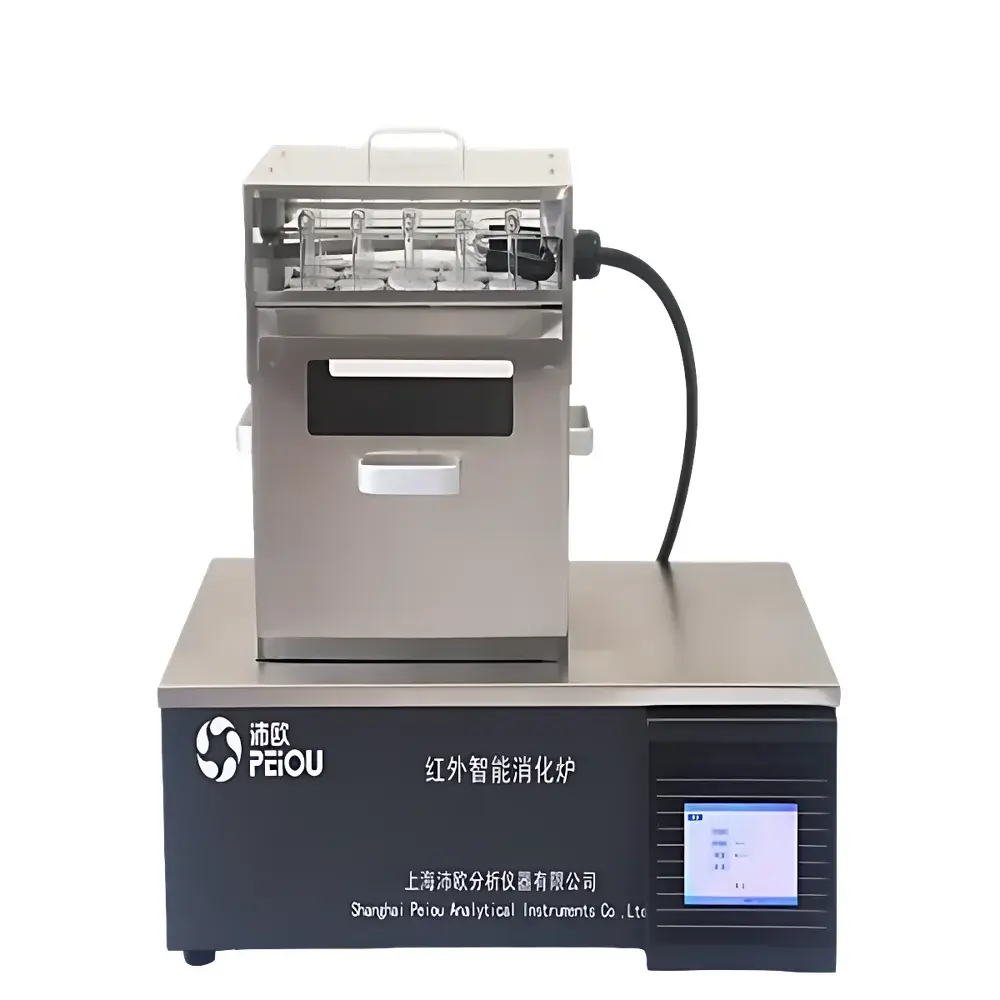
Peiou SKD-08S3 Quartz Infrared Digestion Furnace
| Brand | Peiou |
|---|---|
| Origin | Shanghai, China |
| Model | SKD-08S3 |
| Heating Method | Infrared radiation via opal white quartz tubes |
| Number of Digestion Ports | 8 |
| Temperature Range | Ambient to 550 °C |
| Temperature Stability | ±1 °C |
| Ramp Time | 15 min to 400 °C (preheat) |
| Control Interface | LCD display with n-step programmable ramping and timer |
| Insulation | Dual-layer (ceramic fiber + air gap) |
| Power Supply | AC 220 V |
| Rated Power | 1.6 kW |
| Safety Features | Dual independent switches (power & heating), over-current protection, earth leakage protection, integrated explosion-proof cap, corrosion-resistant stainless steel fume hood with lift mechanism and acid-resistant tray |
| Compliance | CE-marked |
Overview
The Peiou SKD-08S3 Quartz Infrared Digestion Furnace is an engineered solution for open-vessel wet digestion of organic and inorganic matrices under controlled thermal conditions. It operates on the principle of selective far-infrared (FIR) radiation transfer, utilizing opal white quartz heating elements that absorb >97% of visible and near-infrared energy emitted by embedded resistive filaments. This absorption induces Si–O bond vibrational excitation within the quartz lattice, resulting in efficient emission of far-infrared radiation (peak wavelength ~3–6 µm), which couples directly with molecular vibrational modes in digestion reagents (e.g., H₂SO₄, HNO₃, H₂O₂). Unlike conventional metal-sheathed or ceramic heating blocks, this radiation-based heating minimizes thermal lag, eliminates hot-spot formation, and ensures uniform volumetric energy deposition into digestion tubes—critical for reproducible decomposition of complex biological and environmental samples.
Key Features
- Eight independently heated digestion ports with uniform thermal distribution across each zone; inter-port temperature deviation <±0.8 °C at 450 °C
- Opal white quartz infrared emitters—coating-free, chemically inert, resistant to concentrated H₂SO₄, HClO₄, and HF vapors up to 550 °C
- Dual-stage thermal insulation: high-purity ceramic fiber blanket (density ≥128 kg/m³) combined with a sealed air-gap cavity, reducing external surface temperature to <60 °C at full load
- Programmable temperature control with up to 8-segment ramp-and-hold profiles; real-time graphical display of setpoint vs. actual temperature curves
- Integrated safety architecture: dual-pole power isolation switch, independent heating circuit breaker, residual-current device (RCD) rated at 30 mA, and passive explosion-relief caps on all digestion ports
- Corrosion-engineered accessories: electropolished 316L stainless steel fume extraction hood with vertical lift mechanism, PTFE-coated digestion tray, and acid-resistant PVC exhaust tubing interface
Sample Compatibility & Compliance
The SKD-08S3 supports standard borosilicate glass (e.g., Pyrex) and quartz digestion tubes (16–20 mm OD), accommodating sample masses from 0.1 g to 5 g depending on matrix density and acid volume. It complies with ISO 11047:1998 (determination of nitrogen in animal feeding stuffs), EPA Method 3050B (acid digestion of sediments, sludges, and soils), and AOAC 985.01 (crude protein determination). The absence of metallic heater contact surfaces prevents catalytic side reactions and metal leaching—ensuring integrity of trace-metal analysis workflows. All electrical components meet CE conformity requirements per EN 61000-6-3 (EMC) and EN 61000-6-4 (immunity), and mechanical design adheres to EN 61010-1:2010 for laboratory electrical equipment safety.
Software & Data Management
While the SKD-08S3 operates via embedded microcontroller-based firmware (no PC connectivity), its LCD interface logs critical operational metadata—including start time, total run duration, peak temperature achieved per port, and number of thermal cycles—stored in non-volatile memory for GLP-compliant record retention. The PID control algorithm maintains setpoint accuracy within ±1 °C over 24-hour continuous operation, with automatic recalibration triggered upon power-up. Audit trails are exportable via optional RS-232 serial module (sold separately), enabling integration into LIMS environments supporting ASTM E2500-22 data integrity frameworks and FDA 21 CFR Part 11 electronic signature readiness when paired with validated third-party software.
Applications
This furnace is routinely deployed in accredited environmental laboratories for digestion of soil, sludge, and plant tissue prior to ICP-OES or ICP-MS quantification of heavy metals (Cd, Pb, As, Cr). In agricultural research, it enables rapid Kjeldahl nitrogen recovery from feedstuffs and grain without charring artifacts. Food safety labs apply it for sulfate ash preparation and total phosphorus determination per ISO 6496. Geological laboratories use it for silicate rock dissolution under closed-vessel pre-digestion protocols. Its low thermal inertia (<30 s response time to setpoint change) and absence of convective air currents also make it suitable for method development involving volatile analytes (e.g., Se, Hg) where redox control during digestion is essential.
FAQ
What types of digestion tubes are compatible with the SKD-08S3?
Standard 16–20 mm OD borosilicate glass or fused quartz tubes—up to 300 mL capacity—can be accommodated. Tube height must not exceed 350 mm to ensure full immersion in the radiative field.
Does the furnace support method validation per ISO/IEC 17025?
Yes. Its documented temperature uniformity, repeatability (±0.6 °C over 10 consecutive runs), and traceable calibration certificate (NIST-traceable thermocouple input) fulfill Clause 7.7 requirements for equipment verification.
Can the SKD-08S3 be used for perchloric acid digestion?
No. Perchloric acid (HClO₄) digestion requires specialized fume hoods with wash-down capability and explosion-proof enclosures beyond the scope of this instrument’s safety rating. Use only with sulfuric, nitric, hydrochloric, and hydrogen peroxide-based systems.
Is firmware upgrade capability available?
Firmware updates are performed exclusively via authorized service centers using JTAG interface; no user-accessible update path exists to preserve regulatory compliance integrity.
What maintenance is required for long-term performance?
Annual inspection of quartz emitter emissivity (via calibrated pyrometer), replacement of ceramic fiber insulation if compressed >15%, and verification of RCD trip threshold every 6 months per IEC 61558-1.
Related Products



