
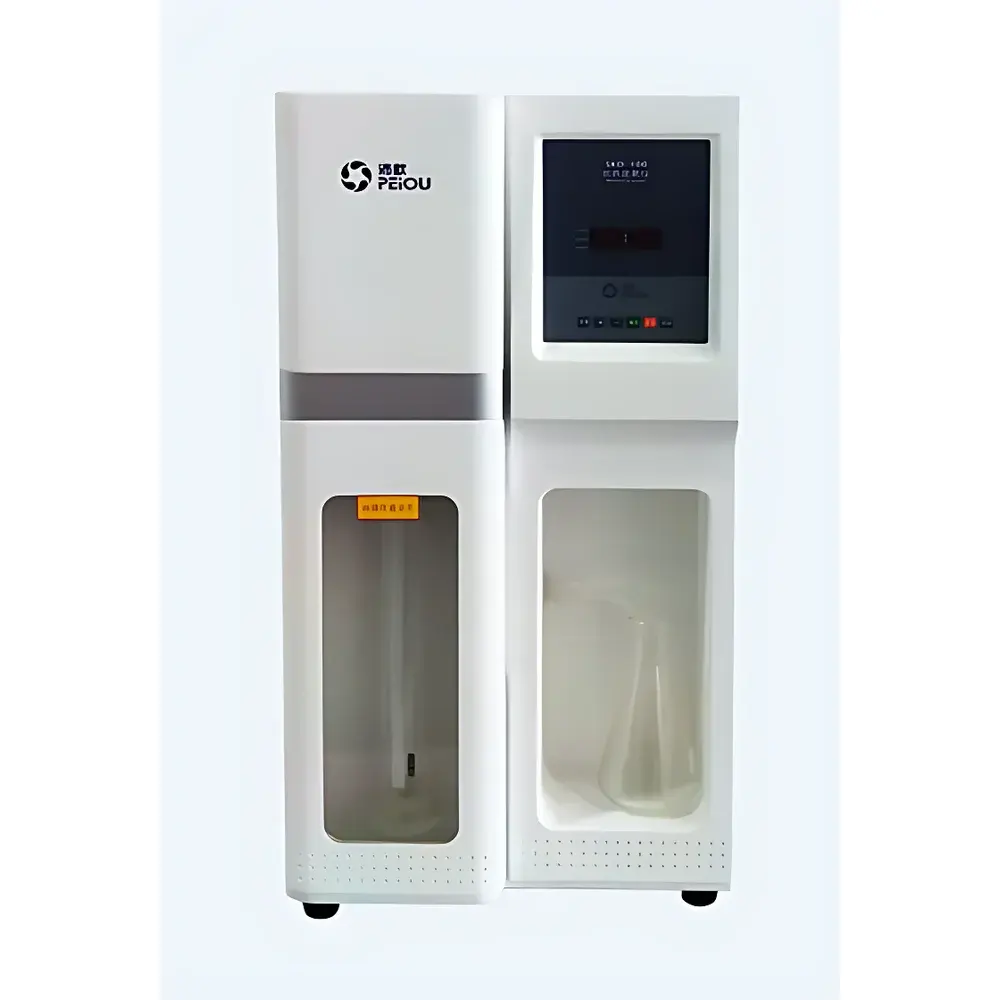
Peiou SKD-100 Kjeldahl Nitrogen Determinator – Protein Analyzer
| Brand | Peiou |
|---|---|
| Origin | Shanghai, China |
| Manufacturer Type | Authorized Distributor |
| Regional Classification | Domestic (China) |
| Model | SKD-100 |
| Instrument Type | Kjeldahl Nitrogen Determinator |
| Automation Level | Semi-Automatic |
| Nitrogen Measurement Range | 0.1–240 mg N |
| Distillation Time | 3–8 min per sample |
| Repeatability | RSD < 0.5% |
| Sample Weight Capacity | Solids < 6 g, Liquids < 16 mL |
| Nitrogen Recovery Rate | ≥99.5% |
| Power Rating | 1500 W |
| Dimensions (L×W×H) | 370 × 300 × 680 mm |
Overview
The Peiou SKD-100 Kjeldahl Nitrogen Determinator is a semi-automatic benchtop analyzer engineered for precise, reproducible quantification of total nitrogen content in organic and inorganic samples via classical Kjeldahl digestion and steam distillation methodology. Designed in accordance with ISO 8968-1, AOAC 981.10, and ASTM D1122–17 standards, the instrument delivers trace-level nitrogen measurement across a broad dynamic range (0.1–240 mg N), enabling direct protein estimation using standard conversion factors (e.g., 6.25 for cereals, 5.70 for dairy). Its robust architecture integrates thermally stable steam generation, pressure-regulated alkali delivery, and real-time liquid-level monitoring to ensure analytical integrity throughout the distillation cycle—critical for laboratories operating under GLP or ISO/IEC 17025-compliant quality systems.
Key Features
- Corrosion-resistant monolithic ABS engineering plastic chassis—chemically inert to concentrated H2SO4, NaOH, and H2O2, eliminating rust, electrical leakage, and structural degradation over extended service life.
- Proprietary high-temperature, acid/alkali-resistant tubing system—rated for continuous exposure to 98% sulfuric acid and 40% sodium hydroxide; validated for >3 years of uninterrupted operation without replacement.
- Pressure-driven alkali dosing mechanism—replaces conventional peristaltic or diaphragm pumps, ensuring consistent volumetric delivery (0–99 s programmable, segmented timing) and eliminating pump corrosion, clogging, and calibration drift.
- Intelligent steam regulation with dual-pressure safety circuitry—maintains stable vapor output while preventing back-suction through integrated overpressure relief and steam equilibrium control.
- Microcontroller-based automation—executes sequential operations including alkalization, distillation (0–99 min adjustable), condensate collection (15–30 mL/min flow rate control), and post-run self-cleaning of distillation chamber and alkali pathways.
- Real-time dry-boil protection—optical liquid-level sensors continuously monitor distillation flask fill level; automatic power cutoff prevents thermal damage during low-water conditions.
Sample Compatibility & Compliance
The SKD-100 accommodates heterogeneous matrices common in food safety, agricultural research, environmental testing, and pharmaceutical QC workflows—including cereals, feedstuffs, dairy products, soil extracts, wastewater, biological tissues, and herbal preparations. Sample introduction supports solids ≤6 g and liquids ≤16 mL per run. All operational parameters comply with internationally recognized validation frameworks: nitrogen recovery consistently exceeds 99.5% against certified reference materials (CRMs) such as BCR-65 (wheat flour) and NIST SRM 8414 (bovine serum albumin). The system meets essential requirements for method traceability under ISO/IEC 17025:2017 Clause 7.2.2 and supports audit-ready documentation when paired with external LIMS integration.
Software & Data Management
Equipped with embedded firmware supporting up to 10 user-defined distillation and alkali addition protocols, the SKD-100 stores method parameters—including alkali delay time, distillation duration, condensate volume target, and power modulation settings—for rapid recall and execution. LED display provides real-time feedback on operational status, elapsed time, and active program ID. While the unit does not feature built-in data export or network connectivity, it generates timestamped internal logs compatible with manual transcription into compliant electronic lab notebooks (ELNs) or CSV-compatible spreadsheets. For regulated environments requiring 21 CFR Part 11 compliance, external validation of operator access controls and audit trail generation must be implemented at the laboratory information management system (LIMS) layer.
Applications
This instrument serves core nitrogen analysis needs across multiple regulated and research-intensive sectors: protein content verification in grain quality control (ISO 20483); crude protein assessment in animal feed formulations (AOAC 984.13); total Kjeldahl nitrogen (TKN) determination in municipal wastewater effluent (EPA Method 351.2); nitrogen balance studies in soil fertility trials (ISO 11261); and residual ammonium quantification in pharmaceutical excipients. Its repeatability (RSD < 0.5%) and recovery performance make it suitable for routine QC labs performing ≥20 samples/day where method ruggedness and minimal maintenance downtime are operational priorities.
FAQ
What digestion apparatus is required for use with the SKD-100?
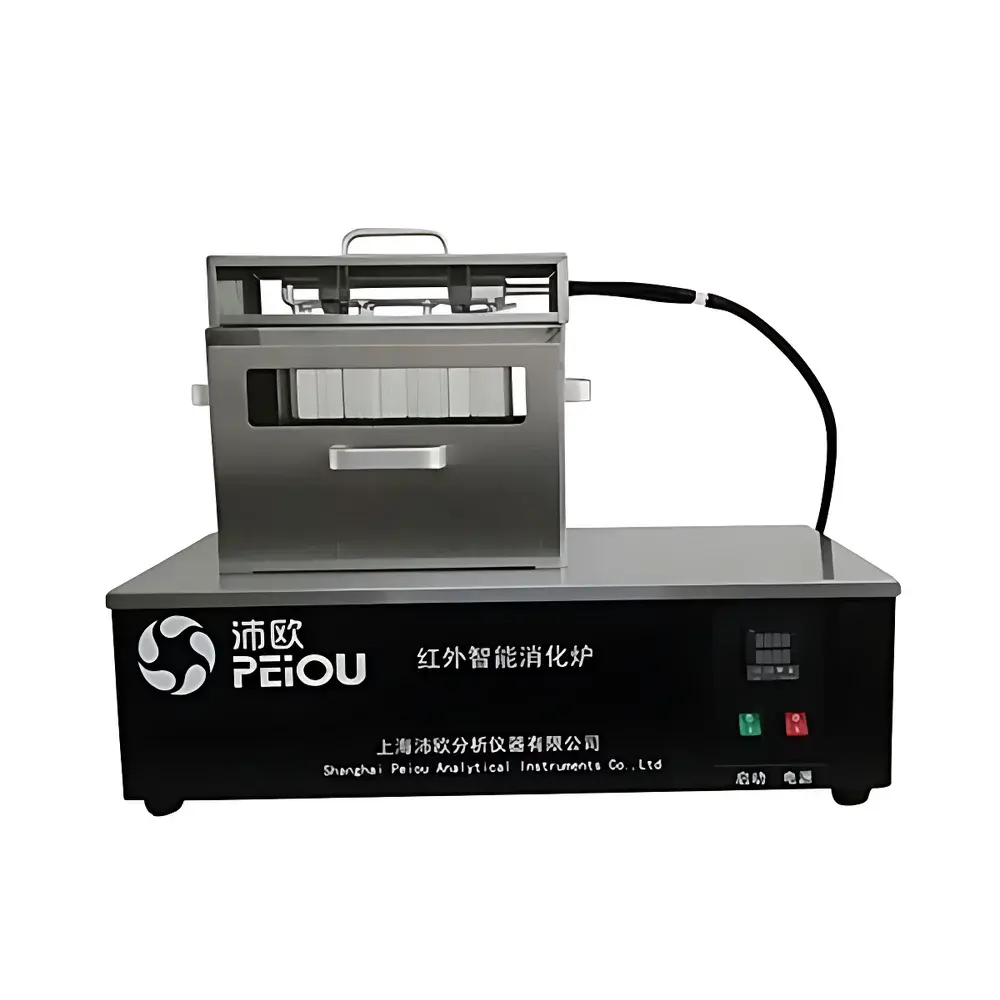
The SKD-100 is a distillation-only unit and requires prior sample digestion using a separate Kjeldahl digestion system (e.g., block digester or reflux unit) compliant with ISO 5983-1.
Is the SKD-100 compatible with borate-buffered titration or colorimetric detection?
Yes—the distillate output (ammonia in boric acid solution) is fully compatible with manual titration using standardized HCl and methyl red–bromocresol green indicator, or with automated colorimetric analyzers (e.g., flow injection or photometric systems) following appropriate dilution protocols.
Does the instrument support GLP-compliant data archiving?
Raw operational logs are retained internally but lack electronic signature, audit trail, or export functionality; full GLP compliance requires integration with validated third-party data capture software or LIMS.
What maintenance intervals are recommended for long-term reliability?
Annual verification of steam pressure calibration, alkali delivery accuracy, and condenser cooling efficiency is advised; tubing replacement is not required within the first 36 months under normal usage conditions.
Can the SKD-100 operate with variable mains voltage?
Yes—it accepts AC 220 V ±10% at 50 Hz, with internal regulation to maintain stable heating element output across specified input fluctuations.





