
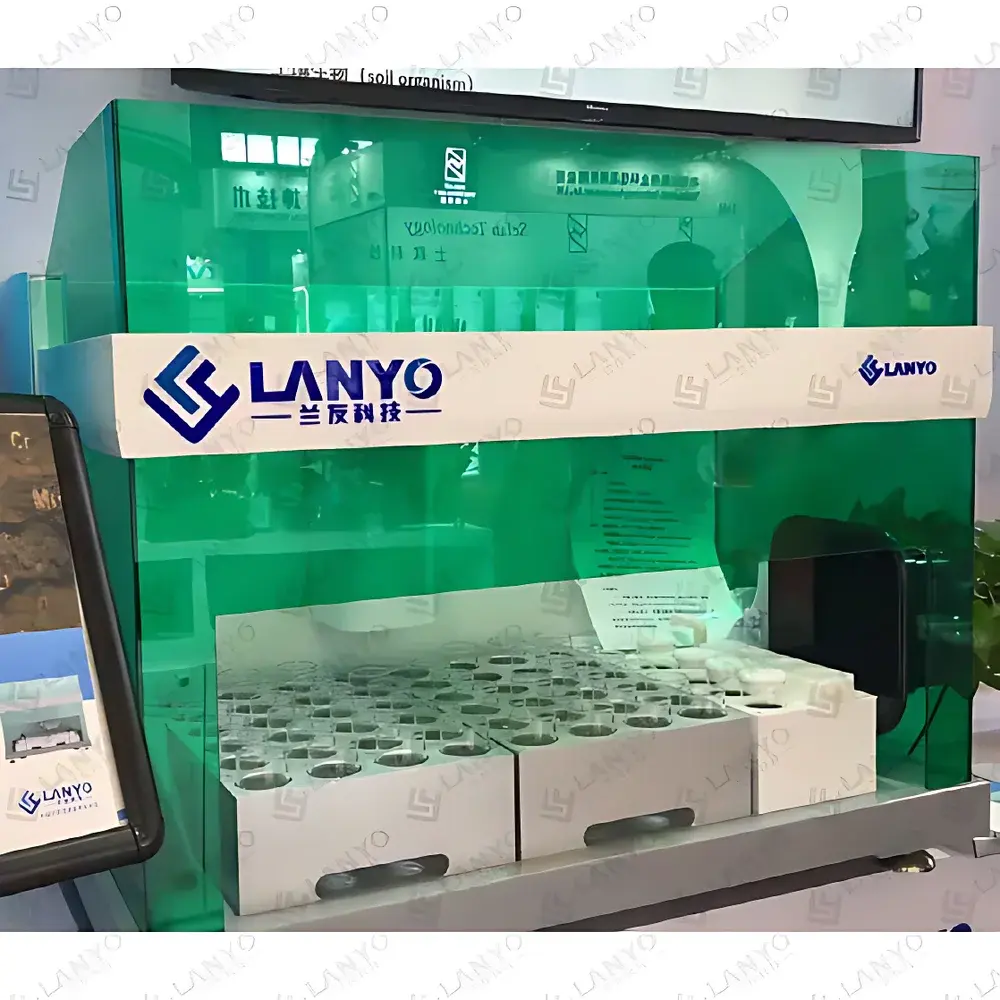
LANYO SOMA Series Automated Soil Organic Matter Analyzer
| Brand | LANYO |
|---|---|
| Model | SOMA Series |
| Standard Compliance | NY/T 1121.6–2006, NY/T 85–1988, LY/T 1237–1999, GB/T 33469–2016 Annex C |
| Heating Stations | 3 independent micro-boiling reflux positions with PID temperature control |
| Reagent Dispensing Accuracy | ≤0.3% (v/v) |
| Titration Endpoint Detection | Biomimetic colorimetric endpoint recognition |
| Reagent Port | 1 dedicated channel with isolated fluid path |
| Tube Cleaning | Programmable pre-run automated line rinse and conditioning cycle |
| Software Interface | Integrated GUI with real-time process logging, CSV export, and LIMS-compatible data transmission protocol |
| Safety | Fully enclosed reagent handling |
Overview
The LANYO SOMA Series Automated Soil Organic Matter Analyzer is a purpose-built electrochemical instrumentation platform engineered for the precise, standardized quantification of soil organic carbon (SOC) via wet oxidation using potassium dichromate (K₂Cr₂O₇) under acidic, refluxing conditions — in strict accordance with the Chinese agricultural standard NY/T 1121.6–2006. Unlike generic titrators or standalone digestion units, the SOMA system integrates mechanical, thermal, fluidic, and optical subsystems into a single workflow architecture: from reagent dosing and controlled micro-boiling reflux to ambient cooling, redox titration, biomimetic colorimetric endpoint detection, stoichiometric calculation, and regulatory-compliant reporting. This end-to-end automation eliminates manual intervention at all critical analytical steps — including hazardous acid handling, high-temperature reflux, and subjective visual endpoint judgment — thereby ensuring inter-laboratory reproducibility, operator safety, and audit-ready traceability.
Key Features
- Triple independent heating stations with PID-controlled micro-reflux modules, maintaining ±0.5 °C thermal stability across 120–150 °C operating range for consistent dichromate oxidation kinetics.
- Biomimetic colorimetric titration engine: employs dual-wavelength photometric sensing calibrated to the Fe²⁺/Fe³⁺–ferroin redox transition, replicating human visual discrimination thresholds while eliminating observer bias — directly satisfying NY/T 1121.6–2006’s requirement for “colorimetric endpoint confirmation”.
- Single-channel reagent delivery system with gravimetrically validated peristaltic pumping; dispensing accuracy certified at ≤0.3% RSD (n=10), traceable to NIM-maintained volumetric standards.
- Automated pre-analytical tube conditioning sequence: programmable flush-rinse-dry cycles using deionized water and low-residue carrier solvent, minimizing carryover between samples and preserving long-term calibration integrity.
- Embedded operational software with timestamped event logging, electronic signature support, and configurable audit trail — compliant with GLP documentation requirements and aligned with FDA 21 CFR Part 11 principles for electronic records.
Sample Compatibility & Compliance
The SOMA Series accommodates standard 5.0 g air-dried, sieved (<2 mm) soil specimens in borosilicate digestion tubes. It supports heterogeneous matrices including agricultural topsoil, forest humus, reclaimed industrial substrates, and sediment cores — provided samples meet moisture and carbonate content limits specified in NY/T 1121.6–2006. All hardware and software functions are validated against four primary national standards: NY/T 1121.6–2006 (definitive method), NY/T 85–1988 (alternative dichromate procedure), LY/T 1237–1999 (forest soils), and GB/T 33469–2016 Annex C (arable land grading). No modifications or method deviations are required to achieve full conformance.
Software & Data Management
The analyzer runs on a Linux-based embedded OS with a Qt-based graphical interface optimized for laboratory workflows. Each analysis generates a structured metadata record containing sample ID, reagent lot numbers, temperature/time profiles, titrant consumption volume, calculated SOC %, and digital image capture of the final titration color state. Data exports natively to CSV and PDF formats; optional OPC UA or HL7 v2.5 interfaces enable bidirectional synchronization with enterprise LIMS platforms. Audit logs retain full history of user actions, parameter changes, and system diagnostics for ≥18 months — supporting ISO/IEC 17025 clause 7.11 and CNAS-CL01:2018 requirements for data integrity.
Applications
- Government-led national soil census programs requiring high-throughput, standardized SOC mapping.
- Third-party environmental testing laboratories performing due diligence for land transfer, brownfield redevelopment, or regulatory compliance (e.g., China’s Soil Pollution Prevention and Control Action Plan).
- Agricultural extension services conducting routine fertility assessments and organic amendment efficacy trials.
- Academic research groups studying carbon sequestration dynamics, land-use change impacts, or climate-smart agriculture interventions.
- Ecological monitoring networks tracking long-term SOC trends across protected areas, afforestation sites, or degraded ecosystems.
FAQ
Does the SOMA Series require method validation before routine use?
Yes. Laboratories must perform initial system suitability testing per NY/T 1121.6–2006 Section 6.2, including recovery checks with certified reference materials (e.g., GBW07401–GBW07410 series) and repeatability assessment across three concentration levels.
Can the instrument handle samples with high calcium carbonate content?
Samples exceeding 2% CaCO₃ must undergo pre-treatment with dilute HCl to remove inorganic carbon, as stipulated in NY/T 1121.6–2006 Clause 4.3; the SOMA platform does not automate this pretreatment step.
Is remote monitoring supported?
Local network access enables real-time status viewing and alarm notifications via web browser; however, cloud-based remote control is disabled by default to maintain data sovereignty and cybersecurity compliance per China’s DSL and PIPL regulations.
What maintenance intervals are recommended?
Daily: visual inspection of tubing integrity and waste reservoir level. Quarterly: photometer calibration verification using NIST-traceable color standards. Annually: full fluidic path replacement and thermal sensor recalibration by authorized service personnel.
How is data integrity ensured during power interruption?
The system incorporates non-volatile memory with automatic checkpointing: all active analyses resume from the last completed sub-step upon power restoration, with no loss of raw sensor data or metadata.
Related Products





