
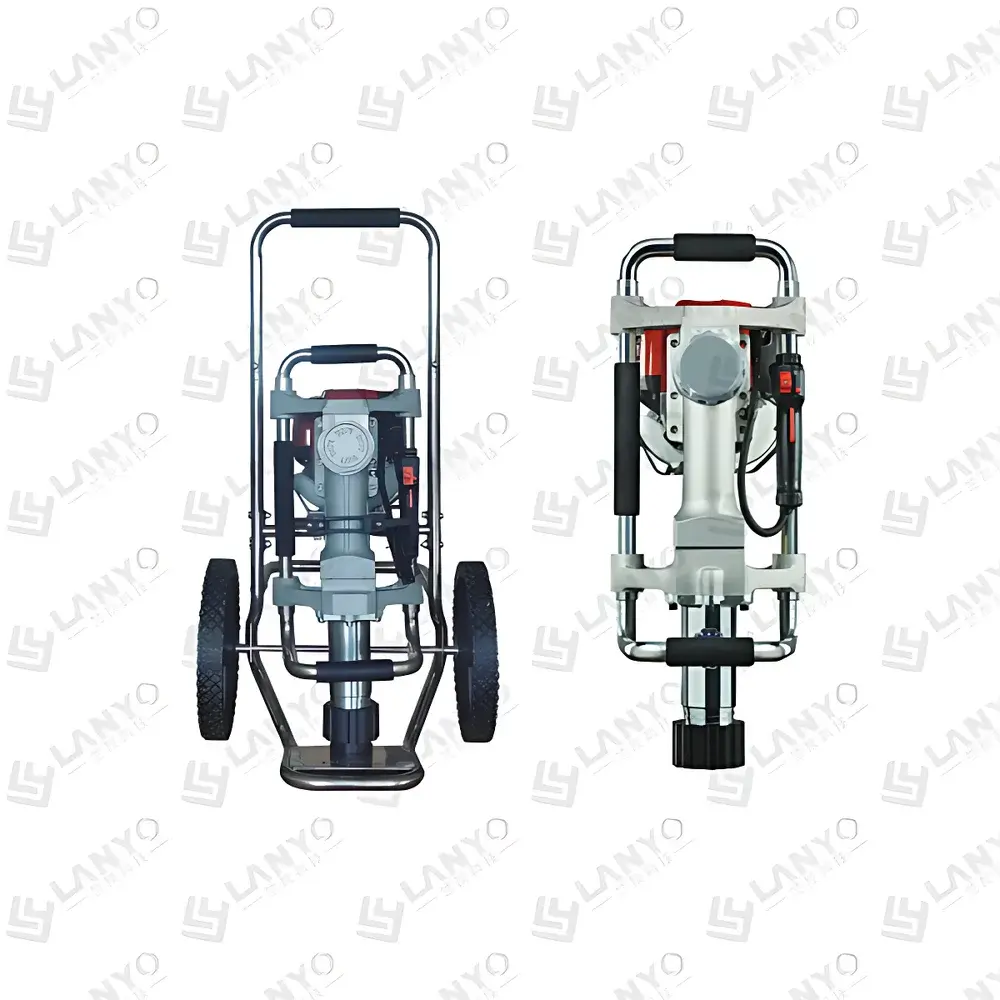
LANYO RT-S100 Hydraulic-Assisted Impact Soil Sampler
| Brand | LANYO |
|---|---|
| Origin | Beijing, China |
| Model | RT-S100 |
| Sampling Depth | 0–10 m |
| Host Weight | 20 kg |
| Core Diameter | 36 mm |
| Outer Diameter | 51 mm |
| Inner Diameter (Sampler Tube) | 41 mm |
| Vibration Frequency | 1720 cycles/min |
| Power Source | 1.6 HP gasoline engine |
| Fuel Consumption | 0.6 L/h |
| Sampling Rate | ≥1.1 m/min |
| Sample Recovery Rate | >97% |
| Sampling Method | Vertical impact-driven coring with single-use inner liner |
| Extraction Mechanism | Integrated hydraulic + mechanical extraction assist |
| Transport Configuration | Wheeled mobile cart assembly |
Overview
The LANYO RT-S100 is a field-deployable, gasoline-powered hydraulic-assisted impact soil sampler engineered for high-fidelity, minimally disturbed deep-soil column sampling. It operates on the principle of high-frequency vertical percussion—delivering controlled kinetic energy to drive a rigid, double-wall sampling tube into heterogeneous subsurface strata without requiring water injection or pre-boring. This mechanism preserves in-situ soil structure, stratigraphic continuity, and pore geometry across clay, silt, loam, sand, and partially weathered sedimentary layers—critical for geotechnical characterization, contaminant migration studies, paleoenvironmental reconstruction, and regulatory compliance sampling. Designed for operational robustness in remote or off-grid locations, the RT-S100 integrates a 1.6 HP air-cooled gasoline engine with a resonance-tuned hammer system (1720 impacts per minute), enabling consistent penetration through compacted horizons up to 10 meters depth—while maintaining >97% core recovery in standard mineral soils per ASTM D1586 and ISO 22475-1 protocols.
Key Features
- Impact-driven coring mechanism eliminates slurry dilution, wall smearing, or compaction artifacts common in rotary or auger-based systems
- Double-wall sampling assembly: outer casing (51 mm OD) provides structural guidance and lateral stability; inner liner (41 mm ID, 36 mm effective core diameter) isolates and protects the intact soil column during retrieval
- Hydraulic-mechanical dual-mode extraction system reduces operator fatigue and ensures reliable core ejection—even from cohesive or high-moisture soils
- Modular wheeled transport cart enables rapid site relocation and stable deployment on uneven terrain without external anchoring
- Fuel-efficient operation at 0.6 L/h supports extended field campaigns with minimal logistical overhead
- No external power source required—fully self-contained for use in ecologically sensitive or infrastructure-limited zones
Sample Compatibility & Compliance
The RT-S100 is validated for sampling across USDA soil texture classes—from coarse sands to plastic clays—and accommodates variable moisture content (10–45% w/w) without core fracture or liner adhesion. Its 36 mm core diameter meets standard requirements for laboratory analysis including grain-size distribution (ASTM D422), organic carbon quantification (ISO 14235), heavy metal leaching (EPA Method 1311), and microbial community profiling (ISO/IEC 17025-accredited labs). The sealed inner liner design complies with EPA SW-846 Chapter 1 guidelines for sample integrity preservation during transit and storage. All metallic components are corrosion-resistant stainless steel (AISI 304), ensuring long-term durability in acidic or saline environments.
Software & Data Management
While the RT-S100 is a manually operated mechanical instrument with no embedded electronics or digital interface, it is fully compatible with industry-standard field data capture workflows. Operators record depth-stamped metadata—including GPS coordinates, stratigraphic notes, visual lithology descriptions, and liner identification codes—using compliant mobile applications such as ESRI Field Maps or Epicollect5. These datasets synchronize seamlessly with LIMS platforms (e.g., LabWare, Thermo Fisher SampleManager) supporting 21 CFR Part 11 audit trails when paired with digital signature-enabled tablets. Optional barcode-labeled liners facilitate automated chain-of-custody tracking in GLP/GMP-aligned environmental monitoring programs.
Applications
- Environmental site assessments (ESA) and Phase II investigations under ASTM E1527
- Long-term soil health monitoring in agricultural extension programs (e.g., USDA NRCS Soil Health Initiative)
- Paleopedological and archaeological stratigraphic excavation support, preserving pedogenic horizon boundaries
- Geotechnical borehole validation for foundation design and landfill liner integrity testing
- Regulatory compliance sampling for PFAS, petroleum hydrocarbons, and legacy pesticides under state-level TSCA or RCRA frameworks
- Baseline characterization prior to renewable energy infrastructure development (e.g., wind turbine pad installation)
FAQ
What soil types are compatible with the RT-S100?
The sampler performs optimally in non-rocky, unconsolidated to moderately cohesive soils—including loams, silts, clays, and gravelly sands—up to USCS classification SP-SM. It is not designed for bedrock, boulder fields, or highly cemented caliche layers.
Is the inner liner reusable?
No. The 36 mm inner liner is a single-use, disposable polypropylene or polycarbonate tube supplied sterile and pre-marked for traceable sample identification.
Can the RT-S100 be used in wetland or saturated conditions?
Yes—its impact-driven mechanism functions effectively in saturated soils, though optimal recovery requires liner insertion immediately post-penetration to prevent slumping.
Does the unit meet international export or customs documentation standards?
Yes. The RT-S100 carries CE marking equivalence per Machinery Directive 2006/42/EC and includes bilingual (English/Chinese) technical documentation, conformity declarations, and UN-certified packaging for air freight.
What maintenance is required between sampling deployments?
Routine inspection of hammer spring tension, liner guide alignment, and fuel system integrity is recommended after every 50 m of cumulative sampling depth; full service intervals are specified at 200 operating hours per manufacturer’s maintenance log.
Related Products







