
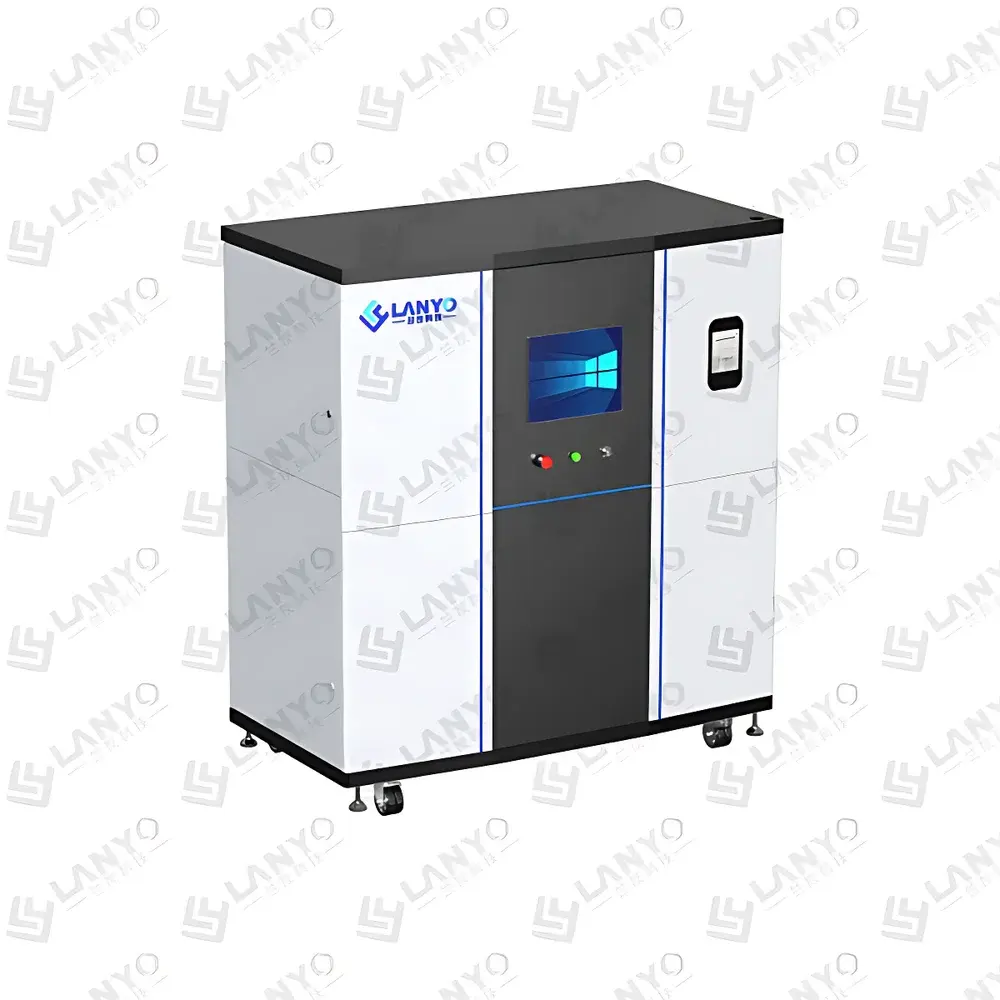
LANYO FASP-01Pro Fully Automated Solid Sample Preparation Workstation
| Brand | LANYO |
|---|---|
| Origin | Beijing, China |
| Model | FASP-01Pro |
| Application Scope | Soil, sediment, solid waste, rock, and geological samples |
| Automation Level | Fully automated with 30-position auto-inlet & auto-outlet |
| Grinding Stages | Dual-stage (coarse jaw + fine impact) |
| Sieve Sizes | 10, 60, 100, 200 mesh per GB/T 6003.1–2022 |
| Integrated Functions | Grinding, homogenization, sieving, quartering, weighing, vial loading, RFID/QR traceability, auto-cleaning (brush + vacuum) |
| Compliance | HJ/T 166–2004, NY/T 395–2012, DZ/T 0130.4–2006, HJ/T 20–1998, EJ/T 428–1989, LY/T 1210–1999, and 102+ related national/regulatory standards for solid environmental sample preparation |
Overview
The LANYO FASP-01Pro Fully Automated Solid Sample Preparation Workstation is an engineered solution for standardized, contamination-controlled processing of heterogeneous solid environmental matrices—including soil, sediment, mine tailings, industrial solid waste, bedrock, and layered geological materials. Designed explicitly for integration into smart laboratories and unattended analytical workflows, the FASP-01Pro implements a deterministic, stepwise protocol aligned with core principles of representative sampling: preservation of particle morphology during coarse grinding, controlled gradation through sequential impact milling, mechanical homogenization via vibratory bulk mixing, and statistically valid mass reduction using automated cross-quartering. Its architecture eliminates manual intervention in critical pre-analytical steps—thereby reducing operator-induced variability, minimizing exposure risk, and ensuring metrological traceability from field-collected composite to analytically ready subsample. The system supports full compliance with ISO/IEC 17025 requirements for method validation and quality control documentation, and its operational logic reflects the hierarchical sample preparation hierarchy defined in EPA SW-846 Method 5035A and ISO 11464:2022.
Key Features
- Fully automated 30-position inlet/outlet carousel enabling unattended batch processing over extended duty cycles—compatible with 24/7 operation in black-light laboratory environments.
- Dual-stage grinding architecture: coarse stage employs dual-jaw crushing to preserve soil aggregate integrity and minimize lattice disruption; fine stage utilizes impact-based milling with interchangeable 60-, 100-, and 200-mesh grinding modules for graded particle size distribution control.
- Integrated sieving station compliant with GB/T 6003.1–2022 (equivalent to ISO 3310-1), supporting simultaneous or sequential screening at 10, 60, 100, and 200 mesh apertures.
- Vibratory bulk homogenization module ensures complete mixing of entire sieve-retained fractions prior to subdivision—eliminating stratification bias inherent in static blending.
- Automated cross-quartering mechanism replicates ASTM D75–22 Annex A1 manual procedure digitally, delivering four equal subsamples with <±1.5% mass deviation per split.
- Onboard precision weighing module (0.001 g resolution) with tare compensation and dynamic drift correction for accurate subsample mass assignment per regulatory target weights.
- Autonomous loading into six standardized amber glass vials (screw-cap, RF-tagged base, QR-coded label), designed for long-term stability of pH-sensitive, redox-active, and exchangeable cation analyses.
Sample Compatibility & Compliance
The FASP-01Pro is validated for use with air-dried, non-volatile solid matrices across environmental, geological, agricultural, and nuclear monitoring domains. It meets the physical and procedural requirements outlined in 105+ national technical specifications—including HJ/T 166–2004 (soil monitoring), NY/T 395–2012 (farmland soil quality), DZ/T 0130.4–2006 (geological lab QA/QC), HJ/T 20–1998 (industrial solid waste), EJ/T 428–1989 (radiological soil handling), and LY/T 1210–1999 (forest soils). All material-contact surfaces are constructed from non-metallic, low-leaching polymers and ceramic-coated stainless steel—ensuring zero contribution of Fe, Mn, Zn, Pb, Cd, or As during processing. The system supports GLP-compliant audit trails, including timestamped event logs for each sample’s grinding duration, sieve dwell time, homogenization cycle count, and cleaning sequence activation.
Software & Data Management
The embedded control software provides role-based access, SOP-driven workflow selection, and real-time status visualization across all eight functional modules. Each sample is assigned dual identifiers: a scannable QR code printed on the vial label and a passive RFID chip embedded in the vial base—enabling bidirectional traceability from raw composite to final analytical aliquot. All process parameters (e.g., jaw gap setting, impact frequency, vibration amplitude, sieve dwell duration) are programmable and version-controlled. Data export conforms to ASTM E2500-22 and FDA 21 CFR Part 11 requirements: electronic signatures, immutable audit logs, and encrypted CSV/Excel reports include full metadata—sample ID, operator ID, instrument ID, calibration status, environmental conditions (temperature/humidity), and QC checkpoint outcomes. Integration APIs support direct data handoff to LIMS platforms (e.g., LabWare, STARLIMS) and portable XRF or hyperspectral analyzers.
Applications
- Environmental monitoring networks requiring high-throughput, auditable soil and sediment sample conditioning for heavy metal, nutrient, and speciation analysis.
- National soil census and pollution investigation programs where statistical representativeness and inter-laboratory reproducibility are mandated.
- Geological survey laboratories performing multi-element geochemical mapping under DZ/T 0130-series quality management frameworks.
- Nuclear radiation monitoring stations processing soil cores for gamma spectrometry and alpha/beta counting—where radiological cleanliness and particulate containment are critical.
- Third-party environmental testing labs seeking ISO/IEC 17025 accreditation with demonstrable control over pre-analytical uncertainty sources.
- Smart mining operations deploying autonomous sample transport vehicles and drone-based collection—requiring seamless docking and metadata synchronization with upstream field systems.
FAQ
Does the FASP-01Pro support method validation according to ISO/IEC 17025?
Yes—the system generates comprehensive process logs, calibration records, and QC metrics required for method validation and uncertainty budgeting per ISO/IEC 17025:2017 Clause 7.2.
Can the grinding modules be calibrated or verified for particle size output?
Each fine-grinding module is factory-characterized using NIST-traceable reference powders (e.g., SRM 1980), and users may perform periodic verification via laser diffraction or sieve stack analysis per ISO 13320:2020.
Is the system compatible with hazardous or moisture-sensitive samples?
The FASP-01Pro is rated for air-dried, non-reactive solids only; it does not support cryogenic, volatile, or pyrophoric materials. Optional inert gas purging can be integrated upon request for oxygen-sensitive applications.
How is cross-contamination prevented between batches?
The system executes a three-phase cleaning sequence—motorized brush agitation, vacuum-assisted particulate removal, and acoustic vibration of all contact surfaces—validated by swab testing per ISO 14644-1 Class 8 protocols.
What LIMS or analytical instruments can be directly interfaced?
Native drivers are provided for LabWare LIMS, Thermo Fisher Qtegra, Bruker S1 TURBO, and Malvern Panalytical Epsilon series; custom OPC UA or REST API integration is available for enterprise-level deployment.



