
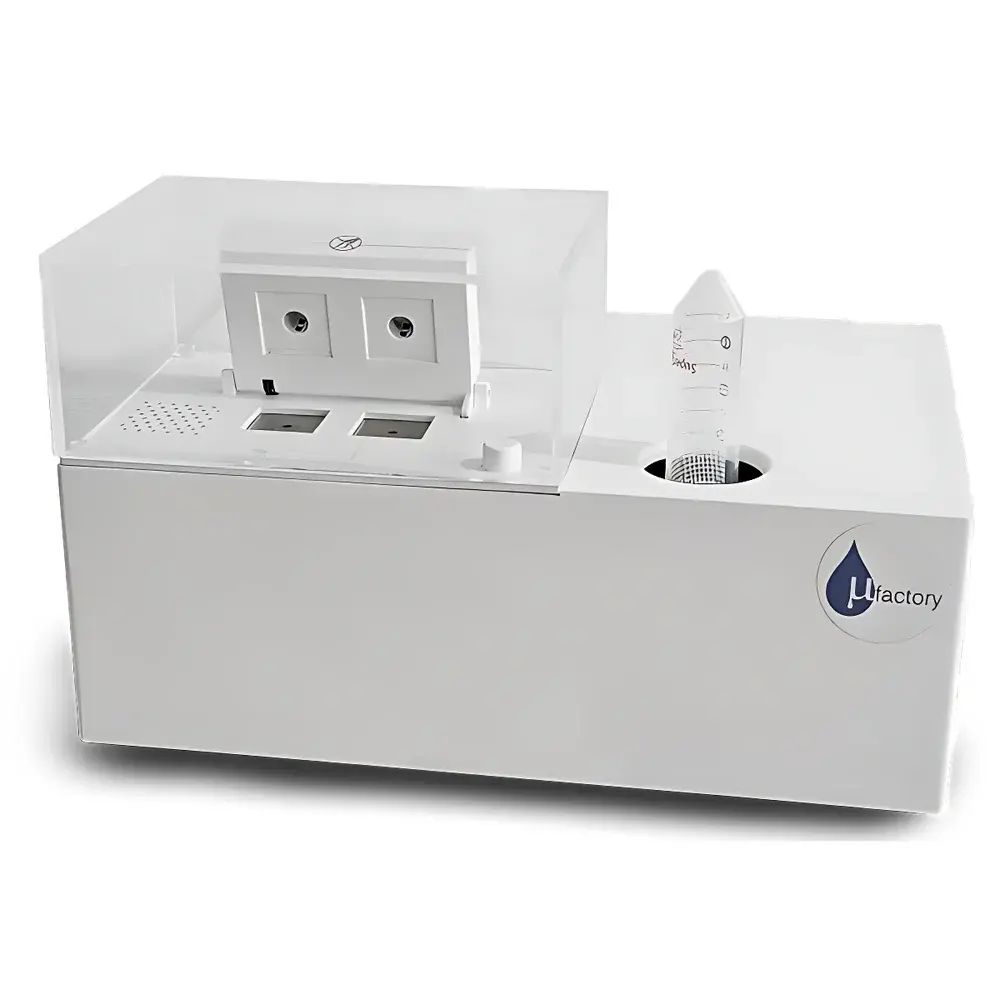
T-Skin In Vitro Transepidermal Water Loss (TEWL) Measurement System
| Brand | μfactory |
|---|---|
| Origin | France |
| Model | T-Skin |
| Application | In vitro skin barrier function assessment |
| Regulatory Context | Designed for GLP-compliant cosmetic ingredient screening and formulation development |
Overview
The T-Skin In Vitro Transepidermal Water Loss (TEWL) Measurement System is an engineered platform for quantitative, non-invasive assessment of skin barrier integrity under controlled laboratory conditions. Unlike conventional in vivo TEWL measurement devices that rely on open-chamber or condenser-based sensors applied directly to human skin, the T-Skin system implements a validated in vitro membrane model—typically composed of synthetic lipid bilayers or reconstructed epidermal equivalents—to replicate the passive diffusion gradient governing water vapor flux across the stratum corneum. This thermodynamically grounded approach enables precise quantification of water loss rates (g/m²·h) as a functional readout of barrier perturbation or protection. The system operates on the principle of dynamic gravimetric analysis combined with microclimate-controlled environmental chambers, ensuring high reproducibility across repeated assays. It is purpose-built for early-stage cosmetic formulation screening, where rapid iteration and objective differentiation between actives, emollients, and occlusives are essential prior to ethical and resource-intensive clinical validation.
Key Features
- Modular in vitro test chamber with programmable temperature (20–35 °C) and relative humidity (10–80% RH) control, enabling physiologically relevant skin surface microenvironment simulation
- High-resolution digital microbalance (resolution ≤ 0.1 mg) integrated with real-time mass decay monitoring and automatic drift compensation
- Standardized membrane mounting interface compatible with commercially available synthetic stratum corneum analogs (e.g., Strat-M®, Episkin™-derived membranes) and custom lipid film substrates
- Automated data acquisition software with timestamped weight logging at user-defined intervals (1–60 min), supporting linear slope calculation for TEWL rate derivation
- Compact benchtop footprint (W × D × H: 320 × 380 × 240 mm) with low power consumption (<150 W), suitable for shared analytical laboratories and QC environments
- CE-marked instrumentation compliant with IEC 61000-6-3 (EMC) and IEC 61010-1 (safety) standards
Sample Compatibility & Compliance
The T-Skin system supports evaluation of diverse topical formulations—including aqueous gels, oil-in-water emulsions, anhydrous oils, and polymer-based films—applied uniformly onto standardized barrier membranes. Membrane selection follows ISO 10993-5 guidelines for biological evaluation of medical devices, while assay protocols align with COLIPA (now Cosmetics Europe) recommendations for in vitro barrier function testing. Data generated meets foundational requirements for Good Laboratory Practice (GLP) documentation, including full audit trails, user authentication, and electronic signature support—facilitating traceability during regulatory submissions under EU Regulation (EC) No 1223/2009 and FDA cosmetic ingredient safety assessments. Though not intended for diagnostic use, its output serves as a scientifically accepted surrogate endpoint for predicting in vivo efficacy in moisturization and barrier repair claims.
Software & Data Management
The proprietary T-Skin Control Suite runs on Windows 10/11 platforms and provides intuitive workflow management—from method setup and calibration verification to raw mass curve visualization and TEWL rate export. All measurements are stored in encrypted SQLite databases with immutable timestamps and operator ID tagging. Export options include CSV, PDF reports (with embedded metadata), and direct integration into LIMS via ODBC connectivity. The software supports 21 CFR Part 11 compliance through role-based access control, electronic signatures, and automated backup logging—ensuring data integrity for internal R&D audits and external regulatory review. Batch processing mode allows concurrent analysis of up to eight parallel test units, significantly accelerating high-throughput screening campaigns.
Applications
- Rapid comparative assessment of occlusive agents (e.g., petrolatum, dimethicone, ceramide blends) based on % reduction in TEWL versus vehicle controls
- Time-course evaluation of barrier recovery kinetics following surfactant-induced disruption using sequential post-treatment measurements
- Stability-indicating studies examining how formulation aging or thermal stress impacts protective performance over time
- Supporting QbD (Quality by Design) initiatives in cosmetic development by establishing design spaces for critical material attributes affecting barrier modulation
- Generating mechanistic evidence for substantiation of “skin barrier strengthening” or “moisture retention” claims per ISO 16128 and COSMOS standards
FAQ
Can the T-Skin system replace human clinical trials?
No—it is designed as a tier-one screening tool to prioritize candidates for subsequent in vivo evaluation, not as a standalone replacement for clinical endpoints.
What membrane types are validated for use with T-Skin?
Strat-M® (Nitto Denko), Corneosurf™ (Synvina), and lab-fabricated ceramide-cholesterol-fatty acid multilamellar vesicles have demonstrated consistent response profiles; full validation reports are available upon request.
Is calibration traceable to national standards?
Yes—mass calibration uses NIST-traceable weights; environmental sensors are certified annually against PTB (Physikalisch-Technische Bundesanstalt) reference standards.
Does the system support multi-site collaborative studies?
Yes—centralized cloud-based data repository modules (optional add-on) enable synchronized protocol deployment and cross-laboratory dataset harmonization.
How frequently does the system require maintenance?
Routine cleaning and sensor verification are recommended every 30 operational days; annual preventive maintenance includes microbalance recalibration and chamber seal integrity testing.




