
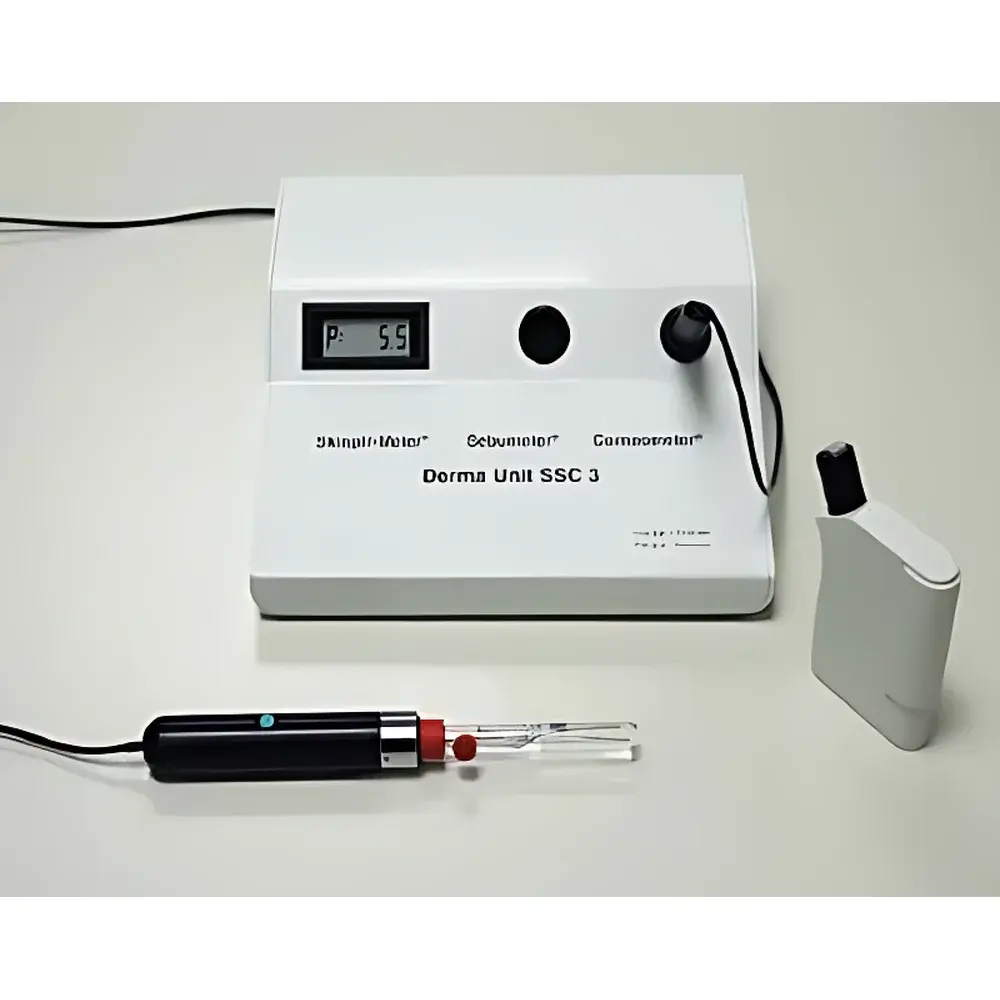
CK SSC3 Multi-Parameter Skin Analysis System (Sebumeter® / Corneometer® / Skin pH-Meter®)
| Brand | CK |
|---|---|
| Origin | Germany |
| Manufacturer Status | Authorized Distributor |
| Origin Category | Imported |
| Model | SSC3 |
| Pricing | Upon Request |
Overview
The CK SSC3 Multi-Parameter Skin Analysis System is an integrated, CE-marked clinical-grade instrumentation platform engineered for objective, non-invasive assessment of three fundamental biophysical skin parameters: surface sebum concentration, stratum corneum hydration level, and epidermal surface pH. Designed in accordance with ISO 13485–certified manufacturing protocols and aligned with ISO 29527 (Cosmetics — Methods of analysis — Instrumental measurement of skin properties), the SSC3 combines three independently validated sensor modules—Sebumeter® SG 20, Corneometer® CM 825, and Skin-pH-Meter® PH 905—into a single ergonomic console with unified data acquisition architecture. Each module operates on distinct, industry-accepted physical principles: sebum quantification via photometric reflectance at 940 nm (based on optical absorption differential between sebum and keratin), hydration measurement via high-frequency capacitance (3.5 MHz) sensitive to dielectric permittivity changes in the upper 10–20 µm of the stratum corneum, and surface pH determination using a miniature, flat-surface antimony electrode with temperature-compensated potentiometric readout. The system delivers traceable, operator-independent measurements essential for longitudinal clinical studies, regulatory-compliant cosmetic efficacy testing, and quality control in dermatological product development.
Key Features
- Tri-modal modular architecture enabling simultaneous or sequential measurement of sebum, hydration, and pH without sensor cross-contamination or recalibration delays
- Ergonomic handheld probe design with integrated LED-guided placement indicator and real-time acoustic feedback for optimal contact pressure (0.5–1.0 N)
- Onboard memory storing up to 1,000 test records with timestamp, anatomical site tag (predefined library: forehead, cheek, nasolabial fold, etc.), and operator ID
- USB-C interface supporting direct data export to CSV or XML formats compatible with statistical analysis packages (e.g., SAS, JMP, R)
- Calibration traceability documented per ISO/IEC 17025; annual calibration service available with certified reference standards (sebum mimic oil, saline hydration phantoms, NIST-traceable pH buffers)
- Robust aluminum-alloy housing rated IP54 for resistance to cosmetic emulsions, alcohol-based sanitizers, and routine clinical disinfection protocols
Sample Compatibility & Compliance
The SSC3 is validated for use on intact, non-lesional human skin across Fitzpatrick skin types I–VI. It complies with IEC 62304 (Medical Device Software Lifecycle), EN ISO 14971 (Risk Management), and EU MDR 2017/745 Class I medical device requirements. All measurement protocols adhere to ASTM E2953-22 (Standard Practice for Conducting Human Repeat Insult Patch Tests) and COLIPA/CTFA guidelines for cosmetic claim substantiation. Data integrity meets FDA 21 CFR Part 11 criteria when used with CK’s optional Audit Trail Module, which logs user logins, parameter modifications, and export events with digital signature capability.
Software & Data Management
The system operates with CK’s proprietary DermData Manager v4.2 software (Windows 10/11 compatible), providing GLP-compliant workflow management including subject randomization, protocol-driven test sequences, automated baseline subtraction, and statistical comparison across timepoints or treatment groups. Raw sensor outputs are stored with full metadata (ambient temperature/humidity, probe serial number, firmware version). Exported datasets include uncertainty estimates derived from Type A (repeatability) and Type B (calibration certificate) uncertainty components per GUM (JCGM 100:2008). Cloud synchronization (AWS-hosted, GDPR-compliant) is available for multi-site clinical trials under formal data processing agreements.
Applications
- Evaluation of sebum-suppressing actives (e.g., niacinamide, zinc PCA) in anti-acne formulations
- Quantification of transepidermal water loss (TEWL) mitigation via occlusive agents (dimethicone, ceramide complexes) in barrier-repair moisturizers
- Monitoring acid mantle recovery post-cleansing or exfoliation treatments
- Objective endpoint measurement in Phase I–II cosmetic clinical trials supporting INCI claim submissions (e.g., “clinically proven to increase hydration by 32% after 4 weeks”)
- Quality assurance of raw material batches (e.g., hyaluronic acid molecular weight distribution impact on hydration kinetics)
- Academic research in cutaneous biophysics, including circadian rhythm studies of sebaceous gland activity
FAQ
Is the SSC3 classified as a medical device?
Yes—it is registered as a Class I medical device under EU MDR 2017/745 and carries CE marking for performance evaluation of skin barrier function.
Can measurements be performed on facial hair or scars?
No—measurements require intact, unbroken stratum corneum. Hairy areas must be shaved ≥24 h prior; scar tissue requires separate validation per ISO 10993-1 biocompatibility framework.
What is the typical coefficient of variation (CV) for repeated measurements?
Intra-operator CV is ≤4.2% for sebum (n=20, forehead), ≤3.7% for hydration (cheek), and ≤0.08 pH units under controlled ambient conditions (22 ± 1°C, 40 ± 5% RH).
Does CK provide method validation documentation?
Yes—each instrument ships with a Certificate of Conformance, IQ/OQ documentation templates, and a Technical File Summary compliant with ISO/TR 20514 for analytical method verification.
Is remote software support available for international users?
Yes—CK’s Global Technical Support team offers screen-sharing diagnostics, firmware updates, and SOP review services in English, German, French, and Japanese.






