
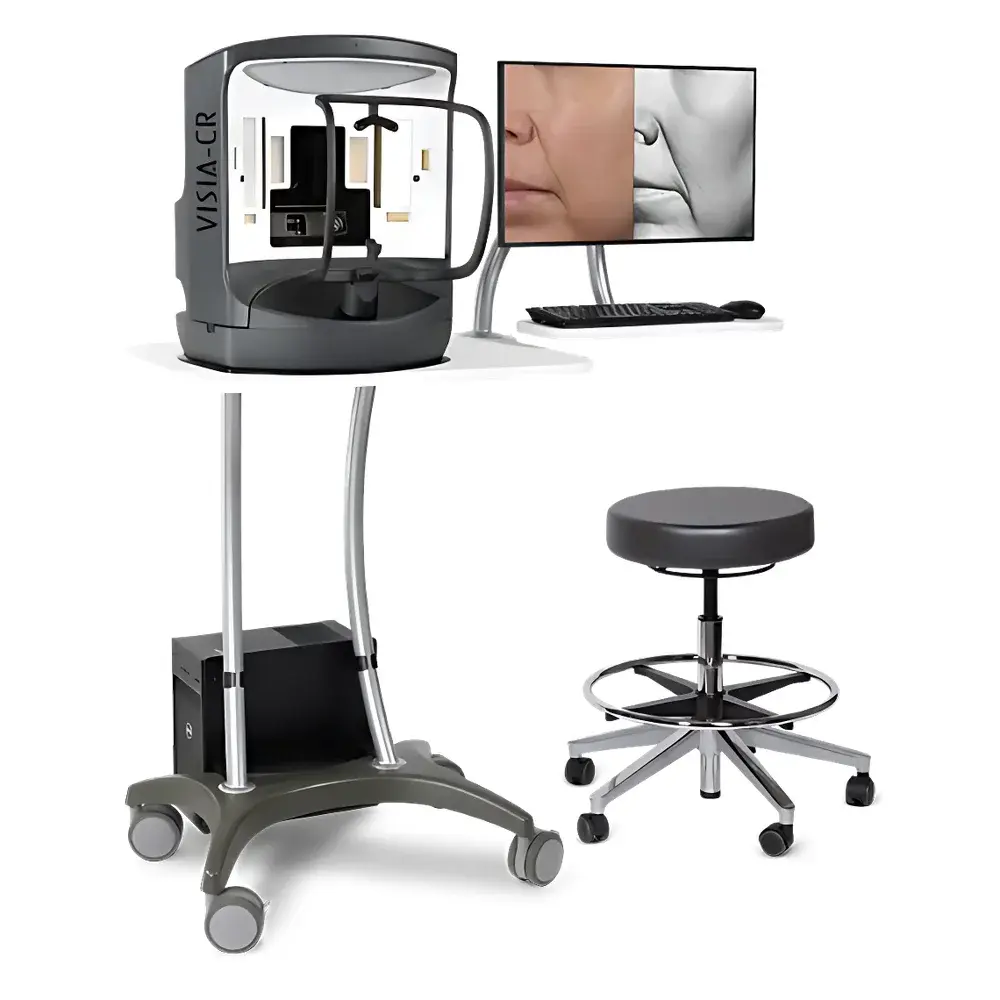
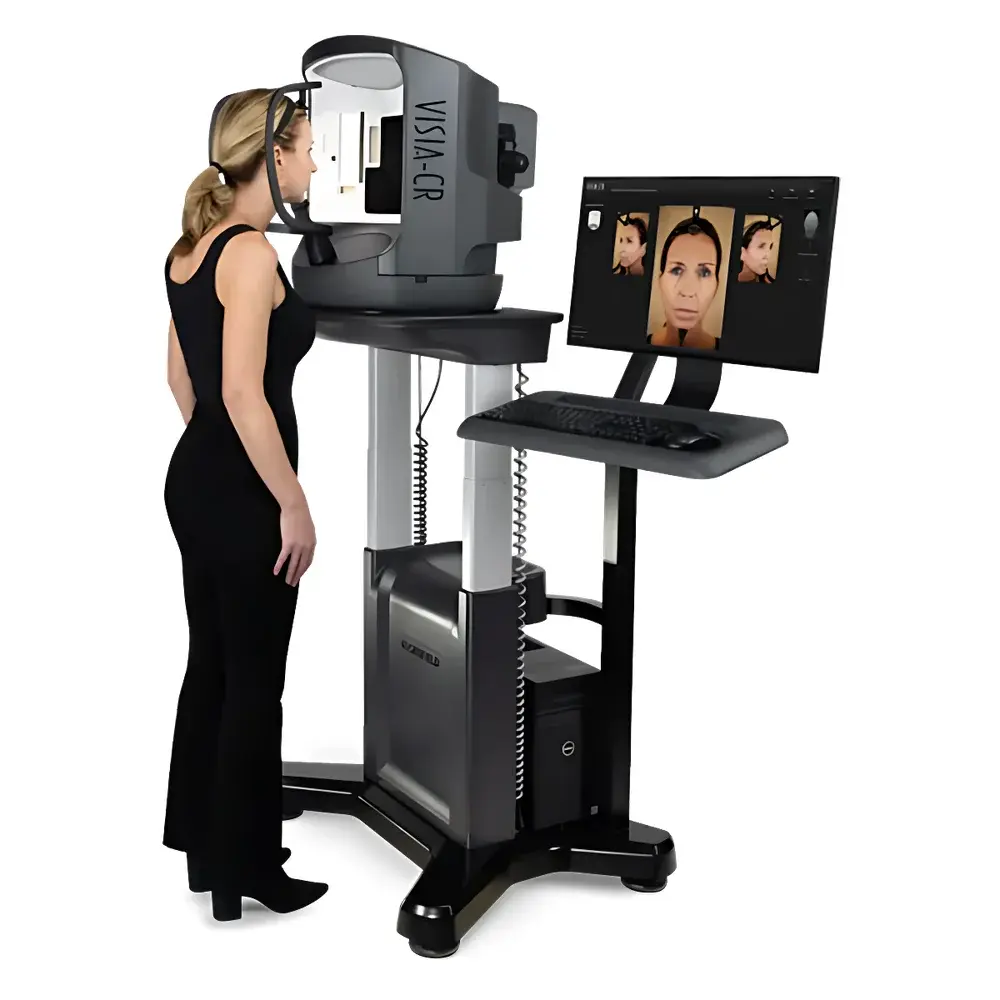
Canfield VISIA-CR 5 Advanced Facial Imaging System
| Brand | Canfield |
|---|---|
| Origin | USA |
| Model | VISIA-CR 5 |
| Light Sources | Standard White, Cross-Polarized, Parallel-Polarized, UV-A, Blue-Filtered Absorption, Blue-Filtered Fluorescence, Raking Light |
| Core Technology | RBX (Red-Blue eXtended) Color Separation Algorithm |
| Imaging Modality | Multi-Spectral Digital Dermatological Imaging |
| Regulatory Status | FDA-cleared for dermatological imaging and cosmetic assessment |
| Compliance | Meets IEC 62304 (medical device software), ISO 13485 (quality management), and supports GLP-compliant data archiving |
Overview
The Canfield VISIA-CR 5 Advanced Facial Imaging System is a clinically validated, multi-spectral digital imaging platform engineered for objective, quantitative analysis of facial skin structure and physiology. It operates on the principle of standardized multi-illuminated capture—acquiring synchronized high-resolution images under eight distinct illumination conditions in a single acquisition cycle. Each light mode selectively enhances specific cutaneous features: standard white light provides baseline surface topography; cross-polarized light suppresses specular reflection to reveal subsurface texture and pore architecture; parallel-polarized light emphasizes epidermal surface irregularities; raking light accentuates relief and contour; UV-A excites porphyrin fluorescence (associated with acne-causing bacteria); narrow-band blue absorption isolates melanin distribution; and narrow-band blue fluorescence visualizes collagen integrity and elastosis. The system’s proprietary RBX (Red-Blue eXtended) color separation algorithm—developed from over two decades of spectral dermatology research—enables pixel-level decomposition of RGB image data into independent melanin and hemoglobin chromophore maps, allowing non-invasive quantification of pigmentation heterogeneity and microvascular density without contact or contrast agents.
Key Features
- Automated, repeatable imaging protocol with integrated chin rest, forehead support, and fixed-distance optical path (35 cm working distance) ensuring inter-session and inter-operator reproducibility.
- Eight synchronized illumination modes captured in <1.2 seconds per session, minimizing motion artifact and enabling longitudinal tracking of subtle changes over time.
- RBX algorithm calibrated against histopathological ground truth and validated in peer-reviewed clinical studies for melanin index (MI) and erythema index (EI) quantification with intra-class correlation coefficients (ICC) >0.92 across operators.
- Integrated LED-based illumination system with spectral stability certified to ±2 nm wavelength tolerance and intensity drift <±1.5% over 10,000 hours of operation.
- Medical-grade 24-megapixel CMOS sensor with 12-bit dynamic range, linear response, and hardware-level gamma correction compliant with DICOM GSDF (Grayscale Standard Display Function).
- Modular software architecture supporting role-based access control, audit trail logging per FDA 21 CFR Part 11 requirements, and encrypted DICOM-compliant image export.
Sample Compatibility & Compliance
The VISIA-CR 5 is designed exclusively for non-invasive, external imaging of human facial skin in clinical, aesthetic, and research environments. It accommodates subjects aged 12–85 years with Fitzpatrick skin types I–VI, and includes adaptive exposure compensation for darker phototypes. All illumination intensities remain below ICNIRP (International Commission on Non-Ionizing Radiation Protection) thresholds for acute photobiological safety (IEC 62471). The system is FDA 510(k)-cleared (K183025) as a Class II medical device for “assessment of skin conditions including pigmentary disorders, vascular lesions, texture abnormalities, and photoaging.” It meets ISO 13485:2016 for design and manufacturing quality systems and supports full traceability for GLP/GCP-compliant trials. Data storage and reporting modules comply with HIPAA security rules and EU MDR Annex XIII requirements for clinical evaluation documentation.
Software & Data Management
VISIA-CR 5 operates with Canfield’s proprietary SkinHealth Analytics Suite v6.2, a Windows-based application built on .NET Framework 4.8 with SQL Server 2019 backend. The software provides automated lesion segmentation using deep learning models trained on >120,000 annotated clinical images, generating standardized metrics including spot count, area-weighted pigment score, porphyrin load index, wrinkle depth ratio, and UV damage quotient. All analyses are timestamped, user-logged, and stored with immutable audit trails—including parameter modifications, image reprocessing events, and export actions. Raw image datasets (TIFF + XML metadata) and processed reports (PDF/A-2b) are exportable in DICOM SR (Structured Reporting) format for integration into PACS or EDC systems. Optional API enables HL7/FHIR interoperability for enterprise EMR linkage.
Applications
- Dermatological clinical trials requiring objective endpoints for melasma, rosacea, post-inflammatory hyperpigmentation, and actinic keratosis interventions.
- Cosmetic formulation development and substantiation—quantifying efficacy of depigmenting agents, anti-redness actives, and barrier-repair ingredients across 8–12 week protocols.
- Aesthetic practice workflow integration for pre-treatment baseline assessment, treatment planning (e.g., laser parameter selection based on melanin/erythema maps), and post-procedure outcome validation.
- Academic research in photodamage biomarkers, ethnic skin variability, and AI-driven phenotypic clustering of chronic inflammatory skin conditions.
- Regulatory dossier preparation for health claims submission to EFSA, Health Canada, or ANVISA, leveraging ISO 16128-aligned ingredient efficacy documentation.
FAQ
Is the VISIA-CR 5 suitable for use outside the United States?
Yes—the system is CE-marked (Class IIa), UKCA-certified, and registered with Australia’s TGA and Singapore’s HSA. Local language UI packs and regional regulatory templates are available upon request.
Does the RBX algorithm require calibration against skin phantoms or reference standards?
No—RBX is factory-calibrated using NIST-traceable spectral targets and validated per ASTM E308-19 for colorimetric accuracy. Routine user calibration is not required; annual performance verification is recommended.
Can third-party software import VISIA-CR 5 raw image files?
Yes—TIFF files include embedded EXIF and custom XMP metadata tags documenting illumination mode, exposure parameters, and RBX processing flags. Open-source Python libraries (e.g., visiaio) provide documented parsing interfaces.
What is the minimum recommended hardware configuration for the analysis workstation?
Intel Core i7-10700K or AMD Ryzen 7 5800X, 32 GB RAM, NVIDIA RTX A2000 (8 GB VRAM), Windows 10/11 Pro 64-bit, SSD ≥512 GB. GPU acceleration is utilized for real-time RBX rendering and AI segmentation.
How does the system handle subject movement during capture?
The VISIA-CR 5 employs a dual-stage motion mitigation strategy: first, sub-100 ms exposure per illumination mode reduces blur; second, real-time facial landmark detection (68-point Active Shape Model) triggers automatic reacquisition if displacement exceeds 1.2 mm between frames.






