
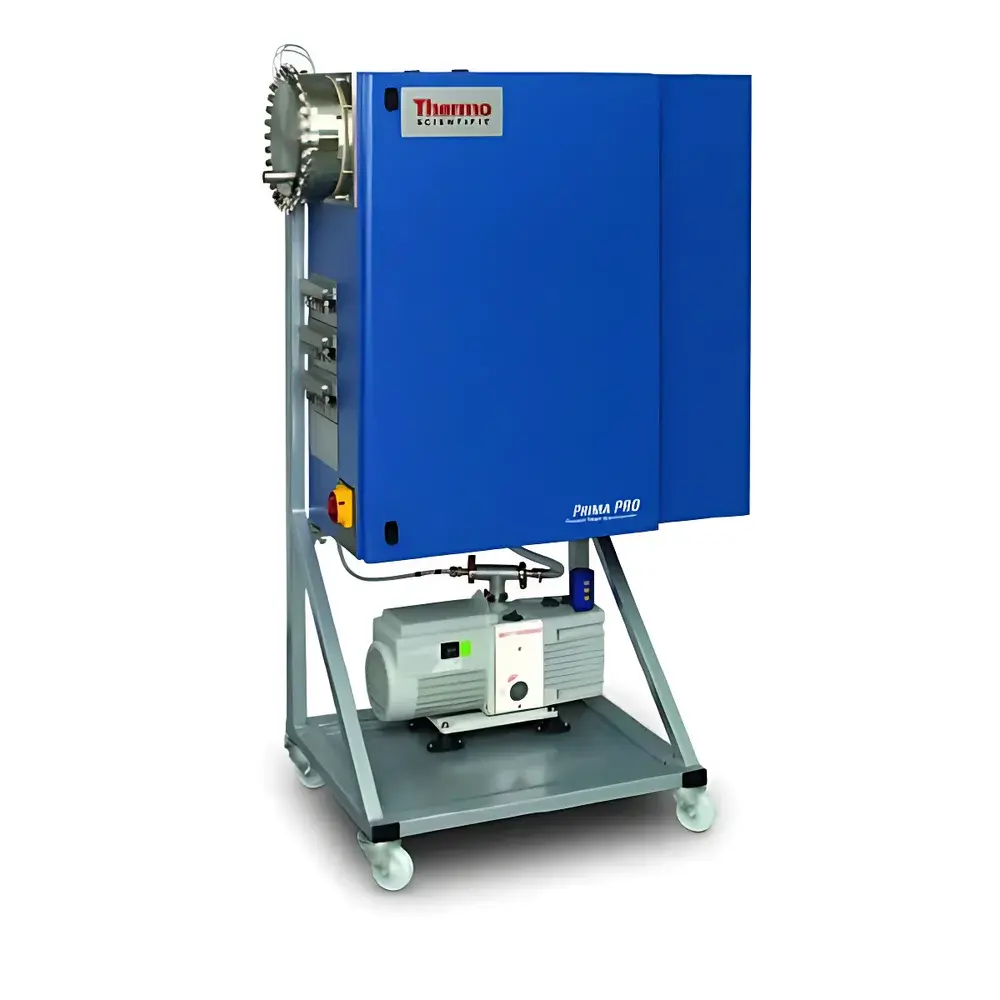
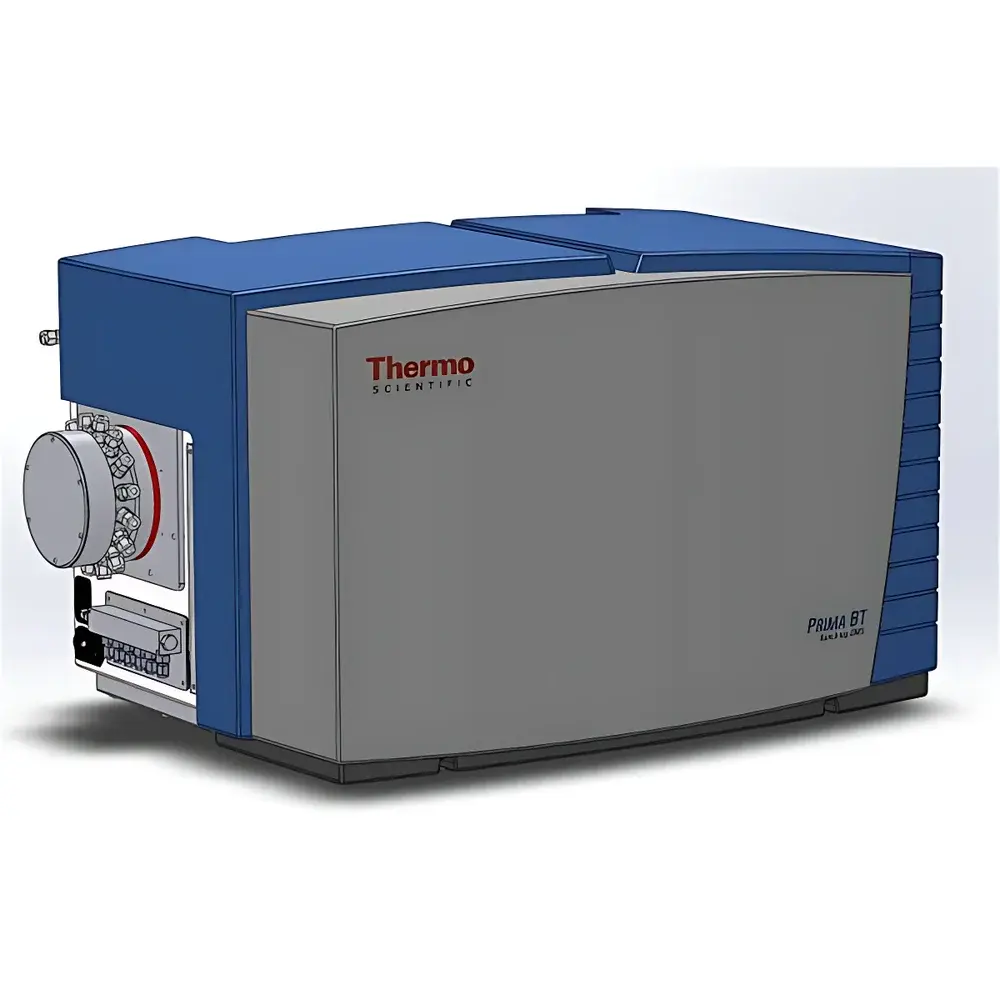
Thermo Fisher Prima PRO & Prima BT Process Mass Spectrometers
| Brand | Thermo Fisher |
|---|---|
| Origin | USA |
| Manufacturer Type | Original Equipment Manufacturer (OEM) |
| Product Category | Imported Instrumentation |
| Models | Prima PRO, Prima BT |
| Pricing | Upon Request |
Overview
The Thermo Fisher Prima PRO and Prima BT are high-performance, vacuum-based process mass spectrometers engineered for continuous, real-time gas-phase compositional analysis in demanding industrial and R&D environments. Both instruments operate on the fundamental principle of magnetic sector scanning mass spectrometry: gaseous samples are ionized via electron impact (EI), accelerated through a fixed potential (750–1000 eV), and subsequently separated in a 150-mm-radius, 80° magnetic sector according to their mass-to-charge ratio (m/z). The separation follows the classical trajectory equation r = √(2M·V / e·β²), where r is the ion path radius, M is ion mass, V is acceleration voltage, e is elementary charge, and β is magnetic field strength. By precisely scanning β while holding V and r constant, ions of sequentially increasing m/z are focused onto the detector. This physics-based architecture delivers inherently high mass accuracy, long-term stability, and exceptional resistance to matrix-induced drift—critical attributes for unattended operation in process-critical applications.
Key Features
- Robust magnetic sector design with dual-resolution slit configuration (standard 60/20 or 60/40; optional 140/85, 100/45, 140/45) enabling flexible trade-offs between resolution and sensitivity
- Flat-top peak profile at resolution 60 (top width = 50% of base width), significantly enhancing quantitative precision and tolerance to minor mass calibration drift
- Mass stability ≤ 0.013 amu at m/z 28 over 24 hours—validated under controlled thermal environment (±0.5 °C cabinet temperature regulation via integrated compressor-based cooling)
- High-reliability ion source: sealed, temperature-controlled (120–200 °C ±0.1 °C) EI source with thoriated tungsten filament (Prima PRO) or dual-filament redundancy (Prima BT)
- Dual-vacuum architecture: primary vacuum provided by rotary vane pump; high vacuum (≤1×10⁻⁷ mbar) maintained by turbomolecular pump (Prima PRO) or optionally by integrated diaphragm pump (Prima BT)
- Integrated digital flow measurement per inlet stream (<0.1% absolute accuracy, <1% linearity over 10:1 concentration range)
- Self-contained industrial controller with embedded real-time OS—no external PC dependency; supports MODBUS RTU, Ethernet TCP/IP, and OPC UA protocols for seamless DCS/SCADA integration
Sample Compatibility & Compliance
The Prima systems accommodate a broad spectrum of reactive, corrosive, and condensable gases—including H₂, O₂, N₂, CO, CO₂, CH₄, C₂H₄, C₂H₆, NH₃, H₂S, Cl₂, HF, and VOCs—without requiring carrier or combustion gases. Sample introduction utilizes heated (up to 120 °C), low-dead-volume rotating multi-stream (RMS) valves: 32-port for Prima PRO and 16-port for Prima BT, both with 1/4″ Swagelok® fittings. Standard sampling employs capillary + molecular leak with bypass, minimizing residence time and adsorption artifacts. All models comply with IEC 61000-6-2/6-4 (EMC), ATEX/IECEx Zone 2 (Prima PRO with optional certification), and support audit-ready data integrity per FDA 21 CFR Part 11 when paired with Thermo Fisher GasWorks™ software. Routine calibration uses up to 12 dedicated ports (Prima PRO) or 6 ports (Prima BT), facilitating traceable, multi-point standard gas delivery per ISO 6142 and ASTM D6348.
Software & Data Management
GasWorks™ is the native, validated application software designed specifically for Prima platforms. It provides full instrument control, method development (including dynamic dwell time allocation across m/z channels), real-time trend visualization, and automated alarm management. All raw spectral data, calibration logs, maintenance records, and user actions are timestamped and stored with immutable audit trails—fully compliant with GLP and GMP requirements. Data export supports CSV, XML, and OPC DA/UA for historian integration (e.g., OSIsoft PI, Emerson DeltaV). Optional advanced modules include multivariate statistical process monitoring (MSPC), stoichiometric balance calculation for reactor optimization, and predictive maintenance alerts based on vacuum performance and filament emission decay trends.
Applications
- Petrochemical & Chemical Manufacturing: Cracking furnace optimization, ethylene oxide/MEG synthesis monitoring, ammonia synthesis loop analysis, syngas composition control, natural gas dew point tracking, and fugitive VOC detection per EPA Method 21
- Metallurgy: Real-time off-gas analysis in blast furnaces, basic oxygen furnaces (BOF), RH/VOD degassers, and direct reduced iron (DRI) units for carbon/oxygen ratio control and energy efficiency improvement
- Biopharma & Fermentation: Dissolved O₂/CO₂ profiling in bioreactors, metabolic flux analysis, headspace monitoring for vaccine and monoclonal antibody production, and residual solvent quantification in lyophilization cycles
- R&D & Catalysis: Catalyst screening under realistic reaction conditions, pyrolysis gas analysis, thermal desorption studies, human calorimetry gas exchange, and microreactor effluent characterization
FAQ
What distinguishes the Prima PRO from the Prima BT?
The Prima PRO is a full-scale industrial online analyzer rated for continuous wall-mounted deployment in hazardous area environments; the Prima BT is a compact, benchtop-optimized variant with identical core analytical performance—designed for lab-scale process development, catalyst testing, and pilot plant integration.
Is carrier gas required for operation?
No. Unlike quadrupole or TOF-MS systems, magnetic sector MS operates without carrier, make-up, or combustion gases—reducing consumables, operational complexity, and potential contamination sources.
How often does the system require recalibration?
Typical recalibration intervals exceed 30 days under stable process conditions; extended intervals (≥90 days) are achievable with automated internal standard tracking and environmental compensation algorithms.
Can the instrument detect trace impurities at ppb levels?
Yes. With optimized resolution settings and Faraday/SEM dual detection, the system achieves a theoretical dynamic range of 10 ppb to 100%—validated for H₂S, NH₃, and chlorinated compounds in refinery gas streams per ISO 10723.
Does it support regulatory-compliant data archiving?
When configured with GasWorks™ in validated mode, all analytical data, method parameters, user logins, and system events are stored with electronic signatures, version control, and tamper-proof timestamps—fully aligned with FDA 21 CFR Part 11 and EU Annex 11 requirements.






