
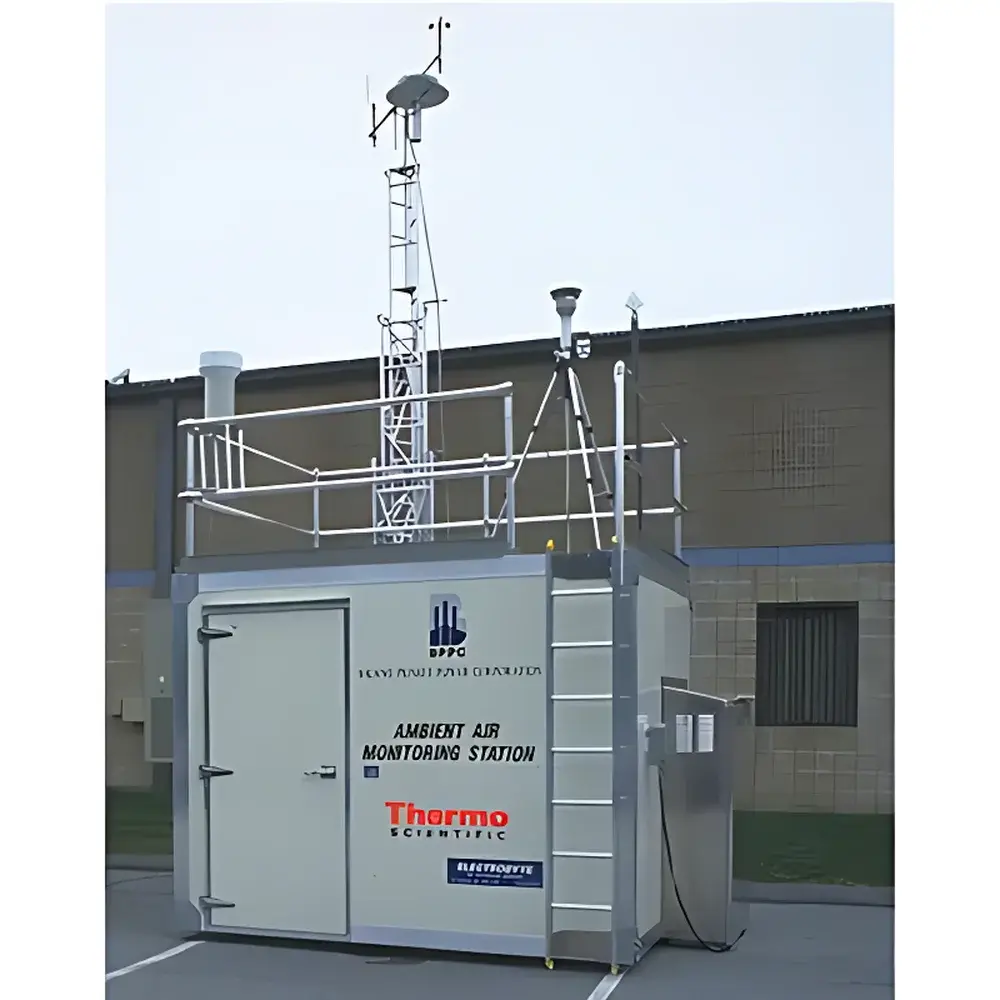
Thermo Fisher Scientific Ambient Gas Monitoring System – Model Ambient Gas MS
| Brand | Thermo Fisher |
|---|---|
| Origin | USA |
| Manufacturer Type | Original Equipment Manufacturer (OEM) |
| Import Status | Imported |
| Model | Ambient Gas MS |
| Pricing | Available Upon Request |
Overview
The Thermo Fisher Scientific Ambient Gas Monitoring System – Model Ambient Gas MS is a fully integrated, EPA-compliant automatic air quality monitoring platform engineered for continuous, unattended operation in regulatory-grade ambient air monitoring networks. Designed in accordance with U.S. Environmental Protection Agency (EPA) Performance Specifications (PS-1 through PS-15), this system implements standardized physical and electrochemical measurement principles—including pulsed ultraviolet fluorescence (PUVF) for SO₂, chemiluminescence (CLD) for NO/NO₂/NOₓ, gas filter correlation (GFC) infrared absorption for CO, UV photometry for O₃, beta attenuation (β-ATM) for PM₁₀ and PM₂.₅, and tapered element oscillating microbalance (TEOM) for real-time particulate mass quantification. The system architecture comprises three functional tiers: the Central Data Management Station (CDMS), distributed Ambient Monitoring Substations (AMS), and a dedicated Quality Assurance/Quality Control (QA/QC) Laboratory—ensuring metrological traceability, data integrity, and long-term operational stability across diverse climatic and urban/rural deployment scenarios.
Key Features
- Modular, rack-mounted subsystem design enabling field-serviceable configuration and scalable sensor integration
- Pulsed UV fluorescence detection with sub-ppb SO₂ sensitivity and <1.5% relative standard deviation over 30-day calibration stability
- Chemiluminescence analyzer with thermal converter for NO₂-to-NO conversion and dual-range NOₓ measurement (0–500 ppb / 0–20 ppm)
- GFC-based CO analyzer compliant with EPA PS-3; UV photometric O₃ analyzer meeting PS-2 requirements
- Dual-method particulate monitoring: β-ray attenuation (PM₁₀/PM₂.₅) and TEOM (PM₂.₅) with integrated temperature/pressure compensation
- Integrated meteorological suite: ultrasonic wind speed/direction, capacitive humidity, platinum RTD temperature, and piezoresistive barometric pressure sensors
- Automated calibration sequence including zero-air generation (catalytic scrubber + synthetic air), span gas delivery (NIST-traceable standards), and multi-point linearity verification
- Data acquisition system with 16-bit ADC resolution, 1 Hz sampling rate, and embedded audit trail per 21 CFR Part 11 requirements
Sample Compatibility & Compliance
The Ambient Gas MS system is validated for ambient air matrices conforming to ISO 12039 (SO₂), ISO 7935 (NOₓ), ISO 4224 (CO), ISO 13964 (O₃), and EN 14907 (PM). All analyzers undergo annual third-party verification against EPA Reference Methods (RM) and are certified under China’s HJ 653–2013 and HJ 654–2013 technical specifications for ambient air monitoring equipment. The system supports GLP/GMP-aligned QA/QC protocols, including daily zero/span checks, weekly multi-point calibrations, and quarterly inter-laboratory comparison exercises conducted at the accredited QA laboratory. Meteorological inputs comply with WMO Guide to Instruments and Observing Methods (WMO-No. 8) standards.
Software & Data Management
ENVIDATA™ v8.2 is the proprietary central data management software, built on Microsoft Windows Server architecture with SQL Server database backend. It provides real-time telemetry visualization, automated report generation (daily/weekly/monthly compliance summaries), configurable alarm thresholds (e.g., exceedance alerts per NAAQS or GB 3095–2012), and full audit logging—including user actions, calibration events, instrument faults, and data flagging history. Substation-level firmware supports dual communication protocols: RS-232/RS-485 serial interface and TCP/IP Ethernet (Modbus TCP and DNP3 optional). Data transmission adheres to China’s HJ 212–2017 communication protocol and EPA’s CDX (Compliance Data Exchange) format for cross-agency interoperability.
Applications
- National and provincial ambient air quality monitoring networks (AAQMN) for regulatory reporting to MEE (Ministry of Ecology and Environment)
- Urban background, traffic, and industrial fence-line monitoring per EU Directive 2008/50/EC and U.S. NAAQS implementation
- Long-term trend analysis for PM₂.₅ source apportionment studies using time-resolved mass concentration datasets
- Validation of satellite-derived aerosol optical depth (AOD) products via ground-truth correlation
- Support for health impact assessments requiring high-temporal-resolution pollutant exposure metrics
- Integration into smart city infrastructure for public-facing air quality index (AQI) dashboards
FAQ
What regulatory standards does the Ambient Gas MS system meet?
It complies with U.S. EPA Performance Specifications (PS-1 through PS-15), ISO 12039/7935/4224/13964/14907, EN 14907, and China’s HJ 653–2013, HJ 654–2013, and HJ 212–2017 standards.
Can the system operate without on-site personnel?
Yes—designed for unattended operation with remote diagnostics, automated calibration, and fault-tolerant data buffering (72-hour local storage capacity).
Is ENVIDATA software compatible with existing national monitoring platforms?
Yes—it supports HJ 212–2017 native protocol and offers API-based integration with provincial environmental data centers and national cloud platforms.
How is data integrity ensured during transmission?
All communications include CRC-32 checksums, TLS 1.2 encryption for remote access, and immutable audit logs synchronized between substation and central server.
What maintenance intervals are recommended for calibration and QA/QC?
Zero/span checks every 24 hours; multi-point calibration every 7 days; flow verification and leak testing monthly; annual full performance evaluation at the QA laboratory.
Related Products







