
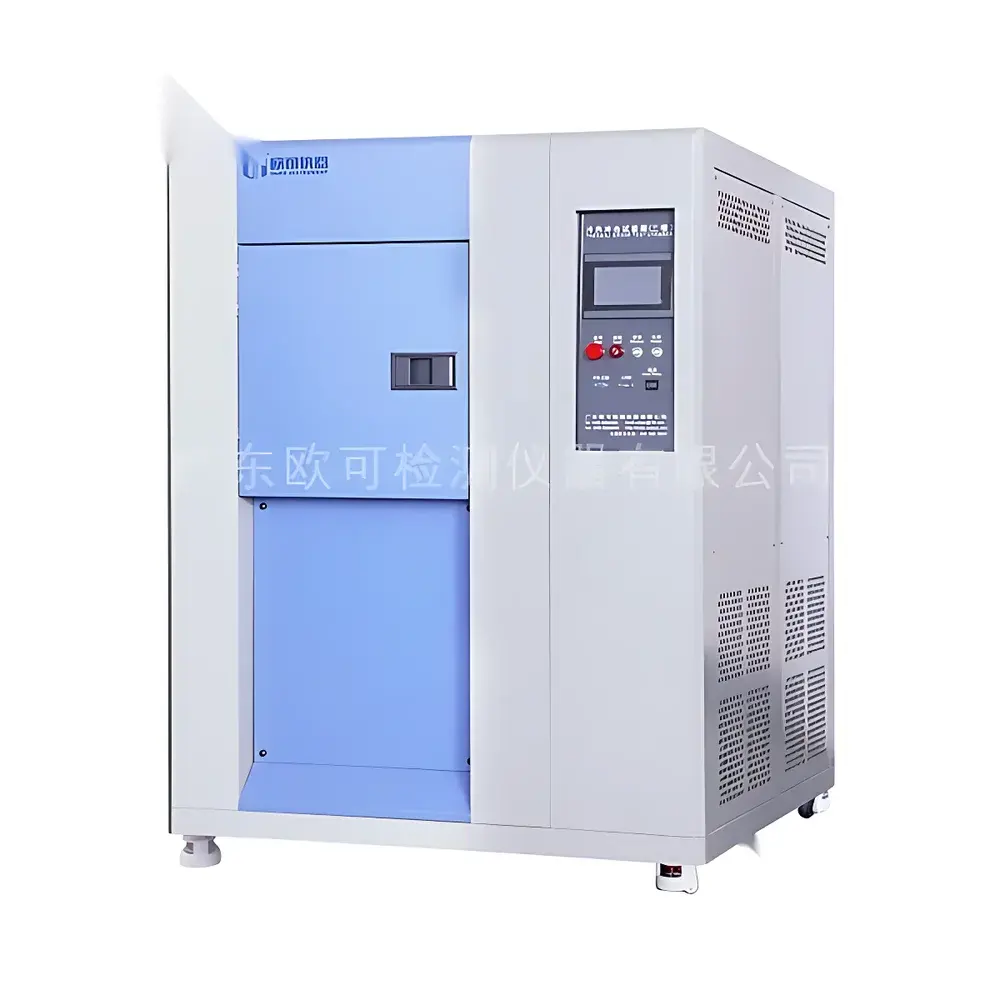
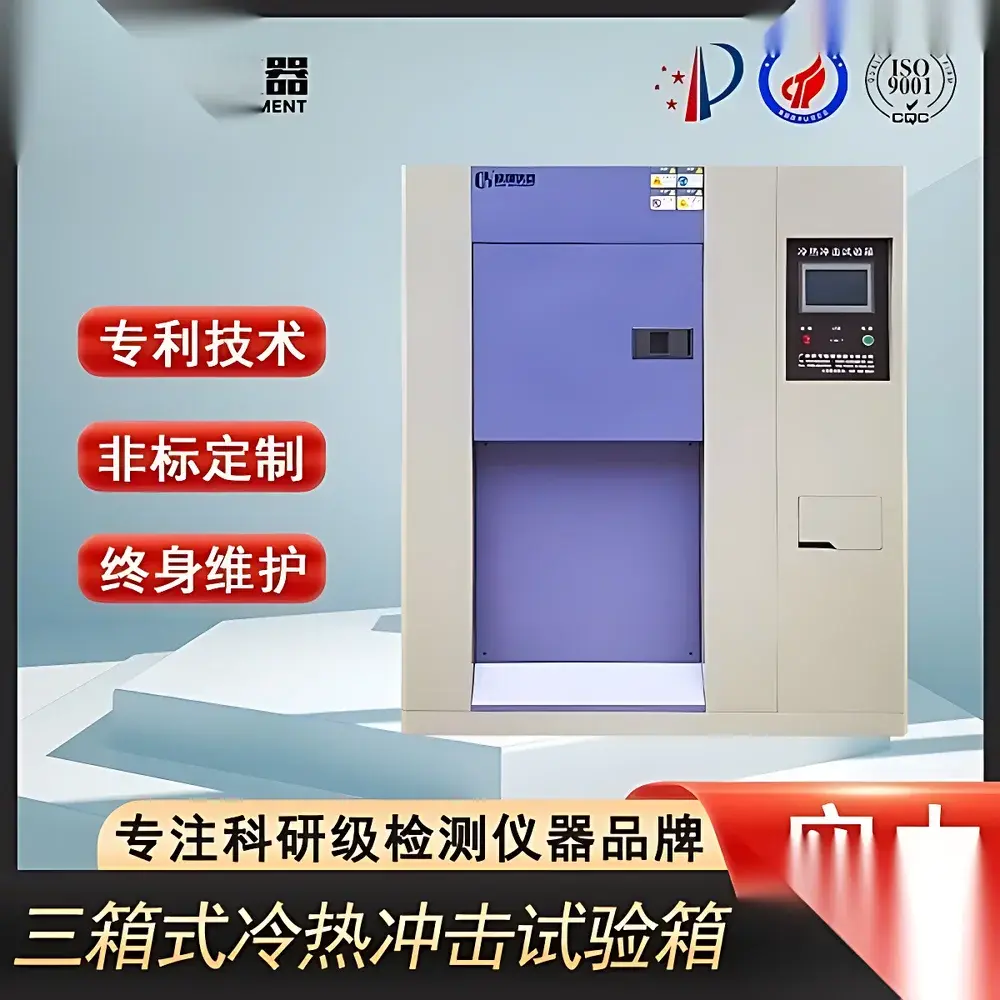
Thermal Shock Test Chamber – Triple-Zone Rapid Temperature Transition System (Model TST-300 Series)
| Key Temperature Range Options | A: -20°C to 200°C |
|---|---|
| B | -40°C to 200°C |
| C | -60°C to 200°C |
| Temperature Stability | ≤ ±2°C in High/Low Temp Zones |
| Thermal Transition Performance | -40°C ↔ 85°C in ≤ 11 min (including dwell) |
| Heat Storage Zone Ramp | Ambient to +100°C in ~30 min |
| Cold Storage Zone Ramp | Ambient to -50°C in ~90 min |
| Test Zone Dimensions | 450 mm (W) × 300 mm (H) × 300 mm (D) |
| Test Load Capacity | 20 kg / 30 kg / 50 kg options |
| Construction | Interior & Exterior Panels – SUS#304 Stainless Steel |
| Insulation | High-Density Fire-Retardant PU Foam + Advanced K-Type Sweat-Prevention Ducting |
| Cooling System | Dual-Stage Cryogenic Refrigeration with Eco-Friendly Refrigerant (R-404A/R-23 blend), Plate-Type Heat Exchangers, Automatic/Manual Defrost Circuits |
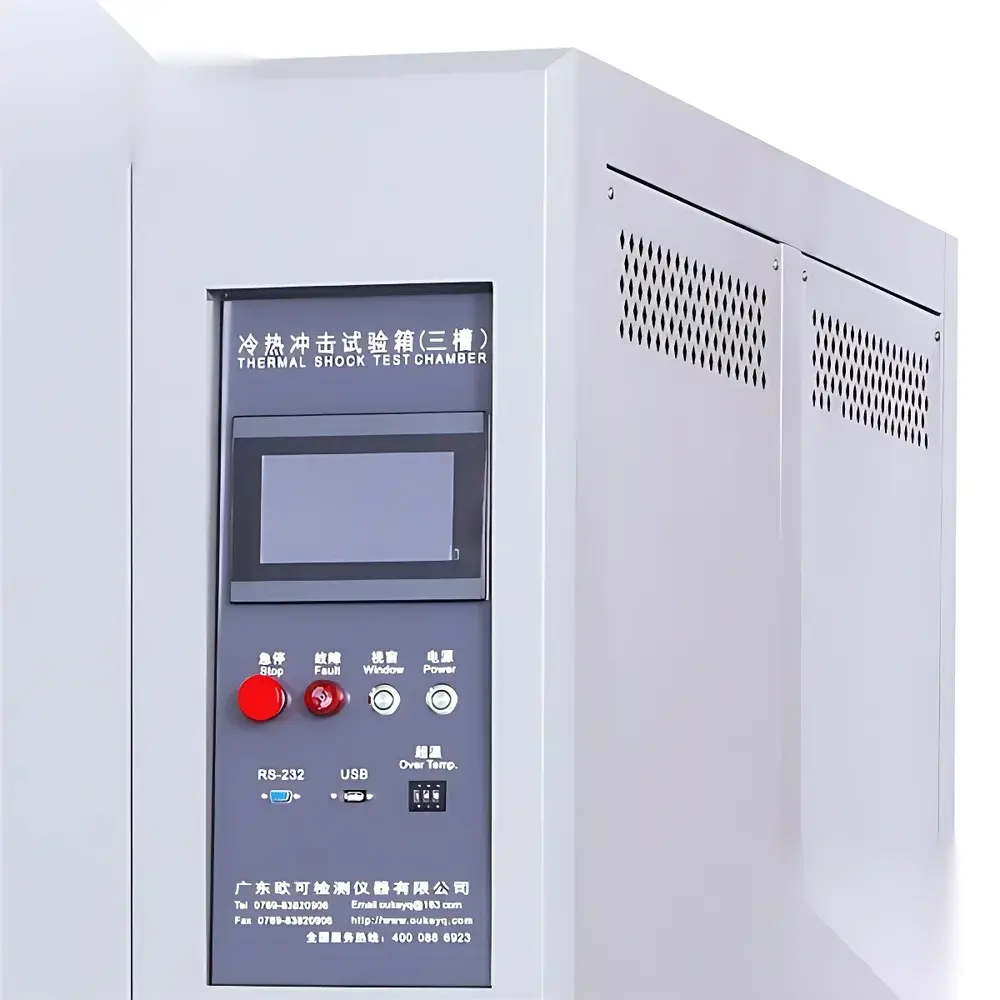
| Control System | 7-inch Full-Color LCD Touchscreen Microprocessor Controller with RS-232/RS-485 Interface |
| Compliance | Designed to meet IEC 60068-2-14, MIL-STD-810H Method 503.5, JIS C 0025, CNS 12227, and ISO 16750-4 environmental stress screening requirements |
| Safety Protections | Independent Over-Temperature Cutout (Test Chamber), Compressor High-Pressure & Low-Oil-Pressure Protection, Heating Element Overload/Short-Circuit Protection, Phase Failure & Undervoltage Detection, Ground Fault Monitoring |
Overview
The Thermal Shock Test Chamber – Triple-Zone Rapid Temperature Transition System (Model TST-300 Series) is an engineered solution for accelerated environmental stress screening (ESS) of electronic components, automotive modules, aerospace hardware, and advanced packaging materials. It operates on the principle of *gas-based thermal shock*, utilizing physically isolated high-temperature and low-temperature reservoirs—each thermally stabilized—to deliver rapid, repeatable temperature transitions into a stationary test zone. Unlike single-chamber ramp systems, this triple-zone architecture eliminates thermal mass limitations, enabling precise, high-fidelity shock profiles compliant with international reliability standards including IEC 60068-2-14 (Change of Temperature), MIL-STD-810H Method 503.5 (Temperature Shock), and JIS C 0025. The system’s core function is not gradual heating or cooling, but the controlled, high-velocity transfer of conditioned air across the test specimen via pneumatically actuated valves—ensuring minimal thermal inertia and superior spatial uniformity within the test volume.
Key Features
- Triple-Zone Architecture: Physically segregated hot zone (up to +200°C), cold zone (down to −60°C), and static test zone enable true step-function thermal transitions without chamber movement or specimen repositioning.
- Rapid Transition Capability: Achieves −40°C ↔ +85°C transitions in ≤11 minutes (including dwell), meeting stringent automotive AEC-Q200 and JEDEC JESD22-A104 qualification timelines.
- Precision Thermal Uniformity: Test zone temperature deviation maintained at ≤±0.5°C during steady-state operation—validated per IEC 60068-3-5—ensuring measurement repeatability across qualification batches.
- Modular Load Capacity: Configurable test load ratings (20 kg / 30 kg / 50 kg) accommodate diverse sample geometries—from bare PCBs to full ECUs—without compromising airflow integrity or thermal response.
- Robust Mechanical Design: SUS#304 stainless steel construction throughout interior and exterior surfaces; reinforced K-type anti-sweat ducting minimizes condensation-induced corrosion in high-humidity shock cycles.
- Intelligent Control & Diagnostics: 7-inch industrial-grade touchscreen controller with real-time graphing, alarm history logging, and configurable PID tuning parameters—supporting both manual operation and automated profile execution.
Sample Compatibility & Compliance
This chamber accommodates a broad range of physical configurations: surface-mount devices (SMDs), molded plastic housings, battery cells, optical sensors, and hermetically sealed assemblies. Its static test zone design eliminates mechanical vibration artifacts common in lift-type shock chambers—critical for MEMS device validation. All models are constructed and validated in accordance with ISO 17025-aligned calibration practices. The system supports full traceability for GLP/GMP-regulated environments through optional audit trail firmware (compliant with FDA 21 CFR Part 11 when paired with validated software). Regulatory alignment includes explicit support for test plans referenced in IPC-9701A (Performance Classes for Interconnect Systems), SAE J2245 (Automotive Electronics Environmental Testing), and NASA-HDBK-7123 (Reliability-Centered Qualification).
Software & Data Management
The embedded controller provides native data logging at user-selectable intervals (1–60 sec), storing temperature readings from up to five independent channel inputs (test zone, hot zone, cold zone, ambient reference, and optional external probe). Export formats include CSV and Excel-compatible .xls. For enterprise integration, the RS-232/RS-485 interface enables bidirectional communication with LabVIEW, MATLAB, or custom SCADA platforms using Modbus RTU protocol. Optional Ethernet module adds TCP/IP connectivity and TLS-secured remote monitoring. All logged data includes timestamp, operator ID (if enabled), and cycle-specific metadata—enabling direct import into LIMS or quality management systems (QMS) for CAPA linkage and statistical process control (SPC) analysis.
Applications
- Qualification testing of semiconductor packages (QFN, BGA, CSP) per JEDEC JESD22-A104 and A106 standards.
- Validation of solder joint integrity in automotive ADAS control units subjected to extreme ambient cycling.
- Accelerated life testing of lithium-ion battery enclosures under combined thermal shock and humidity exposure.
- Material compatibility assessment for conformal coatings, potting compounds, and flexible printed circuits.
- Reliability screening of avionics components prior to DO-160 Section 4 (Temperature Variation) certification.
- Process development support for reflow soldering profile optimization and cold-start performance evaluation.
FAQ
What standards does this thermal shock chamber comply with?
It is engineered to execute test procedures defined in IEC 60068-2-14, MIL-STD-810H Method 503.5, JIS C 0025, CNS 12227, and ISO 16750-4. Full compliance documentation—including temperature mapping reports and uncertainty budgets—is available upon request.
Can the chamber operate as a standalone high-temperature or low-temperature test unit?
Yes. The controller allows independent activation of either the hot zone or cold zone, enabling use as a conventional thermal chamber for bake-out, cold soak, or preconditioning per IPC-A-610 or IPC-J-STD-001 requirements.
Is remote monitoring and control supported?
Standard RS-232/RS-485 interfaces support local PC-based control. Optional Ethernet module enables secure web-based monitoring, real-time data streaming, and integration with centralized facility monitoring systems.
What maintenance is required for long-term operational stability?
Recommended preventive maintenance includes quarterly refrigerant pressure verification, biannual cleaning of condenser coils and air filters, annual calibration of PT100 sensors against NIST-traceable references, and periodic inspection of pneumatic valve seals per manufacturer service schedule.
How is thermal uniformity verified and documented?
Each unit undergoes 9-point temperature mapping (per IEC 60068-3-5) across the test volume at three representative setpoints (−40°C, 25°C, +85°C). As-shipped mapping reports include expanded uncertainty calculations and are supplied with commissioning documentation.



