
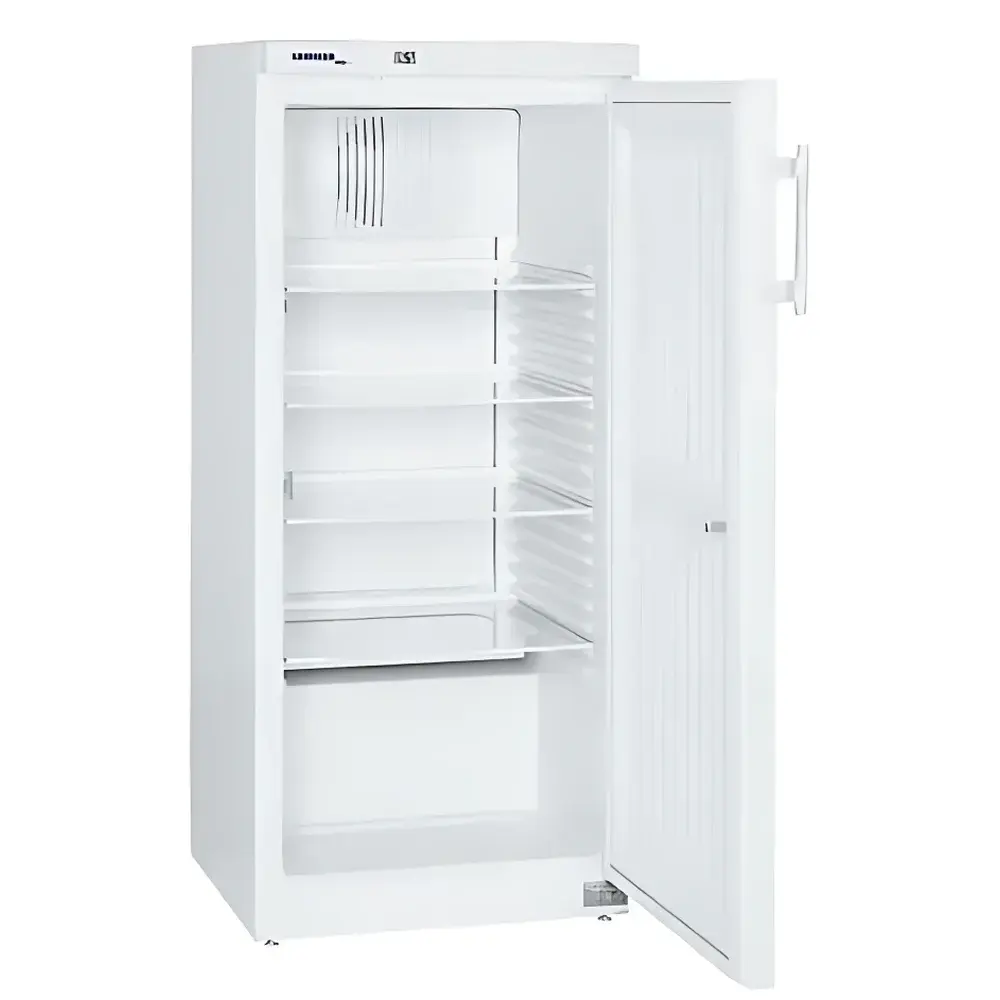
Liebherr LKexv 2600 Explosion-Proof Laboratory Refrigerator
| Brand | Liebherr |
|---|---|
| Origin | Austria |
| Model | LKexv 2600 |
| Type | Upright |
| Capacity | 240 L |
| Temperature Range | +1 °C to +15 °C |
| Energy Consumption (24 h) | 0.786 kWh |
| Dimensions (W×D×H) | 600 × 600 × 1250 mm |
| Climate Class | SN-ST (10–38 °C ambient) |
| Temperature Control Accuracy | ±0.1 °C |
| ATEX Certification | Directive 2014/34/EU (ATEX 95) |
| Refrigerant | R600a |
| Noise Level | Low acoustic power output |
| Door | Reversible hinge |
| Shelf Load Capacity | 40 kg (glass), 24 kg (plastic drawer) |
| Alarm Functions | Temperature deviation, door open, power failure, sensor fault |
| Data Logging | Last 3 alarm events stored |
| Optional External Sensor | PT100 probe compatible |
| Defrost System | Automatic, spark-free design |
Overview
The Liebherr LKexv 2600 is a CE-marked, ATEX-certified explosion-proof laboratory refrigerator engineered for the secure, stable, and compliant storage of flammable liquids, volatile organic compounds (VOCs), reactive solvents, combustible powders, and other hazardous substances in research, academic, and industrial laboratory environments. Designed and manufactured in Austria under strict adherence to Directive 2014/34/EU (ATEX 95), the unit employs intrinsic safety principles—including non-sparking electronic components, sealed control circuits, and spark-free automatic defrost technology—to eliminate ignition sources within the refrigerated compartment and surrounding enclosure. Its precisely regulated temperature range of +1 °C to +15 °C meets critical storage requirements for reagents such as acetone, ethanol, ether, benzene derivatives, and peroxide-forming solvents, while maintaining thermal uniformity across the full 240 L internal volume. The unit operates reliably in ambient conditions ranging from 10 °C to 38 °C (SN-ST climate class), ensuring consistent performance in variable lab environments—from air-conditioned clean rooms to warmer utility corridors.
Key Features
- ATEX 95-compliant explosion protection certified by notified body—fully compliant with EN 60079-0, -7, -15, and -31 for Group II (non-mining), Category 2G (gas/vapor) and 2D (dust) zones
- High-precision microprocessor-based temperature control with ±0.1 °C setpoint accuracy and <±0.5 °C internal uniformity (measured at 3 standard points per shelf level)
- Triple-layer insulated stainless steel cabinet with reinforced door seal and flame-retardant interior lining
- Energy-optimized refrigeration system using eco-friendly R600a refrigerant (GWP = 10), achieving 0.786 kWh/24 h consumption under standard test conditions (ISO 8561-1)
- Comprehensive alarm architecture: real-time monitoring of chamber temperature deviation, door status, mains supply interruption, and sensor integrity—with non-volatile memory storing the last three alarm events including timestamp, type, and duration
- Optional external PT100 temperature probe input for independent verification or dual-point validation per GLP/GMP protocols
- Reversible door configuration with ergonomic slim-profile handle and high-security dual-key mechanical lock
- Low-noise operation (<42 dB(A) at 1 m) suitable for shared lab spaces and quiet-zone facilities
Sample Compatibility & Compliance
The LKexv 2600 is validated for storage of Class I (flammable liquid) and Class II (combustible dust) materials per NFPA 30 and NFPA 484. Its interior accommodates standard laboratory containers—including glass bottles (up to 4 L), HDPE carboys, solvent cans, and powder jars—on adjustable tempered glass shelves (40 kg max load per shelf) and reinforced polypropylene drawers (24 kg max). All internal surfaces are chemically resistant and static-dissipative. The unit complies with ISO/IEC 17025:2017 clause 5.10.4 (equipment suitability), EU GMP Annex 15 (qualification of storage equipment), and supports 21 CFR Part 11-compliant data integrity when integrated with validated third-party monitoring software. It is routinely deployed in accordance with institutional chemical hygiene plans (CHPs) and OSHA Lab Standard 29 CFR 1910.1450.
Software & Data Management
While the LKexv 2600 operates via embedded hardware controls without cloud connectivity, its alarm log and temperature history support manual audit trails required under GLP and ISO 17025. The onboard display provides real-time chamber temperature, setpoint, and alarm status. For automated data capture, users may connect an external calibrated PT100 sensor to a validated environmental monitoring system (EMS) such as SensiNet™, TempTale® Ultra, or Vaisala viewLinc—enabling time-stamped, tamper-evident records with configurable alert thresholds, trend analysis, and electronic signature workflows compliant with FDA 21 CFR Part 11 and EU Annex 11.
Applications
- Storage of flammable solvents (e.g., methanol, toluene, THF) in synthetic chemistry labs
- Stabilization of peroxide-sensitive reagents (e.g., diethyl ether, tetrahydrofuran, dioxolane)
- Secure holding of pyrophoric catalysts (e.g., Raney nickel, sodium hydride suspensions)
- Controlled-temperature staging of volatile calibration standards for GC/FID and HPLC analysis
- Long-term stability testing of reference materials under defined thermal conditions (ICH Q5C)
- Compliance-driven storage for pharmaceutical QC labs operating under EU GMP or USP
FAQ
Is the LKexv 2600 certified for use in Zone 1 hazardous areas?
Yes—it carries ATEX Category 2G certification for gas/vapor atmospheres, permitting installation in Zone 1 (where explosive gas mixtures are likely to occur periodically) and Zone 22 (for combustible dust), subject to site-specific risk assessment and zoning documentation.
Can this unit be validated for IQ/OQ/PQ protocols?
Absolutely. The unit’s documented temperature uniformity, alarm response times, recovery profiles, and traceable calibration points enable full qualification per ASTM E2500, ISO 14644-3, and ISPE Good Practice Guide for Cold Chain Equipment.
Does it support remote monitoring integration?
The unit features a dry-contact alarm relay output and analog voltage signal for external PT100 input, allowing seamless integration into facility-wide EMS platforms with appropriate interface modules and cybersecurity validation.
What maintenance intervals are recommended?
Liebherr recommends biannual inspection of door gaskets, condenser coil cleaning, and verification of alarm functionality; annual calibration of internal sensor against NIST-traceable reference thermometer is advised for regulated environments.
Is R600a refrigerant safe for laboratory use?
R600a is non-toxic and ozone-safe (ODP = 0), with low global warming potential (GWP = 10). Its use is permitted in ATEX-certified equipment under EN 378-1, provided charge size remains below 150 g—well within the LKexv 2600’s design limit.



