
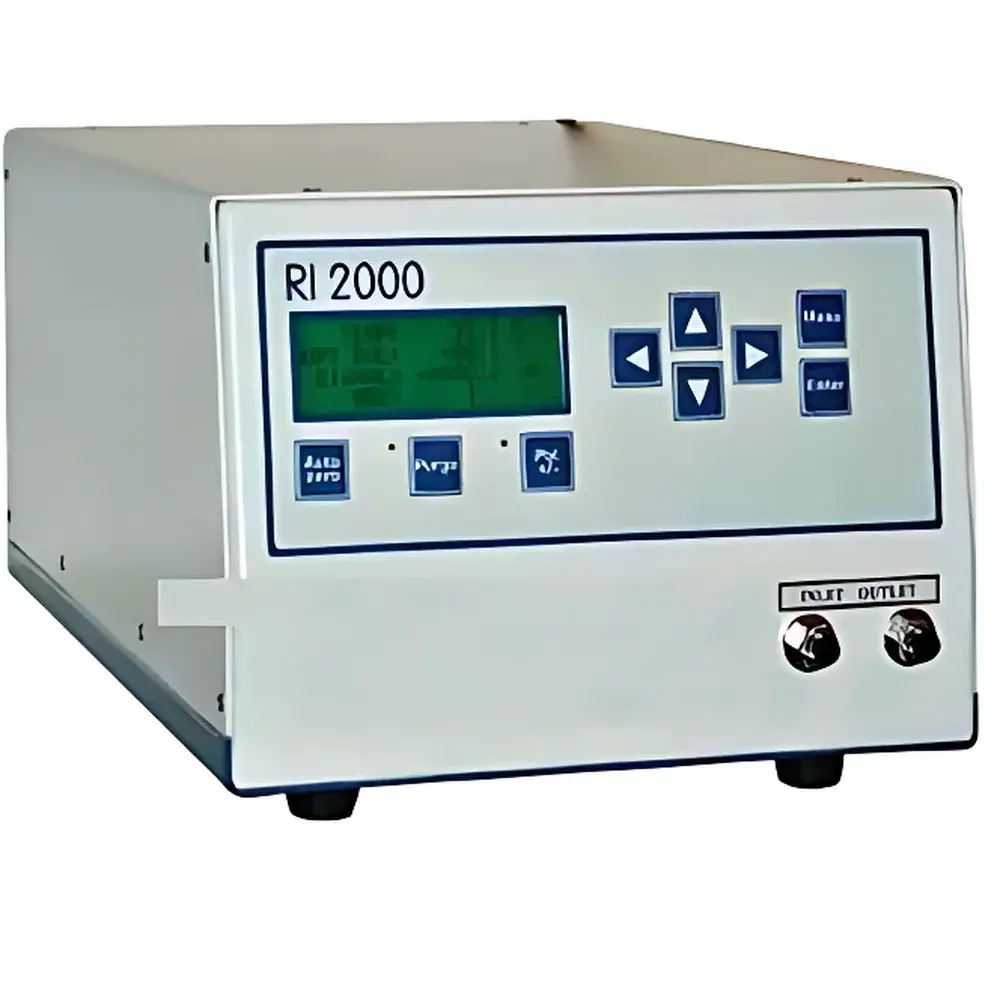
Labindex 2000 Differential Refractometer Detector
| Brand | GRACE |
|---|---|
| Origin | Germany |
| Model | RI 2000 |
| Detection Principle | Differential Refractometry |
| Refractive Index Range | 1.00–1.75 |
| Flow Rate Range | 0.2–3.0 mL/min |
| Linear Range | 80 × 10⁻⁵ RIU |
| Noise Level | 5 × 10⁻¹⁰ RIU |
| Auto-Zero Range | 40 × 10⁻⁵ RIU |
| Auto-Zero Resolution | 5 × 10⁻¹⁰ RIU |
| Integrator Output | ±1 V |
| Recorder Output | ±10 V |
| Analog Input Range | −5 to +5 V DC |
| Temperature Setpoints | Ambient, 35 °C, or 55 °C (microprocessor-controlled) |
| Flow Cell Volume | 9 µL |
| Maximum Flow Cell Pressure | 6 kg/cm² |
Overview
The Labindex 2000 Differential Refractometer Detector is a precision optical detector engineered for universal detection in liquid chromatography (LC) systems where analytes lack strong UV absorbance or fluorescence—such as carbohydrates, polymers, lipids, and small organic molecules. Operating on the principle of differential refractometry, the instrument measures minute changes in the refractive index (RI) between a sample stream and a reference solvent stream passing through matched optical flow cells. This measurement is inherently concentration-dependent and independent of molecular structure, making it a mass-sensitive, non-destructive, and label-free detection method. Designed and manufactured in Germany under GRACE’s quality system, the Labindex 2000 integrates high-stability optics with fully digital signal processing architecture to deliver exceptional baseline stability, ultra-low electronic noise, and long-term operational reproducibility—critical attributes for quantitative analysis in regulated environments including pharmaceutical QC, polymer characterization, and food ingredient profiling.
Key Features
- Fully digital circuitry enabling high-fidelity analog-to-digital conversion, supporting integration not only as a standalone RI detector but also as an A/D interface for other analog-output detectors (e.g., UV-Vis, conductivity) within hybrid LC configurations.
- Microprocessor-controlled temperature regulation with three fixed setpoints (ambient, 35 °C, 55 °C), minimizing thermal drift and ensuring consistent optical path stability across extended runs.
- Low-volume (9 µL), high-pressure-compatible flow cell (up to 6 kg/cm²) optimized for compatibility with both analytical and preparative LC systems—including binary and SSI (Solvent Selection Interface) configurations.
- Graphical front-panel display with real-time chromatogram visualization, onboard data buffering, and intuitive menu navigation—eliminating dependency on external acquisition hardware during method development or troubleshooting.
- Dual analog outputs (±1 V integrator, ±10 V recorder) and bidirectional analog input (−5 to +5 V DC) for seamless interfacing with legacy integrators, modern CDS platforms, or custom DAQ systems.
Sample Compatibility & Compliance
The Labindex 2000 is compatible with all common HPLC mobile phases—including aqueous buffers, alcohols, acetonitrile, THF, and chlorinated solvents—provided refractive index contrast exists between sample and eluent. Its universal detection capability supports gradient-elution workflows when paired with low-drift reference solvents (e.g., matched eluent blanks). The detector complies with fundamental design requirements outlined in ISO/IEC 17025 for analytical equipment validation and supports GLP/GMP documentation practices through traceable calibration protocols and audit-ready output logging. While not intrinsically 21 CFR Part 11 compliant, its analog/digital I/O architecture allows integration into validated CDS environments that enforce electronic signature, audit trail, and data integrity controls.
Software & Data Management
Although the Labindex 2000 operates autonomously via its embedded firmware and graphical interface, it is designed for interoperability with industry-standard chromatography data systems (CDS) such as Empower, Chromeleon, and OpenLAB. Raw analog signals are digitized at high resolution (≥16-bit effective) and transmitted via stable voltage outputs; optional third-party drivers or custom LabVIEW/Python interfaces enable direct data streaming for automated peak integration, baseline correction, and multi-detector synchronization. Internal memory buffers chromatographic transients for up to 30 minutes at standard sampling rates, facilitating recovery from brief communication interruptions without data loss.
Applications
- Quantitative analysis of sucrose, lactose, dextran, and other non-chromophoric carbohydrates in food, beverage, and biopharmaceutical matrices.
- Molecular weight distribution profiling of synthetic and natural polymers (e.g., PEG, polystyrene standards) via SEC/GPC coupled with RI detection.
- Process monitoring of fermentation broths and downstream purification steps where UV-inactive metabolites dominate.
- Method development support for orthogonal detection strategies—e.g., simultaneous UV and RI acquisition to distinguish co-eluting species with differing optical properties.
- Stability-indicating assays for excipients and formulation components lacking chromophores under ICH Q5C guidelines.
FAQ
Does the Labindex 2000 support gradient elution?
Yes—when used with a matched reference solvent (e.g., eluent blank) and temperature-stabilized flow paths, it maintains baseline stability during shallow gradients. Steep gradients require careful solvent matching and system equilibration.
What is the minimum detectable ΔRI under optimal conditions?
With a noise level of 5 × 10⁻¹⁰ RIU and linear range of 80 × 10⁻⁵ RIU, the theoretical limit of detection (LOD) is approximately 1.5 × 10⁻⁹ RIU (3σ), assuming optimal flow cell alignment and thermal equilibrium.
Can the Labindex 2000 be integrated into a UHPLC system?
It is compatible with UHPLC backpressures up to 60 bar (6 kg/cm²); however, dwell volume and dispersion effects must be evaluated—especially with sub-2 µm particles—to avoid band broadening in the 9 µL flow cell.
Is firmware upgrade capability available?
Firmware updates are performed via RS-232 or proprietary service port using GRACE-certified utilities; version history and release notes are provided under NDA to authorized service partners.
How is calibration performed?
Calibration is conducted using certified sucrose or sodium chloride solutions of known concentration and refractive index; factory-provided calibration curves are traceable to NIST SRMs and documented per ISO 8655-5.





