
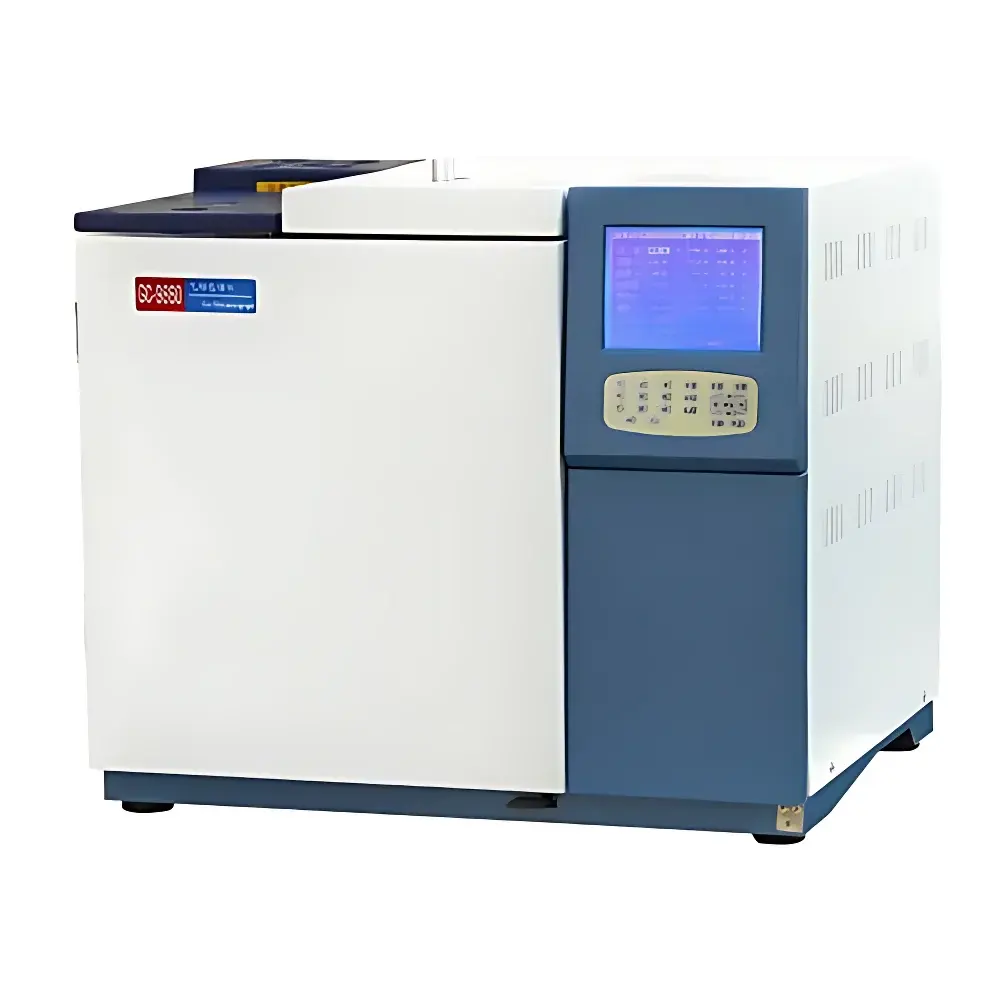
BFSANPU GC-9860 High-Performance Gas Chromatograph for Pharmaceutical Analysis
| Brand | BFSANPU |
|---|---|
| Origin | Hebei, China |
| Manufacturer Type | Direct Manufacturer |
| Instrument Type | Laboratory Gas Chromatograph |
| Application Field | Pharmaceutical Analysis |
| Oven Temperature Range | Ambient +5°C to 400°C |
| Temperature Control Accuracy | ±0.1°C |
| Programmable Ramp Rate | 0.1–50°C/min |
| Maximum Programmed Steps | 8 |
| Injector Temperature Range | 100–350°C |
| Carrier Gas Flow Control Range | 0–1200 mL/min |
| Carrier Gas Pressure Control Range | 0–970 kPa |
| Detector Configurations | Up to 4 simultaneous detectors (dual FID, dual TCD, dual ECD, or mixed combinations) |
| Dimensions (L×H×W) | 520×480×500 mm |
| Weight | 50 kg |
| Power Requirement | 220 V ±10%, 2500 W |
Overview
The BFSANPU GC-9860 is a high-performance, microprocessor-controlled gas chromatograph engineered specifically for regulated pharmaceutical analysis. It operates on the fundamental principle of separating volatile and semi-volatile compounds based on differential partitioning between a mobile phase (inert carrier gas) and a stationary phase (capillary or packed column), followed by selective detection using thermally or electron-sensitive transducers. Designed to meet the stringent reproducibility, trace-level sensitivity, and system suitability requirements of pharmacopeial methods (USP , EP 2.2.47, ChP IV), the GC-9860 supports method validation workflows in QC laboratories conducting residual solvent testing (ICH Q3C), impurity profiling, assay quantification, and stability-indicating assays. Its modular architecture enables configuration flexibility across GMP-compliant environments while maintaining robust thermal management, precise gas flow regulation, and real-time hardware diagnostics.
Key Features
- Eight-step linear programmable temperature ramping with ±0.1°C oven temperature accuracy across a range from ambient +5°C to 400°C — enabling broad-spectrum method development for APIs, excipients, and degradation products.
- Dual independent back-oven door design facilitating rapid cooling (e.g., 350°C to 100°C in ~6 minutes) and near-ambient temperature control, critical for low-boiling solvent analysis and method transfer consistency.
- Integrated flash memory-based data retention system eliminating battery-dependent storage; retains up to 20 complete chromatographic methods and associated calibration curves without external backup.
- Intelligent gas control architecture with digital mass flow controllers (MFCs) delivering stable carrier, makeup, and detector gases across 0–1200 mL/min (flow) and 0–970 kPa (pressure) ranges — ensuring retention time stability and peak shape reproducibility.
- Multi-detector support: Simultaneous operation of up to four detectors including FID, TCD, ECD, FPD, and NPD — configurable in parallel or series via event-triggered switching for multi-analyte workflows (e.g., simultaneous organic impurities and genotoxic nitrosamines).
- Self-diagnostic firmware with real-time fault detection and Chinese/English bilingual on-screen alerts — accelerating troubleshooting and reducing instrument downtime during routine QC operations.
- Hardware-level power failure protection and automatic carrier gas cutoff upon pressure loss — safeguarding columns, detectors (especially TCD filaments and ECD ⁶³Ni sources), and analytical integrity.
Sample Compatibility & Compliance
The GC-9860 accommodates standard 6-inch (152.4 mm) column mounts compatible with 0.1–0.53 mm ID fused-silica capillaries and 3–5 mm OD packed columns (glass/metal). Its split/splitless inlet supports both quantitative headspace analysis (with optional auto-headspace sampler integration) and direct liquid injection for residual solvents, ethanol content, or volatile extractables. The system complies with key regulatory expectations for analytical instrumentation: built-in audit trail capability (via optional software module), electronic signature readiness per FDA 21 CFR Part 11, and design conformity to IEC 61010-1 safety standards. It meets ISO/IEC 17025 technical requirements for calibration traceability when operated with certified reference materials and documented system suitability protocols.
Software & Data Management
The GC-9860 operates with embedded firmware supporting full method setup, sequence definition, and real-time chromatogram display on its 5.7-inch VGA LCD (320×240 resolution). Data files are stored in vendor-neutral ASCII formats compatible with third-party CDS platforms (e.g., Chromeleon, OpenLab CDS). Optional PC-based software provides GLP-compliant features including user access levels, electronic signatures, audit trail logging, and automated report generation aligned with USP Chapter Analytical Instrument Qualification guidelines. All detector signals are digitized at ≥20 Hz sampling rate, ensuring accurate peak integration for tailing or co-eluting compounds common in complex pharmaceutical matrices.
Applications
- Residual solvent analysis per ICH Q3C guidelines (Classes 1–3 solvents in drug substances and products)
- Impurity identification and quantification in active pharmaceutical ingredients (APIs)
- Stability-indicating assays tracking degradation products under accelerated conditions
- Extractables and leachables profiling from packaging components and manufacturing equipment
- Alcohol content determination in topical formulations and oral solutions
- Environmental monitoring of VOCs in cleanroom air and water samples (per EPA Method 8260)
FAQ
Does the GC-9860 support 21 CFR Part 11 compliance?
Yes — when paired with the optional validated CDS software package, it provides role-based user authentication, electronic signatures, and immutable audit trails meeting FDA requirements.
Can the instrument perform unattended overnight analysis?
Yes — with programmable run sequences, auto-shutdown logic, and integrated thermal protection, it supports extended unattended operation for batch QC testing.
Is column switching functionality available?
Column switching is supported via external valve modules (e.g., 6-port/10-port valves) controlled through TTL or voltage-triggered events in method programming.
What is the minimum detectable level for nitrosamines using the ECD configuration?
With optimized sample preparation and cold on-column injection, typical MDLs for NDMA and NDEA are ≤0.1 ng/mL in aqueous extracts, consistent with current regulatory thresholds.
How is detector performance verified during routine use?
Built-in system suitability tests include retention time precision, peak area RSD, signal-to-noise ratio, and linearity verification using certified standards — all logged automatically in the audit trail.





