
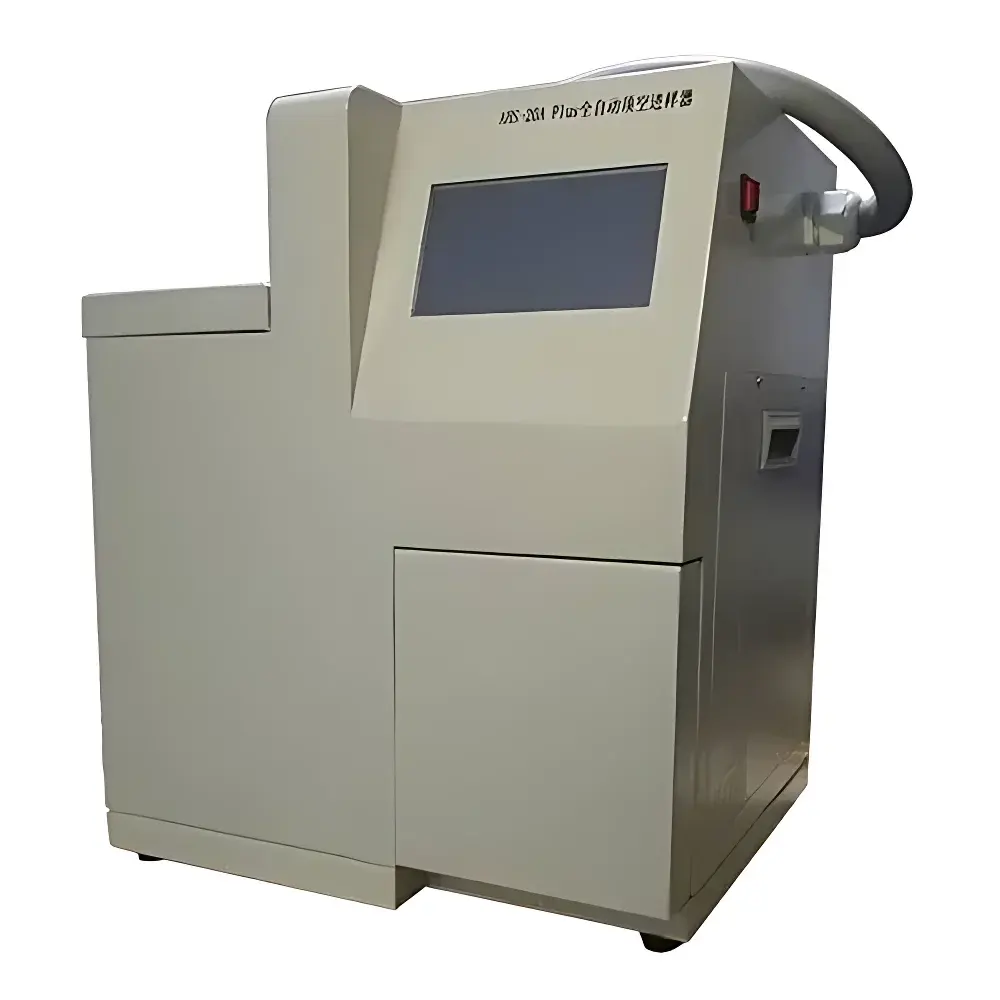
Beifen Sanpu TAHS-20A Plus Fully Automated Headspace Sampler
| [Brand | Beifen Sanpu |
|---|---|
| Origin | Beijing, China |
| Manufacturer Type | Direct Manufacturer |
| Model | TAHS-20A Plus |
| Sample Positions | 20 |
| Sample Vial Capacity | 10 mL or 20 mL (customizable up to 100 mL) |
| Quantitative Loop Volume | 1 mL (optional: 0.5 / 2 / 5 mL) |
| Sample Heating Range | 40–220 °C (extendable to 300 °C) |
| Valve & Transfer Line Heating Range | 40–220 °C (extendable to 300 °C) |
| Temperature Accuracy | ±0.5 °C |
| Temperature Stability | < ±0.5 °C |
| Pressure Control Range | 0–0.25 MPa (continuously adjustable) |
| Pressurization Time | 0–999 s |
| Sampling Time | 0–30 min |
| Injection Time | 0–999 s |
| Bake-out/Flush Time | 0–30 min |
| Time Resolution | 1 ms |
| RSD | < 1.0% (for 100 ppm ethanol in water) |
| Purge Flow Rate | 0–100 mL/min (adjustable) |
| Communication Interface | USB |
| Automation Mode | Motor-driven actuation (no external gas required) |
| Compliance | ASTM D6866, ISO 11843-2, USP <467>, FDA 21 CFR Part 11 (with optional audit trail software)] |
Overview
The Beifen Sanpu TAHS-20A Plus Fully Automated Headspace Sampler is an engineered solution for precise, reproducible, and unattended volatile organic compound (VOC) analysis in complex matrices. Designed around the principle of equilibrium headspace sampling—where analytes partition between a solid or liquid sample phase and its vapor phase above—the instrument enables quantitative transfer of volatile species into a gas chromatograph (GC) without solvent interference or matrix contamination. Its architecture integrates thermally controlled zones (sample oven, valve manifold, and transfer line), positive-pressure sampling, and motor-driven precision mechanics to ensure robust performance across environmental, pharmaceutical, food safety, and forensic laboratories. Unlike manual or semi-automated alternatives, the TAHS-20A Plus eliminates operator variability and minimizes carryover through inert, de-activated flow paths and programmable flush cycles—making it suitable for regulated environments requiring GLP/GMP traceability.
Key Features
- 20-position rotary sample carousel with automatic vial recognition and fault-tolerant positioning—skips empty slots and prevents mechanical collision during operation.
- Triple-zone independent temperature control: sample heating (40–220 °C, extendable), six-port valve heating (40–220 °C), and transfer line heating (40–220 °C), all stabilized to < ±0.5 °C and calibrated to ±0.5% accuracy.
- Motor-driven actuation system—no external carrier gas or pneumatic lines required—reducing infrastructure dependency and enhancing operational safety.
- High-inertness fluidic path: all internal tubing, quantitative loops (standard 1 mL, customizable), and needle assemblies are constructed from silanized fused silica or Sulfinert®-treated stainless steel to prevent adsorption, degradation, or cross-contamination.
- Optimized low-dead-volume injection pathway: six-port valve coupled directly to heated transfer line within thermal enclosure—eliminating cold spots and preserving analyte integrity during transit.
- Flexible sampling protocols: supports single-vial multi-injection, single-vial single-injection, and multi-vial sequential injection modes—all programmable via intuitive 7-inch graphical LCD or remote USB interface.
- Comprehensive self-diagnostic suite: power-on system check, real-time positional feedback, thermal fault detection, and hardware error logging with on-screen alerts and event timestamps.
Sample Compatibility & Compliance
The TAHS-20A Plus accommodates standard 10 mL and 20 mL crimp-top headspace vials, with optional support for 50 mL and 100 mL formats upon request. It accepts both liquid and solid samples—including aqueous solutions, polymers, soils, pharmaceutical tablets, and packaged foods—without derivatization or extraction. The system meets method validation requirements under USP for residual solvents, ASTM D6866 for biobased content determination, and ISO 11843-2 for limit-of-detection estimation. When integrated with EPC-enabled GC systems and configured with audit-trail-capable software, it supports compliance with FDA 21 CFR Part 11 for electronic records and signatures in regulated QC/QA workflows.
Software & Data Management
Control and configuration are fully supported via USB-connected PC software featuring parameter scripting, method scheduling, real-time status monitoring, and event logging. All operational parameters—including temperature ramps, pressurization profiles, sampling durations, and purge flows—are programmable with 1-ms time resolution. The software exports timestamped run logs in CSV format compatible with LIMS integration and supports synchronized start triggers for GC acquisition and data system activation. Optional firmware upgrades enable secure user access levels, electronic signature capture, and full audit trail generation per ALCOA+ principles.
Applications
- Residual solvent analysis in active pharmaceutical ingredients (APIs) and excipients per ICH Q3C guidelines.
- Volatile impurity profiling in polymer packaging materials for food contact compliance (EU 10/2011, FDA 21 CFR 177).
- BTEX (benzene, toluene, ethylbenzene, xylene) and chlorinated hydrocarbon quantification in soil and groundwater per EPA Method 502.2 and 8260D.
- Alcohol content verification in beverages and fermentation monitoring in bioprocess development.
- Off-gas analysis of lithium-ion battery electrolytes and thermal runaway screening in energy storage R&D.
FAQ
What sample vial sizes does the TAHS-20A Plus support?
Standard configurations accommodate 10 mL and 20 mL crimp-top vials; custom adapters for 50 mL and 100 mL formats are available upon request.
Is external pressurization gas required for operation?
No—the system uses an integrated motor-driven pressure generator; no compressed air or nitrogen supply is needed.
Can the instrument be integrated with third-party gas chromatographs?
Yes—it provides TTL-level synchronization signals and USB-based command protocol compatibility with Agilent, Thermo Fisher, Shimadzu, PerkinElmer, and other major GC platforms.
What is the typical repeatability performance for low-concentration VOCs?
RSD is < 1.0% for 100 ppm ethanol in aqueous solution under optimized equilibrium conditions; actual precision depends on matrix complexity and method parameters.
Does the system support regulatory-compliant data integrity features?
With optional audit-trail software and EPC-controlled GC coupling, it fulfills core requirements of FDA 21 CFR Part 11 and EU Annex 11 for electronic records and signature validation.







